Key Takeaways
- Advertising copy in Amazon Ads is the text and creative an advertiser supplies or selects inside an ad, and it is separate from the Search Term Report of what shoppers typed.
- Standard Sponsored Products ads carry no free-text field, so the product detail page becomes the copy a shopper reads.
- The call to action in Amazon ads is often fixed, because component-based creatives pick it from a dropdown of pre-approved options.
- Every claim in Amazon ad copy must match the product detail page and may need substantiation, with stricter rules for health and environmental claims.
- Click-through rate measures the whole served ad rather than the words alone, so an Amazon ad copy test changes one element at a time.
- Each Amazon ad format exposes different copy fields, so the same message is written differently for Sponsored Brands, Sponsored Display, video and DSP.
Effective advertising copy on Amazon combines a clear headline, one provable benefit and a call to action that suit the ad format and its destination. Advertising copy here means the advertiser-controlled words and closely linked creative inside Amazon Ads, such as a Sponsored Brands headline or a Sponsored Display image and logo (as of September 2026, Amazon presents Sponsored Display within its wider Display ads offer). It is neither product listing copy, which belongs to listing optimisation, nor the Search Term Report. The distinction matters because standard Sponsored Products ads expose no free-text field at all, so the listing does the talking. This page maps ten elements to the ad fields where they live and shows what to check before an ad goes live.
What is advertising copy in Amazon Ads?
Advertising copy in Amazon Ads is the words and closely linked creative an advertiser supplies or selects to communicate an offer. Depending on the format, that copy can include a Sponsored Brands headline, a Sponsored Display headline, video on-screen text, a brand logo, the product selection and a call to action.
How much of that copy you control changes sharply by format. Standard Sponsored Products image ads expose no conventional free-text field. They promote an individual listing and send the click to its product detail page (PDP), so the title, main image, price, star rating and availability on that page become part of the paid-ad experience.
One pair of terms causes constant confusion. A targeting keyword is a word or phrase you select for Sponsored Products or Sponsored Brands, with broad, phrase or exact match. A customer search term is the phrase a shopper actually typed, recorded only after an ad click.
Most of what a shopper reads in an Amazon ad is decided before anyone writes a line. Knowing which fields each format exposes puts writing effort where it counts and stops a team from crediting its words for results that price, reviews or bids produced.
What are the different types of Amazon advertising copy?
The types of Amazon advertising copy divide by ad format, and each format hands you a different set of editable fields. The copy field map below is the framework Clear Ads uses before any ad goes live: it shows what you can write, what Amazon fixes or assembles for you, and the check worth running first.
| Ad format | Editable copy fields | Fixed or automatic | Clear Ads pre-launch check |
| Sponsored Products | None in the ad itself; the listing title, main image and price on the PDP | No free-text ad field; the click goes to the PDP | Read the PDP title, main image and price as if they were the ad, and fix the listing before raising bids |
| Sponsored Brands | Brand name, logo, headline, custom image, product selection, video | Format rules vary across collections, Store spotlight and video; automatic collections generate the headline | Headline in sentence case with one benefit the landing page proves; logo and products match the Store or PDP |
| Sponsored Display | Image ads: any combination of custom headline, brand logo and custom image. Video ads: one product video with optional headline and logo | Dynamic retail elements (rating, price, “Shop now”) and pre-approved calls to action | Headline and image stay legible after cropping; price and rating are competitive before launch |
| Streaming TV ads (formerly Sponsored TV) | The video creative | Length, frame size and delivery specifications | Product and brand appear early, and the file meets the current specs |
| Amazon DSP | Static, video, responsive e-commerce or component-based creatives | Personalised combinations in responsive creatives | Every combination Amazon can assemble still reads correctly and makes no unprovable claim |
| Sponsored Brands Store Spotlight | Headline and logo, plus up to three Store sub-pages, with an editable label and image for each | Your Store needs at least three sub-pages, each featuring a unique product | Each label reads as a category name a shopper would recognise |
Two creative types assemble themselves: component-based creatives and dynamic templates. Component-based creatives pick the call to action from a dropdown of pre-approved options, and dynamic templates can crop, resize or recombine assets. As of Amazon’s August 2026 API documentation, streaming TV ads treat the video itself as the creative, with a minimum frame size of 1920×1080 at a 16:9 ratio and a length that depends on where the ad runs, in the marketplaces where the format is available.
Two format details change what you can write right now. As of Amazon’s July 2026 help documentation, Sponsored Products video is a US-only format, so advertisers outside the US should not plan copy around it yet. As of Amazon’s September 2026 UK help documentation, manual Sponsored Brands collections can use an advertiser-provided or auto-generated headline, automatic collections generate the headline for you, and legacy Product Collections are set to lose support from January 2027.
The platform language is moving as well. Amazon now presents Sponsored Display inside a broader Display ads offer and a unified workspace, so “Sponsored Display” remains a recognised label while the surrounding product name changes.
The field map decides where copy can work, so read it before writing a single headline.
What are the 10 elements of effective Amazon ad copy?
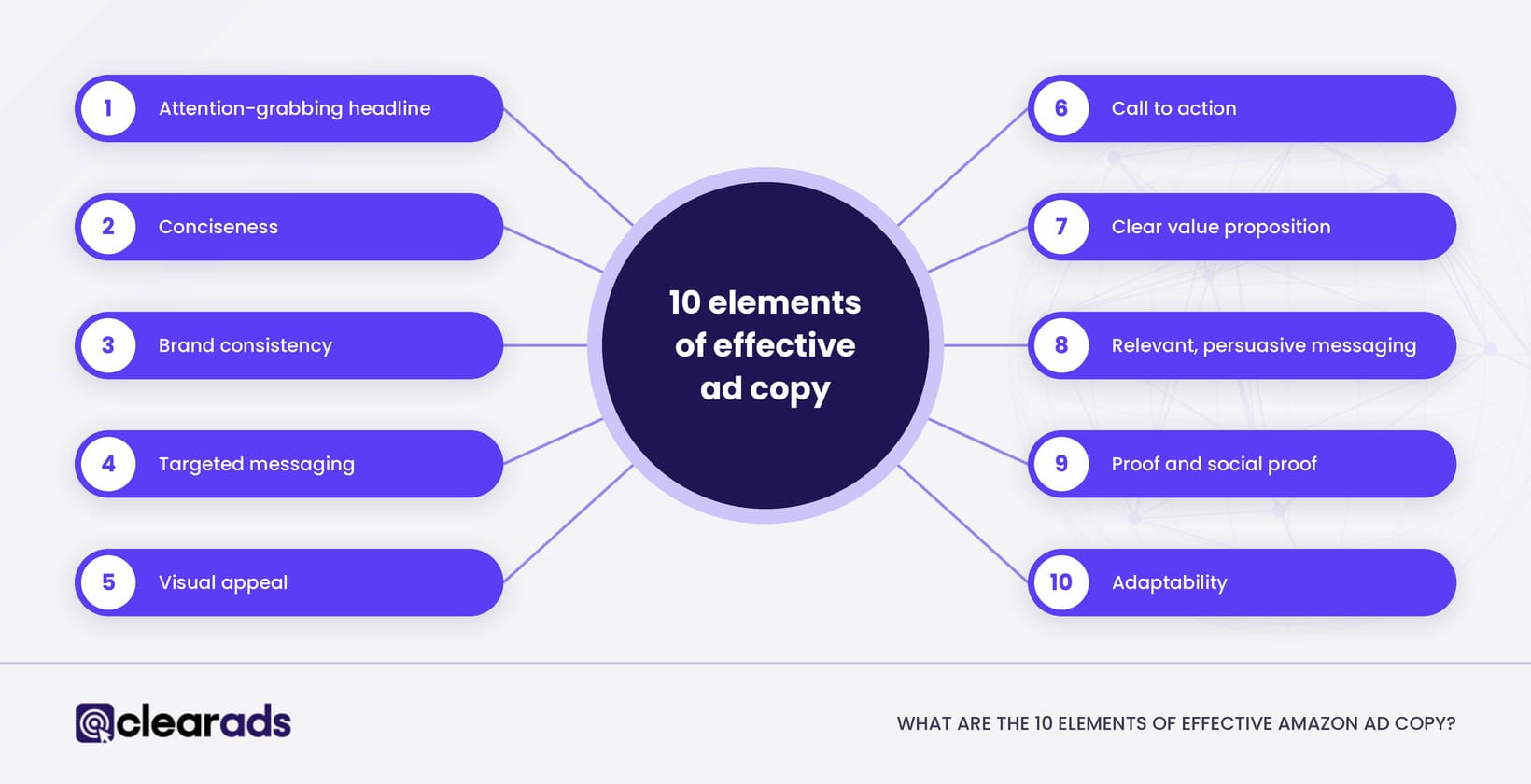
The ten elements of effective Amazon ad copy are the parts of an ad that win attention and trust, each tied to a field the format exposes, from the headline you write to the creative Amazon assembles. Not every field exists in every format, so each element below opens with the formats that expose it.
Attention-grabbing headline
An attention-grabbing headline on Amazon states one provable benefit in sentence case, inside the headline field the format offers. Sponsored Brands ads, some Sponsored Display creatives and manual Sponsored Brands collections carry a headline field, and it is the main written line a shopper scans. Amazon requires sentence case and legible text in that headline, and it prohibits all caps, mixed case, repeated punctuation and character substitutions.
A short headline reads cleanly on a phone and leaves less room for a claim to drift from the landing page. Name one benefit the product page proves. Standard Sponsored Products ads have no headline, so there the listing title carries the first impression.
A headline earns its place by stating one provable benefit in the format Amazon will approve.
Conciseness
Conciseness on Amazon starts with the character limit: a Sponsored Brands headline allows up to 50 characters in most marketplaces and 35 in Japan, and display ad headlines are short too, so plan for 50 characters or fewer. One benefit fits in that space. A list of features does not.
Put the benefit first and leave out anything the image already shows. “Crush garlic without peeling it first” (37 characters) gives a shopper one thing to picture. “Premium Stainless Steel Garlic Press With Peeler And Brush” (58 characters) runs past the limit and is in title case, which Amazon rejects.
A short headline also leaves less room for a claim the product page cannot back.
Brand consistency
Brand consistency means the brand name, logo and look in the ad match what the shopper sees after the click. Sponsored Brands, Sponsored Display and the end card of a Sponsored Brands video show the brand name and logo. As of Amazon’s August 2026 help documentation, Sponsored Brands is available to vendors and to professional sellers enrolled in Amazon Brand Registry, so the brand-led formats depend on registration as well as on writing.
The logo and name should match what the shopper sees after the click. A shopper who clicks a branded ad and lands on a Store or PDP with the same name and logo meets a page that confirms the ad.
Brand name and logo are fields gated by Brand Registry, and they work only when the landing page repeats them.
The logo must be the brand’s registered logo. It should fill the image or sit on a white or transparent background, carry no added text, and never be a product or lifestyle image. Using the same logo in every ad keeps the brand recognisable from one placement to the next.
Brand-led formats depend on how the campaign is built as well as on the words. For how campaigns in this format are set up, bid and measured, see how Sponsored Brands ads work.
Targeted messaging
Targeted messaging matches the products and words in the ad to the search behind each ad group. Sponsored Brands and Sponsored Display let you choose which products appear in the creative, and that choice speaks before any text does. Here, targeting means PPC targeting: the keywords or products your ad is set to match.
The search behind the click decides which products to show. A shopper on a branded keyword already knows you, so the creative can feature a specific product or range. A shopper on a non-branded keyword is comparing options, so the selection should lead with the product whose benefit sets it apart.
Product selection is copy that the shopper reads as a lineup, so match the products to the search intent behind each ad group.
How should the headline change with the targeting behind it?
The headline should start from what the shopper already knows, and the targeting tells you what that is. A shopper searching for your brand needs a reason to pick a product; a shopper searching the category needs a reason to pick your brand.
| Targeting | What the shopper knows | Headline job | Example (fictional brand “Ferro”) |
| Branded keywords | Your brand | Point to the range or the newest product | Ferro presses, peelers and graters in one place |
| Category keywords | The need, not the brand | Name the benefit that sets you apart | Crush garlic without peeling it first |
| Competitor products | A competitor’s product | Give a reason to compare, without naming the competitor | An all-steel press built for daily use |
| Seasonal searches | The occasion | Tie the product to the occasion | Kitchen gifts for keen home cooks |
A headline written for branded searches wastes a category click, and the reverse is true too, so give ad groups with different targeting their own headlines.
Visual appeal
Visual appeal on Amazon rests on two assets: the custom image and the video. Sponsored Brands and Sponsored Display image ads accept a custom image, which usually carries more of the message than the headline. The image and the headline have to say the same thing, because a shopper takes in both at once.
Dynamic templates can crop and resize assets. Keep essential words out of a custom image unless the specification allows text there, so that a crop never cuts the message in half.
A custom image works when it shows the product and the benefit, and it survives every crop Amazon applies.
Custom images may carry only text that belongs in the scene, such as the words printed on the product’s packaging. Added headlines, buttons and borders are rejected, and so is a plain product shot on a solid or transparent background. In Sponsored Brands, the same product image cannot appear twice in one ad.
Video and on-screen text
Sponsored Brands video ads carry their message mainly in the video, so on-screen text and the end card do the work a headline does elsewhere. Amazon recommends showing the product in the first few seconds, communicating the customer benefit, keeping visuals consistent and closing on a brand-name or logo end card.
Video formats differ in reach and rules. Amazon’s Sponsored Products video guide reports, from its US internal data for June 2026, that Sponsored Products campaigns with video recorded 67 percent higher click-through rate and 9 percent higher conversion rate than campaigns without video. That figure compares formats, so it does not prove that the words alone caused the lift. Streaming TV ads use the same principle on a bigger screen, with their own length and frame specifications.
In Amazon video ads, the first seconds and the end card are the copy, so write them before anything else.
Amazon’s moderation rules bar customer reviews and star ratings inside video creative, even reviews taken from Amazon.
Call to action
Component-based creatives, Sponsored Display and Brand Store destinations often fix the call to action, so you choose it rather than write it. Component-based creatives use a dropdown of pre-approved calls to action, so a universal instruction such as “Buy now” is not always available to type.
Treat the call to action as a format decision first and a wording decision second. In a Sponsored Brands video that ends on a Brand Store, for example, the call to action routes the shopper to the store rather than to a single product.
A call to action on Amazon is mostly chosen from a list, so pick the format and destination that make the right one available.
Display ads add a call to action automatically, so extra call-to-action text or buttons in display creative are rejected. In Sponsored Brands, a call to action works best as a direct phrase of two or three words. Amazon rejects pressure phrases such as “Act now” and “Last chance”, rejects “Click here”, and does not allow a call to action to end in punctuation.
Clear value proposition
A clear value proposition is one specific, provable reason to choose the product, stated in the words the format allows. Every format with a text field, from Sponsored Brands headlines to Sponsored Display and DSP creatives, carries claims that Amazon can check. A clear value proposition names the specific reason to choose this product, and it must hold up on the PDP. As of Amazon’s September 2026 advertising policies, unsupported superlatives such as “best” or “top-selling” can be rejected, and Amazon can require substantiation for a claim.
Lead with one concrete benefit rather than a list of features. That gives the shopper a single reason to click, and the benefit still has to be provable on the page the click lands on.
A claim belongs in Amazon ad copy only when the product page and your evidence can both back it.
Relevant and persuasive messaging
Relevant and persuasive messaging on Amazon matches both the shopper’s search and the landing page. Sponsored Brands and Sponsored Display text must be consistent with the landing page’s offer and products, so the destination is part of the copy. A headline that promises something the PDP or Store does not show risks rejection.
Persuasion on Amazon is mostly a matter of fit. Copy that mirrors the shopper’s search and the product page gives the shopper what they expected when they click, while copy that oversells sets up a disappointment on the landing page.
The ad and its landing page are read as one message, so write them as one.
Proof and social proof
Proof on Amazon comes mostly from elements Amazon renders for you, such as star ratings and review counts, rather than from lines you write. Certain Sponsored Display creatives show star ratings, review counts, price and a “Shop now” cue as dynamic retail elements, so much of the proof renders automatically. You do not write these fields, but they sit next to your words and shape how the words land.
Written proof carries a heavier burden. A claim you add yourself must match the PDP and may require substantiation, and no published test isolates the effect of social-proof wording from the product’s actual quality, price and review count. Proof helps, but it is policy-bound and no published test shows a reliable lift from wording alone.
Dynamic retail elements make price and reviews part of the ad, so fix them on the listing before you rewrite the copy.
Adaptability
Adaptable copy still reads correctly when Amazon resizes, recombines or translates it. Amazon DSP responsive e-commerce creatives and dynamic templates assemble or recombine the message for you, so copy has to survive combinations you never see together. A line that reads well only next to one specific image is a weak fit for these formats.
Automated creative still needs a human check for factual claims, brand consistency, legibility and destination match before it runs. Adapt the wording to each marketplace’s language and spelling rather than reusing one version everywhere.
Copy for automated creative has to work in any combination, so review each version before it goes live.
If you run Sponsored Brands in Germany, France, Italy or Spain with an English headline, you can ask Amazon to translate it into the local language at no extra cost. Amazon says this takes up to 24 hours, and translated ads must still meet the same content rules. Every ad must be in the marketplace’s primary language, and copy you translate yourself must keep the meaning of the default-language campaign.
Optimised Sponsored Brands ads, where Amazon chooses which products to show, need a general headline that names no specific product, because the products in the ad can change.
Amazon’s generative tools can now draft headlines, images and video inside the console. Treat their output as a first draft: it passes through the same moderation as copy you write, and its claims are still yours to substantiate.
How do keywords contribute to advertising copy effectiveness?
Keywords decide which searches your ad can appear in. A targeting keyword controls matching opportunities, and Amazon treats keywords as targeting and search-term analysis rather than as a creative ranking factor. No Amazon documentation says that keywords in a headline improve ad placement, so write the headline for the shopper.
Keywords still guide the writing. As of Amazon’s May 2026 help documentation, the Sponsored Products Search Term Report lists the customer terms that produced at least one click. Those terms show the language shoppers use to reach the product, which tells you which benefit to name and which intent to match.
Search Query Performance in Brand Analytics answers a different question. It reports query-level funnel data and a brand’s share of Amazon store performance, covering paid and organic behaviour together. Use it to decide which queries deserve tailored copy. To see how each targeted keyword performs once the copy is live, use the keyword performance report.
Keywords choose where the ad can appear, and the search terms behind them tell you what the copy should say.
What are the challenges of writing Amazon ad copy?
The main challenge is that Amazon, not the writer, sets many of the rules the copy has to pass. Sponsored Brands and Sponsored Display text must be clear, legible, in the site’s primary language and consistent with the landing page, and Amazon enforces sentence case while blocking all caps, repeated punctuation and character substitutions.
Claims face a second layer of checks. As of Amazon’s January 2026 claims and substantiation policy for the UK marketplace, Amazon requires accurate claims and factual substantiation on request, with additional requirements for environmental claims, origin claims, warranties and guarantees, and health or ingredient-quality claims. A line that would pass on another channel can be rejected on Amazon without the evidence to back it.
Automation and change add the rest. Dynamic and template-generated elements can crop or recombine assets, and availability differs by marketplace, as with US-only Sponsored Products video. Amazon updates its policies periodically, so confirm current headline rules, accepted claims and call-to-action options in the live console before publishing.
Amazon approves ad copy against its own rules, so the console, not the writer, has the final word.
Which copy rules get Amazon ads rejected?
Amazon rejects ad copy most often for formatting, unsupported claims, price language and pressure, and its moderation guide for Sponsored Brands and display ads sets out each rule. The table pairs each rule with a rejected line and an accepted rewrite for a fictional garlic press.
| Rule | Rejected | Accepted |
| Sentence case: capitals only for the first word, proper nouns and trademarks | Crush Garlic Without Peeling | Crush garlic without peeling it first |
| No repeated punctuation, and no symbols or numerals in place of letters | Crush garlic fast!!! | Crush garlic in one squeeze |
| No superiority claim you cannot substantiate | The best garlic press ever made | An all-steel press for everyday cooking |
| No competitor names (“leading brand” is allowed) | Sturdier than [competitor’s brand] | An all-steel alternative to plastic presses |
| No specific prices or savings in ad copy | Save 30% on our garlic press | Great savings on our garlic press (only while the promotion also runs on the detail page) |
| “Deal” only during a live Amazon deal | Garlic press deal of the week | Use “deal” only while a deal such as Deal of the Day runs for the whole campaign |
| No urgency or pressure | Hurry, last chance to save | Fresh garlic for every recipe |
| Avoid “you” and “your” | Your new favourite kitchen tool | A kitchen tool for daily garlic prep |
Submit ads at least one week before launch, so a rejection leaves time to fix it. Amazon emails the reason for each rejection; correct the named issue and resubmit. Images and logos can be approved ahead of time in bulk through the asset library, which saves a round trip before a seasonal campaign. Ads must not look like Amazon’s own content, and any Amazon branding needs Amazon’s written approval.
How do you test the effectiveness of Amazon ad copy?
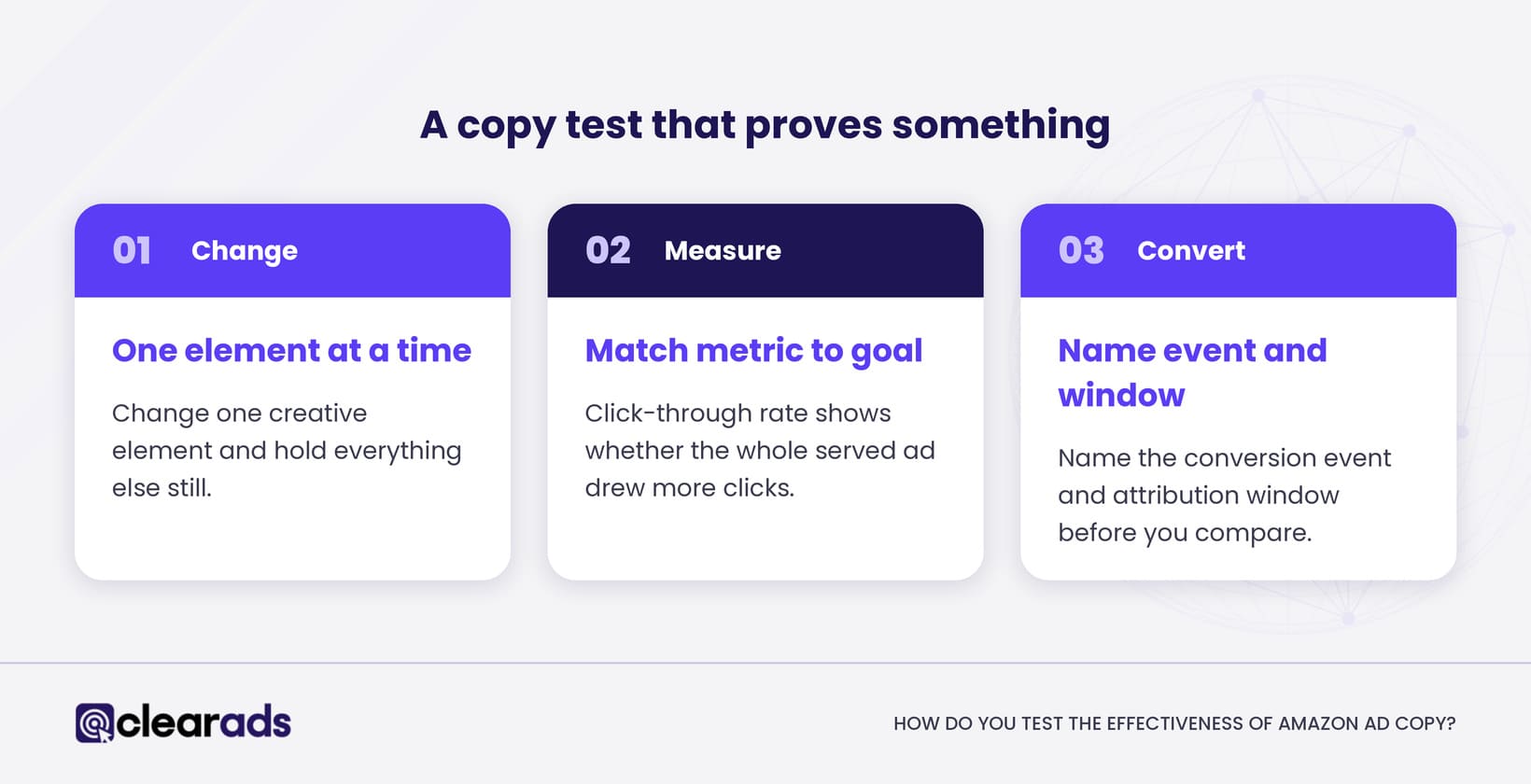
You test ad copy by changing one creative element at a time and judging it against the metric that matches your goal. Click-through rate shows whether the whole served ad drew more clicks, but bids, price, reviews and placement sit inside that number too.
For conversions, name the event and the attribution window before you compare two versions. In Sponsored Brands, new-to-brand purchases show whether brand-led copy reached shoppers who had not bought the brand before. Test design, run length and how to read the result are covered in how to set up an A/B test for Amazon PPC ads.
A copy test only proves something when one element changed and everything else held still.
Frequently asked questions
Can you use emojis or special characters in Amazon ad headlines?
Not emojis, and other special characters only in narrow cases. Amazon’s moderation guide allows special characters where they belong to a brand, product or slogan name, or are accepted symbols such as $ or #, and emojis are not on that list. Numerals and symbols used in place of letters, such as @ for an “a”, are rejected.
How long does Amazon take to review a new ad?
Amazon does not publish a standard review time for Sponsored Brands and display ads, which is why its moderation guide asks for ads to be submitted at least a week before launch. For translated Sponsored Brands campaigns, the same guide says review usually takes up to 72 hours.
Does better ad copy lower your cost per click?
Amazon does not say that creative quality changes the price of a click. Copy works on what happens around the click: a clearer headline can raise click-through rate and a better-matched landing page can raise conversion rate, so each click buys more sales even when cost per click stays the same.
How often should you refresh Amazon ad copy?
Refresh ad copy when the evidence calls for it rather than on a fixed calendar: after click-through rate falls across a settled period, when the product, price or offer changes, or ahead of a seasonal event. Prepare seasonal versions early, so moderation does not hold them back.
What happens to an ad if a featured product goes out of stock?
Amazon’s moderation guide says an ad must be paused when the product it promotes becomes unavailable. Check stock for every product in a Sponsored Brands or display creative before a busy period, and swap in an available product rather than leave the ad promoting something shoppers cannot buy.
What does this page not cover?
This page covers the copy and creative fields inside Amazon ads, and it leaves three neighbouring topics to other pages. Running a controlled copy test from start to finish belongs on the Amazon PPC A/B testing guide. DSP creative formats and dynamic creative belong on creative strategies and ad formats in Amazon DSP.
Full listing work, including tests of titles and images through Manage Your Experiments, belongs on the Amazon listing optimisation guide.
Ad copy sits between targeting and the listing, and each of those has its own page.
What is the next step?
The next step is to check each live ad against the ten elements above, one format at a time. Where a field is empty or a claim cannot be proven on the product page, fix that before writing new lines.
For how ad copy fits with targeting, bids and structure, return to the Amazon PPC hub. If your team lacks the time to design clean creative tests and read them correctly, Clear Ads Amazon PPC management covers creative, testing and reporting as one service.