This article starts with how Amazon Marketing Cloud (AMC) has evolved and how it works, and covers what has changed in AMC’s availability, which advertisers are now eligible to use AMC, what advertisers can do with AMC through Sponsored Ads, how these developments influence Amazon’s advertising strategy, how access is provisioned in the Ads Console and through partners, how teams can activate insights with AMC Audiences for Sponsored Ads, and finally ends with the strategic impact of AMC’s expansion and the introduction of self-service access in September 2025.
The article begins by defining AMC and describing its privacy-centric, event-level analytics framework, then outlines its staged evolution from DSP access to full self-service availability for Sponsored Ads advertisers. It details eligibility and markets, demonstrates how advertisers use AMC for multi-touch and frequency analysis, and links those insights to ROAS and ACoS optimisation. It also explains access management in the Ads Console, audience creation and refresh through AMC Audiences, and concludes with the strategic impact of AMC’s 2025 self-service expansion in unifying Amazon’s advertising measurement.
The article begins by defining AMC and describing its privacy-centric, event-level analytics framework, then outlines its staged evolution from DSP access to full self-service availability for Sponsored Ads advertisers. It details eligibility and markets, demonstrates how advertisers use AMC for multi-touch and frequency analysis, and links those insights to ROAS and ACoS optimisation. It also explains access management in the Ads Console, audience creation and refresh through AMC Audiences, and concludes with the strategic impact of AMC’s 2025 self-service expansion in unifying Amazon’s advertising measurement.
AMC is now available through Amazon Sponsored Ads
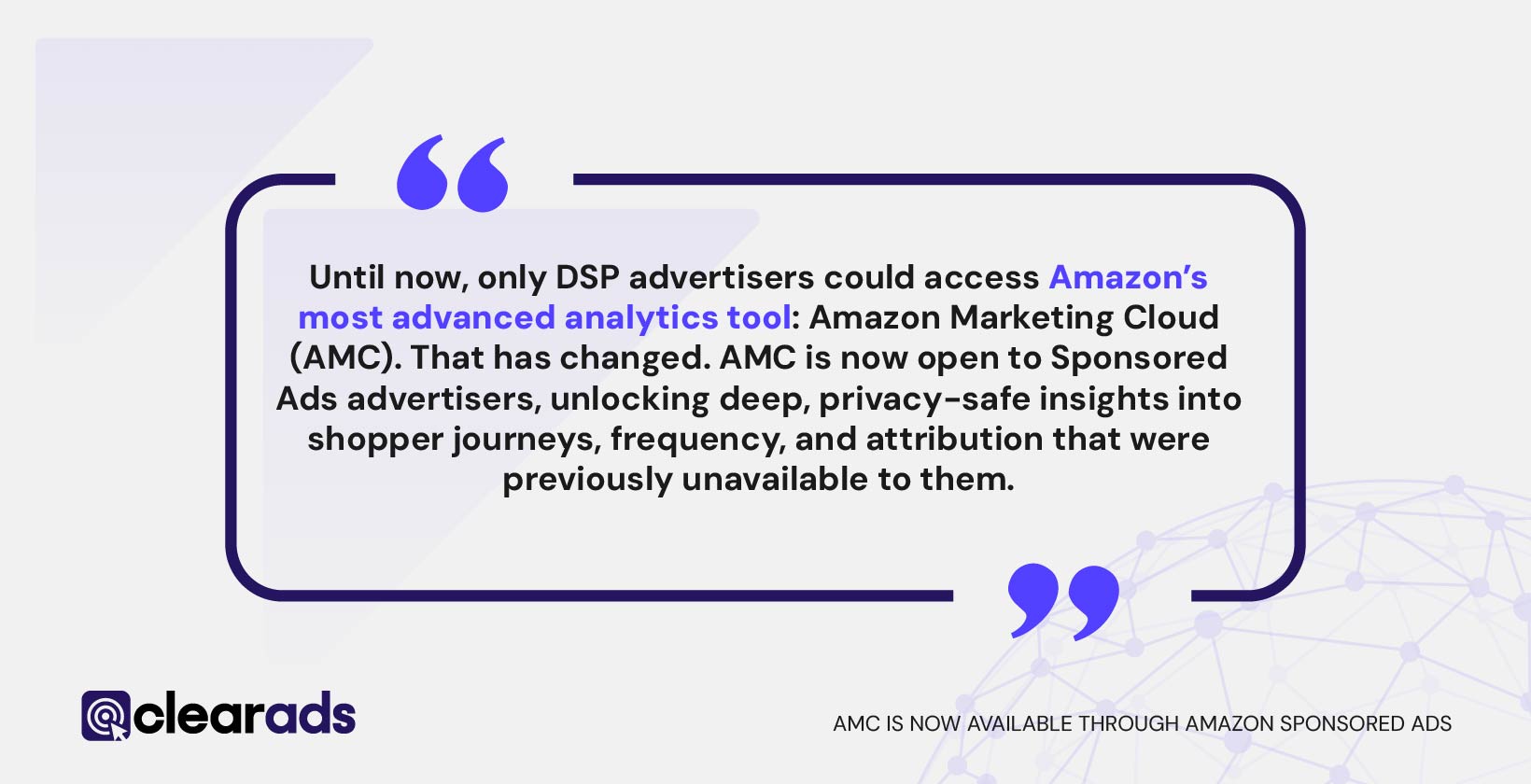
Until now, only DSP advertisers could access Amazon’s most advanced analytics tool: Amazon Marketing Cloud (AMC). That has changed. AMC is now open to Sponsored Ads advertisers, unlocking deep, privacy-safe insights into shopper journeys, frequency, and attribution that were previously unavailable to them.
AMC’s evolution reflects Amazon’s progressive unification of advertising analytics. In May 2023, Amazon launched AMC Audiences (beta), enabling advertisers to create custom audiences for their DSP campaigns. This was followed by a significant update in October 2024, when Amazon Ads officially announced at its unBoxed event the expansion of Amazon Marketing Cloud (AMC) eligibility to include advertisers using Sponsored Ads accounts. The announcement, published on 15 October 2024, allows sellers, vendors, and agency partners to access AMC’s advanced analytics capabilities without requiring DSP campaigns or Amazon Managed Services. According to the official announcement, this update broadens AMC’s reach within Amazon’s advertising ecosystem.
Building on these developments, as of September 2025, Amazon introduced self-service AMC access for all Sponsored Ads advertisers, offering direct audience creation and reporting capabilities within the Amazon Ads Console. This advancement eliminates the dependency on DSP participation while maintaining full measurement and audience activation functionality.
This progression marks a pivotal step in the integration of Sponsored Ads with AMC’s data environment, empowering advertisers to perform advanced analysis, optimise campaigns, and activate high-intent audiences within a privacy-safe framework.
This article explains AMC’s structure, the revised access model, expanded eligibility, and the strategic implications of integrating AMC with Sponsored Ads.
What Is Amazon Marketing Cloud and How Does It Work?
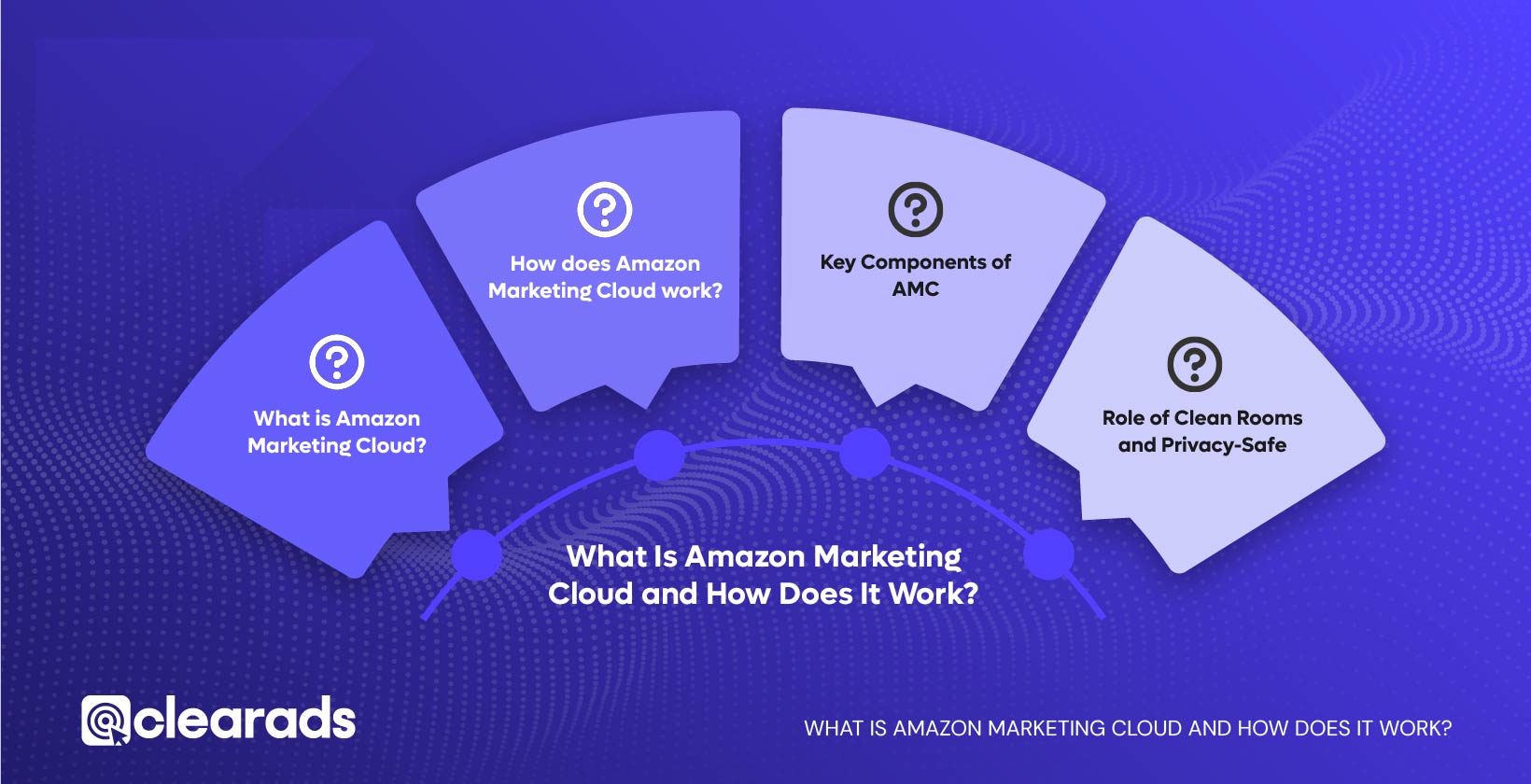
This section defines Amazon Marketing Cloud in precise terms, then explains its operating model, data handling, and analysis workflow for Sponsored Ads advertisers.
What is Amazon Marketing Cloud?
Amazon Marketing Cloud (AMC) is a secure, cloud-based clean room that provides privacy-safe, aggregated, event-level advertising insights for analysis across Amazon Ads products.
This enables advertisers to understand the complete impact of their media investments by combining cross-channel and audience data without compromising consumer privacy.
How does Amazon Marketing Cloud work?
AMC runs an SQL-based query environment where analysts interrogate pseudonymised datasets to measure journeys, attribution, reach, and frequency across campaigns and formats.
By allowing custom SQL queries, advertisers can explore how audiences interact with ads at different stages of the purchase journey and determine which combinations of Sponsored Products, Sponsored Brands, and Sponsored Display drive conversions.
AMC supports multi-touch attribution, so advertisers can finally see how every ad, not just the last click, contributes to a sale.
AMC combines advertiser-provided first-party data with Amazon Ads event signals under strict privacy controls that prevent access to raw user-level identifiers. This clean-room framework ensures that data stays compliant while advertisers uncover actionable insights to guide planning and optimisation.
AMC now ingests Sponsored Ads signals such as impressions, clicks, detail page views, and purchases, enabling cross-campaign analysis that connects upper-funnel exposure with lower-funnel conversion.
Key Components of AMC
AMC is built as a serverless data clean room that operates on Amazon Web Services. It offers an SQL-based interface where advertisers can write queries to extract insights from anonymised datasets. These datasets include metrics from various Amazon advertising solutions, such as impressions, views, add-to-carts, and purchases.
This structure supports multi-touch attribution, helping advertisers quantify the combined influence of multiple ad exposures and accurately assess campaign efficiency.
The platform also supports complex measurement queries that span multiple ad formats and campaigns. Advertisers use AMC to construct customer-journey analyses, frequency-impact models, and audience-segmentation reports based on event-level data.
Through these capabilities, advertisers can identify where to optimise spend, improve reach without over-frequency, and understand how upper-funnel ads contribute to final conversions.
Role of Clean Rooms and Privacy-Safe Data Analysis
The clean-room structure of AMC ensures privacy by design. Advertisers cannot access raw user-level data but instead analyse trends based on aggregated and pseudonymised events.
This structure ensures data compliance while still allowing meaningful insight generation. Advertisers can evaluate how campaigns perform across the funnel without ever exposing personal identifiers.
For instance, AMC enables analysis showing how many shoppers saw a Sponsored Brand ad before purchasing from a Sponsored Product ad, illustrating real upper-funnel value.
This privacy-first model maintains both regulatory alignment and analytical power, allowing advertisers to make data-driven optimisation decisions confidently while remaining privacy-compliant.
What has changed in AMC’s availability?
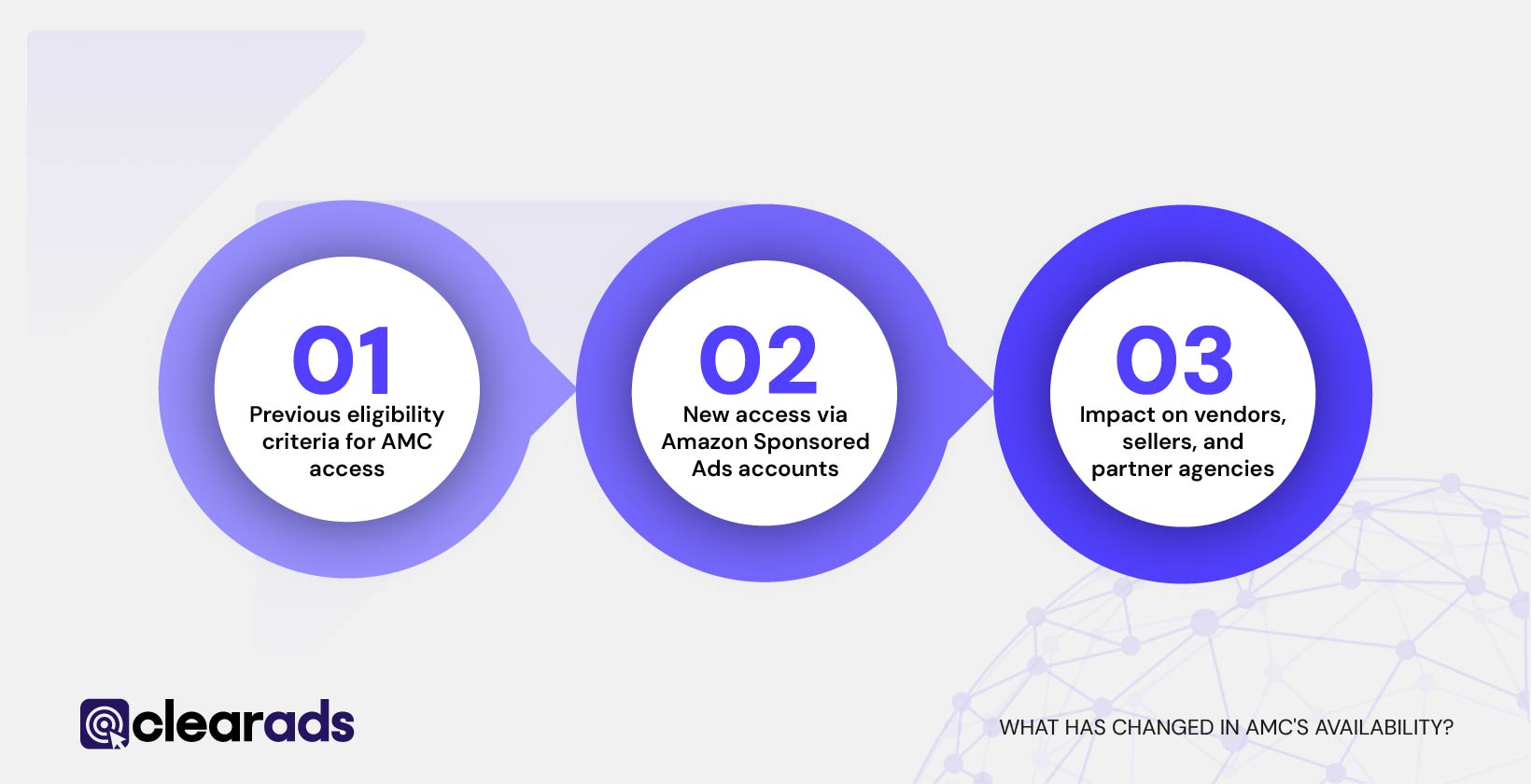
Amazon Ads expanded AMC eligibility from DSP-only registration to include advertisers using Sponsored Ads accounts; the change was announced on 15 October 2024 at unBoxed.
Previous eligibility criteria for AMC access
AMC registration historically required active Amazon DSP usage or access via an eligible partner; Sponsored Ads-only advertisers generally accessed AMC through a Partner Network provider.
The product page documented that advertisers working with registered partners could utilise AMC, including those using Sponsored Ads only, indicating a partner-mediated path before broader direct access.
New access via Amazon Sponsored Ads accounts
Amazon Ads announced direct AMC availability for Sponsored Ads advertisers; AMC now ingests Sponsored Ads event signals and enables analytics without requiring DSP campaigns.
Amazon’s release notes and what’s new updates confirm that Sponsored Products, Sponsored Brands, and Sponsored Display signals feed AMC reporting, expanding measurement coverage for Sponsored Ads programmes.
Impact on vendors, sellers, and partner agencies
Vendors and sellers running Sponsored Ads gain access to cross-funnel measurement, path-to-conversion analysis, and frequency insights; agencies continue to support activation through AMC audiences and bid adjustments for Sponsored Ads.
The expansion standardises privacy-safe analytics across more advertiser types and markets listed on the AMC product page, improving comparability of Sponsored Ads outcomes across regions.
Which Advertisers are now eligible to use AMC?
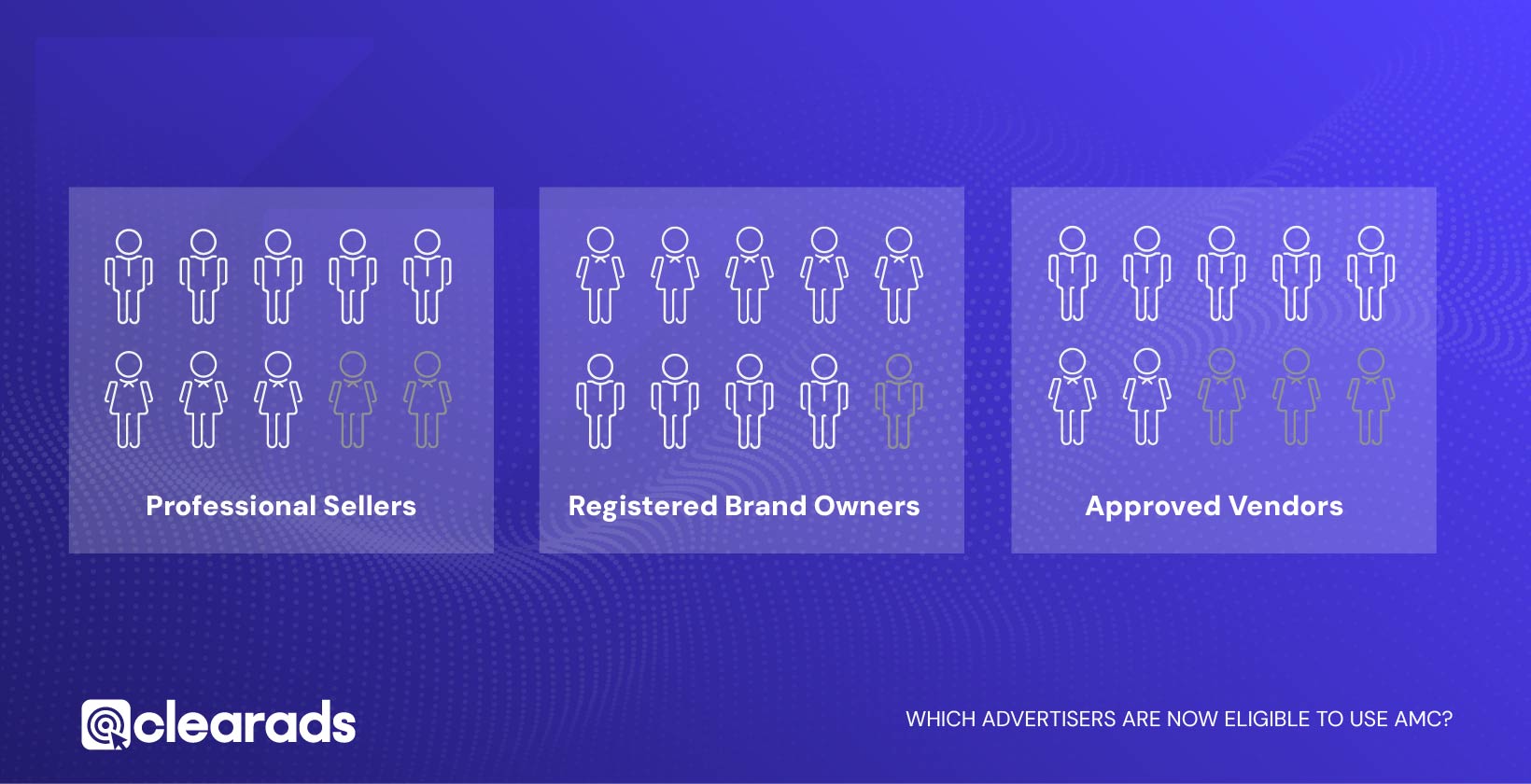
Eligibility centres on the advertiser’s account type, market coverage, and permissions in the Ads Console. Sponsored Ads advertisers gain access through the same identity used for Sponsored Products, Sponsored Brands, or Sponsored Display.
Advertiser identity types and prerequisites
Eligible identities include Professional Sellers, registered brand owners, and approved Vendors that already meet Sponsored Ads policy requirements, such as a valid payment method and ship-to coverage. Brand owners access Sponsored Brands through Brand Registry, which confirms brand ownership for eligibility.
Access pathways and ownership
Access is available in the Ads Console for Sponsored Ads advertisers; partners in the Amazon Ads Partner Network can also register and manage client access where applicable. This dual pathway supports self-service advertisers and agency-managed programmes without requiring DSP registration.
Markets and language availability
AMC lists 20 supported marketplaces across North America, South America, Europe, the Middle East, and Asia-Pacific: CA, MX, US; BR; BE, DE, ES, FR, IT, NL, PL, SE, TR, UK; KSA, UAE; AU, IN, JP, SG. Advertisers active in any of these markets qualify when other eligibility conditions are met.
Permissions and user roles
Account-level permissions in the Ads Console govern who can view or edit AMC within the advertiser’s organisation. Administrators assign appropriate rights so analysts can query while maintaining least-privilege access.
What can advertisers do with AMC through sponsored ads?
With Amazon Marketing Cloud (AMC), advertisers can finally move beyond last-click reporting. The tool connects signals from Sponsored Products, Sponsored Brands, and Sponsored Display campaigns to reveal how each ad format works together, showing the complete customer journey from first impression to final purchase.
Advanced Measurement Capabilities
AMC enables in-depth analysis across multiple ad formats. Advertisers can build multi-touch attribution models, path-to-conversion reports, audience-penetration studies, and frequency-distribution analyses that quantify the contribution of each ad type throughout the funnel.
These measurements provide transparency into how upper-funnel branding impacts lower-funnel sales outcomes, replacing single-touch metrics with full-funnel visibility.
For example, suppose an advertiser runs Sponsored Products and Sponsored Brands campaigns simultaneously. Using AMC, it becomes possible to see how many shoppers viewed a brand ad before completing a purchase through a product ad, revealing the true upper-funnel contribution of branding efforts.
Another scenario involves frequency and exposure optimisation. Advertisers can measure how often users are exposed to a Sponsored Display campaign before converting, helping determine the optimal exposure rate that maximizes conversions without over-serving ads.
AMC also supports cross-format sequencing analysis, allowing marketers to understand which campaign sequence, such as Display → Brands → Products, yields the highest return. This helps design data-driven funnel strategies that improve efficiency and boost ROAS across Sponsored Ads placements.
Sponsored Ads Insights Available Through AMC
AMC ingests Sponsored Ads signals such as impressions, clicks, detail page views, and purchases, enabling cross-campaign reporting and cohort analysis for Sponsored Ads programmes. These datasets allow advertisers to connect engagement metrics with actual conversion paths, offering clearer insights into customer behaviour across different formats.
How does this affect Amazon’s advertising strategy?
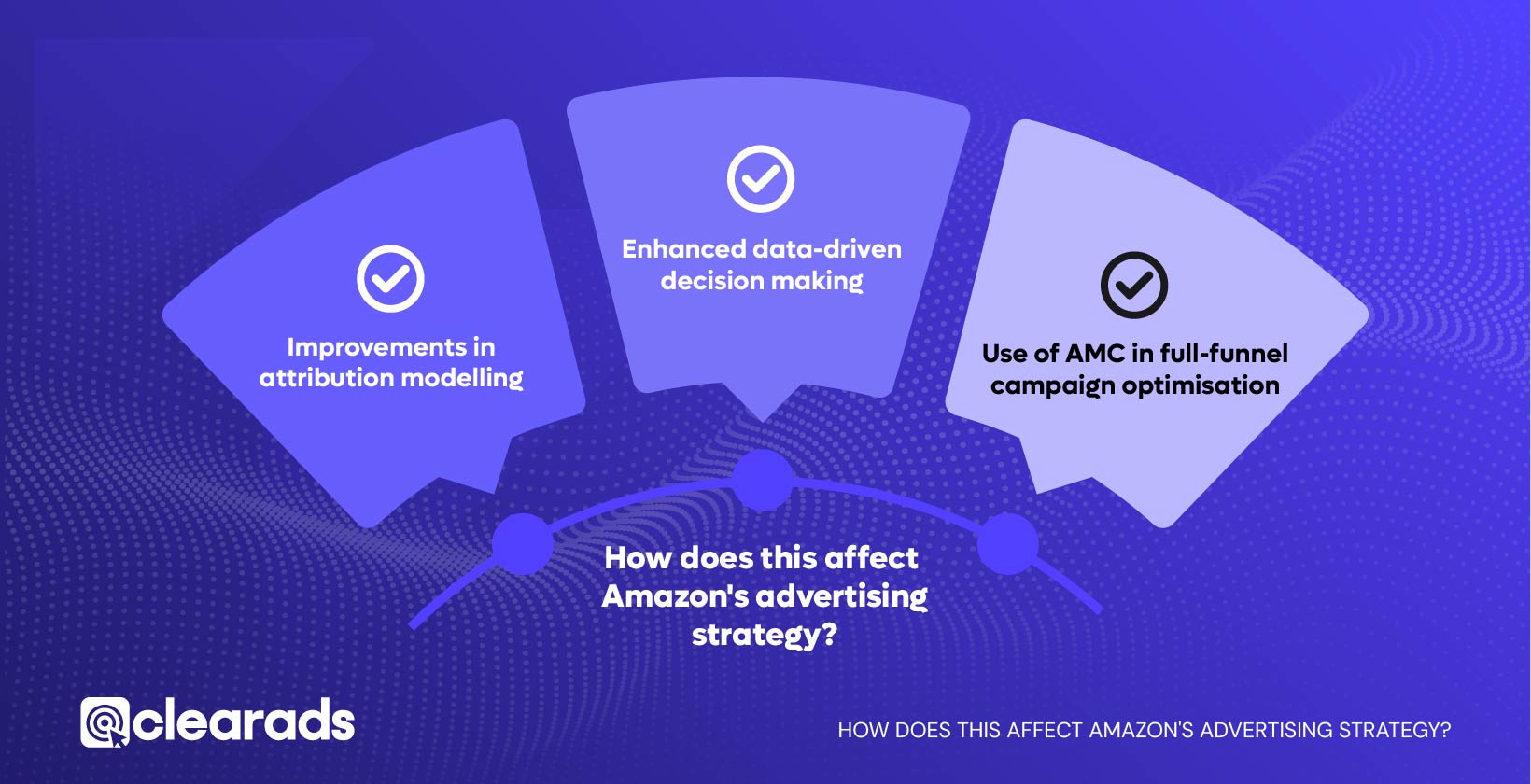
The expansion aligns Sponsored Ads signals with AMC’s event-level environment; teams plan budgets using privacy-safe queries instead of last-click views, which improves comparability across formats and time windows.
Improvements in attribution modelling
AMC supports multi-touch, sequence, and path analyses that attribute conversions across exposures to Sponsored Products, Sponsored Brands, and Sponsored Display. In practice, this means advertisers can see how every ad contributes to a sale rather than giving full credit to the final click. By identifying which ad interactions drive conversions at each stage, advertisers gain more balanced visibility into the performance of upper-, mid-, and lower-funnel activities.
Enhanced data-driven decision making
Analysts join pseudonymised Amazon Ads signals with first-party inputs to run cohort, reach, and frequency studies; the SQL environment enables controlled comparisons that inform ROAS and ACoS targets at campaign, audience, and time-window levels.
Use of AMC in full-funnel campaign optimisation
Insights produced in AMC activate through AMC Audiences for Sponsored Ads, enabling audience creation and bid adjustments that connect upper-funnel exposure to lower-funnel conversion, with measurable shifts in path-to-purchase and frequency distribution.
How is AMC access provisioned in the Ads Console and via partners?
Access to Amazon Marketing Cloud (AMC) operates at the instance level. Administrators associate one or more AMC instances with the advertiser’s Sponsored Ads account and invite authorised users directly through the Ads Console. This structure centralises permissions and ensures that only approved users can query data or activate audiences in a controlled environment.
What steps enable AMC for a Sponsored Ads account?
To activate AMC, advertisers create or select an AMC instance, link it with the relevant Sponsored Ads account, accept terms, and connect eligible data sources. Where a partner manages onboarding, registered partners can complete the same setup on behalf of clients. This process provides consistent access control whether accounts are self-managed or agency-managed.
Which roles and permissions are required for query, admin, and audience activation?
AMC uses a tiered permission system to maintain security and data governance.
- Administrators assign and manage user access, link AMC instances, and configure integrations.
- Analysts receive query rights to explore aggregated datasets and generate insights.
- Operators manage audience workflows such as activation and scheduling.
These clearly defined roles follow a least-privilege principle, ensuring that each team member has exactly the level of access required for their function while keeping advertiser data secure and compliant.
How can teams activate insights with AMC Audiences for Sponsored Ads?
Teams activate insights from Amazon Marketing Cloud (AMC) by turning analytical findings into actionable audiences. Within the AMC environment, advertisers create audience definitions directly from query results and then push these audiences to Sponsored Products, Sponsored Brands, and Sponsored Display campaigns for activation.
This process bridges measurement and execution: once an analysis identifies high-performing audience segments, such as users with repeated exposure or recent product interactions, advertisers can retarget or adjust bids for those cohorts across Sponsored Ads placements.
Which audience definitions are supported: sequence, frequency, recency, and product-based cohorts?
AMC supports rule-based audience creation through SQL logic or pre-built templates. These definitions can use event sequences (for example, shoppers who viewed a Sponsored Brand video before a product detail page), frequency (number of ad exposures), recency (time since interaction), and product-based cohorts (ASIN views or purchases).
How are audiences pushed to Sponsored Ads, and how often do they refresh?
After audience definitions are finalised in AMC, they are published to eligible Sponsored Ads destinations through supported integration endpoints. The refresh cadence is daily by default, ensuring audiences remain aligned with current shopping behaviour and campaign objectives.
Advertisers can monitor synchronisation status to maintain consistency between audience logic and activation windows, ensuring campaigns stay responsive to the latest insights.
What is the strategic impact of AMC’s expansion?
AMC’s expansion marks a defining point in Amazon’s advertising ecosystem. By extending access from DSP advertisers to Sponsored Ads users, Amazon has created a unified, privacy-safe environment where campaign performance can be analysed across every stage of the shopper journey.
As of September 2025, Amazon has also introduced self-service access to AMC directly within Sponsored Ads accounts. This enables advertisers to build high-intent audiences, run advanced reporting, and activate insights without relying on DSP participation, completing the transition to a fully integrated measurement platform.
Together, these developments transform how Sponsored Ads campaigns are planned and optimised. Advertisers can connect upper-funnel awareness with lower-funnel conversion, align budgets with real behavioural data, and refine ROAS and ACoS targets through verifiable, privacy-safe insights. AMC now stands not only as an analytics solution but as the core of Amazon’s measurement framework, driving precision and transparency across the entire advertising lifecycle.