Key Takeaways
- Amazon’s algorithm now evaluates keyword relevance, creative quality, and post-click conversion together, so the highest bidder no longer wins the auction.
- Raising ad budget gives Amazon permission to expand into lower-intent traffic, which drops conversion rate and lifts ACoS within two to three weeks.
- Sponsored Products ad costs are up 48% cumulatively since 2019, and competitive categories like supplements and electronics are seeing 25 to 35% annual increases.
- TACoS (total advertising cost of sale) reveals whether ads are building organic growth or funding a dependency, and a healthy range sits between 5 and 15%.
- Underperformance traces back to the listing in roughly nine out of ten diagnostic cases, not to bids or budget.
- Increasing budget is the correct move only when already-converting campaigns are running out of budget before the day ends.
General Summary
Amazon advertising costs have risen 10 to 15% annually across the platform, with competitive categories climbing 25 to 35%, and the brands responding with bigger budgets are the ones losing the most return on ad spend. The cause is structural: Amazon’s algorithm has shifted from a pure bid auction to a system that weights conversion rate, creative quality, and listing performance alongside the bid itself. A product converting at 15% will now outrank a product bidding twice as much but converting at 5%, because Amazon optimises for revenue per click across the entire marketplace. Within that environment, adding budget to a weak listing accelerates the problem rather than solving it. The fix is a diagnostic sequence that starts with the listing, moves through conversion data, and only reaches bid strategy at the final step.
Extractive Summary
Amazon’s algorithm now evaluates three things simultaneously, not just your bid: keyword relevance, creative quality, and post-click performance. Increasing budget doesn’t scale what’s already working: it gives Amazon permission to explore more traffic, and most of that traffic is lower intent. The metric that actually tells you whether your advertising is working is TACoS, not ACoS. There is a diagnostic sequence for fixing underperformance, and it starts with the listing rather than the bid.
Abstractive Summary
The shift inside Amazon’s auction reflects a broader pattern across major advertising platforms: the move from intent-based bidding toward outcome-based ranking. Google, Meta, and TikTok all rebuilt their ad systems around predicted conversion value rather than auction price, and Amazon completed a version of the same transition between 2022 and 2025. For sellers, the practical consequence is that paid media and listing optimisation are no longer separate disciplines. The listing is the bid. Brands that still operate with a separate “PPC team” and “listing team” are structurally disadvantaged against brands that treat conversion rate as the primary advertising lever.
Why Did Your ROAS Drop After You Increased Your Ad Budget?
Your ROAS dropped because Amazon’s algorithm responded to the larger budget by expanding into lower-quality traffic, not by scaling what was already working. The platform treats a budget increase as a signal to explore: more search terms, weaker placements, audiences with lower purchase intent. The new traffic converts worse than the traffic you already had, so your conversion rate falls and ACoS climbs.
This is not a malfunction. It is the algorithm doing exactly what it was designed to do. Amazon optimises for revenue per click across the entire marketplace, and a budget increase tells Amazon you are willing to pay for less efficient inventory.
The pattern repeats across thousands of seven and eight-figure accounts. Week one after the increase, revenue rises and the change feels like a win. Week two, clicks are up but conversions are flat. Week three, ROAS sits below where it started. The brands hit hardest are the ones that were already performing well, because their campaigns had already captured the most efficient traffic before the budget change.
How Does Amazon’s Advertising Algorithm Actually Work in 2026?
Amazon’s advertising algorithm now evaluates three signals together: keyword relevance, creative quality, and post-click performance. Bid amount is one input among several, not the primary input. The system decides ad placement based on which listing is most likely to generate revenue per impression for the marketplace, not which seller is willing to pay the most per click.
Keyword relevance determines whether a product is eligible to appear at all. Creative quality covers the main image, secondary images, and video, and it drives click-through rate from the search results page. Post-click performance covers conversion rate and recent purchase history, and it feeds directly back into whether Amazon continues showing the listing.
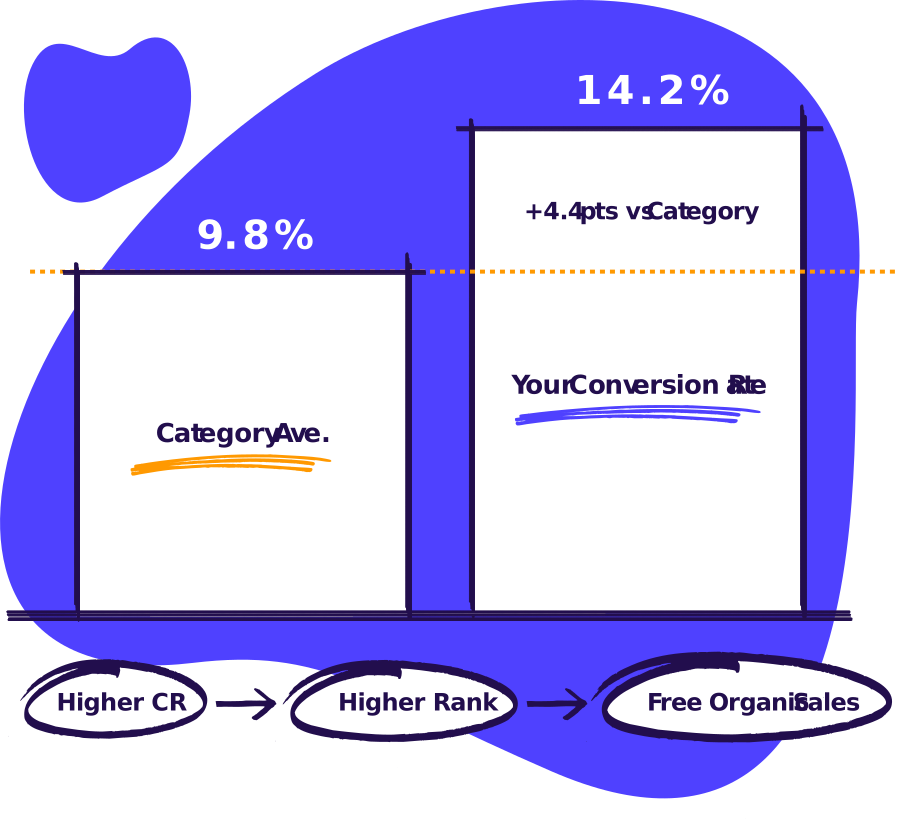
The mechanism produces results that feel counter-intuitive at first. A product converting at 15% will receive preferential placement over a competitor bidding twice as much but converting at 5%. The 15% converter generates more revenue per impression for Amazon, so Amazon serves it more often even at the lower bid. The lower-bidding seller stays competitive because the platform wants the better listing in the auction.
The practical consequence is that bid strategy now sits downstream of listing performance. A seller can be outbid on every keyword and still win more impressions than a competitor, provided the listing converts better. A seller can also raise a bid by 50% and watch impression share decline, because the algorithm is signalling that the listing is not earning the traffic it is paying for.
What Conversion Rate Does Amazon Reward?
Amazon rewards conversion rates above 10% with preferential placement, and listings below that threshold typically face rising costs regardless of bid level. Conversion rate sits at the centre of the algorithm because it is the cleanest signal of revenue per click, which is what Amazon optimises for.
If a listing converts below 10%, the problem is the listing, not the campaign. No bid adjustment fixes a structural conversion problem. The diagnostic question to ask before any other change is what the conversion rate actually is across the top five to ten keywords driving spend.
Category baselines shift the threshold. Consumables and low-consideration categories often see healthy CVR above 15%. Considered purchases like electronics or home appliances run lower, with 7 to 10% representing strong performance. The rule is to compare the listing against the category median, not against a universal target. Brand Analytics provides the comparison data inside the Search Query Performance report.
How Does Creative Quality Affect Ad Placement?
Creative quality affects placement because click-through rate feeds the algorithm’s ranking model, and the main image drives the majority of CTR variance from the search results page. A weak main image suppresses CTR, which suppresses the algorithm’s confidence in the listing, which suppresses placement.
The components Amazon weighs include main image clarity at thumbnail size, the presence of trust signals like badges and ratings count, the price point relative to the visible competitive set, and the title’s keyword and benefit clarity. Secondary images and video influence post-click conversion rather than CTR, but both feed the same revenue-per-click calculation.
A useful test is to view the search results page on mobile at standard zoom and compare the listing against the top three competitors. If the listing fails the three-second visual test against the competitive set, no campaign adjustment compensates for the gap.
Why Does More Budget Make Things Worse Instead of Better?
More budget makes things worse because Amazon uses the additional spend to test traffic the campaign was previously ignoring, and that newly-tested traffic converts at lower rates than the original traffic. The campaign expands into less relevant search terms, lower-quality placements, and audiences with weaker purchase intent. The averages drop.
The Amazon PPC community documented this pattern in detail across 2025. Budget increases give the algorithm permission to explore inventory that was not fully utilised at the lower spend level. That inventory exists for a reason: it converts worse. When budgets rise too quickly, ads appear for less relevant queries, in worse placements, in front of audiences less likely to buy.
The damage compounds for accounts that were performing well before the increase. A well-optimised campaign has already captured its most efficient traffic. There is nowhere left for the algorithm to expand except into lower-quality inventory. The better the campaign was performing, the steeper the drop after the budget change.
Why Do Most Fixes Make the Problem Worse?
Most fixes make the problem worse because they reset the algorithm’s learning phase before any data has accumulated. Large bid swings, toggling campaigns off and on, restructuring entire account architectures: each of these sends the algorithm back to day one of optimisation.
Amazon needs consistent data to optimise. A 50% bid change or a campaign pause-and-restart erases the learning Amazon has built over previous weeks. What looks like the strategy failing is the reset, not the strategy. The fix is incremental: 5 to 10% adjustments, several days between changes, and patience while the data accumulates before the next move.
The same principle applies to negative keyword additions, match type changes, and bid placement modifiers. Each adjustment is a signal the algorithm has to absorb. Stacking three or four changes in the same week makes attribution impossible, because no single change can be tested against the others. The discipline is one variable at a time, with enough days between changes to read the signal cleanly.
How Long Should You Wait Between Bid Changes?
The minimum waiting period between bid changes on the same campaign is 7 to 10 days, with 14 days preferred for low-volume campaigns. Amazon’s algorithm needs roughly 100 clicks per ad group to develop statistical confidence in a change, and most campaigns need a full week to reach that threshold.
Acting earlier introduces noise. A campaign that looks worse three days after a bid drop may simply be running through a slow purchase cycle, not responding to the change itself. Daily ROAS variance often exceeds 30% on healthy accounts, which means short windows produce false signals in both directions.
What Metric Should You Actually Be Tracking?
The metric that reveals whether advertising is building the business is TACoS, not ACoS. TACoS, or total advertising cost of sale, divides ad spend by total revenue including organic. ACoS only measures ad spend against ad-attributed revenue, which captures campaign efficiency but says nothing about whether the campaign is supporting compound growth or replacing it.
A healthy, scaling brand sees TACoS decline over time. Paid ads lift organic rank, organic rank generates organic sales, and the ratio of ad spend to total revenue falls. If TACoS stays flat or rises while ACoS looks acceptable, the ads are holding organic rank in place rather than building it. The moment spend pulls back, sales drop, because advertising has substituted for organic rather than fuelled it.
The target range for a healthy brand sits between 5 and 15% TACoS, with the exact figure depending on category and growth stage. A new product launch runs higher. An established product in a mature category runs lower. A TACoS above 15% that is not declining points to a structural problem regardless of what ACoS shows.
How Do You Know if Your Ads Are Building Organic Growth?
Pull TACoS for the last 90 days and look at the trend line. A declining trend means paid ads are lifting organic rank and the business is compounding. A flat or rising trend means paid spend is propping up sales rather than expanding the base.
The signal matters more than the absolute number. A brand at 12% TACoS that is trending down is healthier than a brand at 8% TACoS that is trending up. Direction reveals whether the system is working.
A second confirmation comes from organic rank tracking on the top 20 keywords. Tools like Helium 10 or Jungle Scout chart organic position over time. If organic positions on core keywords are improving while ad spend stays flat or declines, the compound flywheel is functioning. If organic positions are flat or declining despite increased ad spend, the spend is replacing organic rather than building it.
What Does a Healthy TACoS Look Like by Category?
A healthy TACoS varies by category, growth stage, and competitive density. Established brands in stable categories typically run 5 to 8% TACoS. Brands in high-competition categories like supplements, beauty, or consumer electronics often sit between 10 and 15%. New product launches can run 20 to 30% TACoS for the first 90 days before normalising.
The shift between launch TACoS and steady-state TACoS is the key signal. A new product that stays at 25% TACoS after six months has not built organic share. A new product that drops from 25% to 12% over the same period has converted paid traffic into organic rank successfully.
How Do You Diagnose an Underperforming Amazon Account?
The diagnostic sequence runs in five steps, and each step rules out a category of problem before moving to the next. Most accounts get fixed at step one or two. Skipping ahead to bid strategy without running the earlier checks is the most common reason brands cannot stabilise their accounts.
Step one: high ACoS with low CTR points to a creative problem. The main image, the price point, or the keyword relevance is failing before the click happens. The fix is the listing, not the campaign.
Step two: high ACoS with normal CTR but low CVR points to a listing conversion problem. People are clicking but not buying. The fix is A+ content, review volume, and listing copy.
Step three: high ACoS with normal CTR, normal CVR, but high CPC points to a structural bidding problem. This is the first step where adjusting keyword targeting and match type efficiency is the right move.
Step four: rising TACoS over time means ads are replacing organic rather than building it. The fix is to pull back on broad discovery spend and concentrate budget on keywords that are already converting.
Step five: low impression share on already-converting keywords. This is the only scenario where increasing budget is the correct response. The listing works, the CVR is strong, and campaigns are running out of budget before the day ends. That is captured demand left on the table. Increase only here, not before.
Which Amazon Report Reveals the Highest-Value Keyword Gaps?
The Search Query Performance report inside Brand Analytics reveals the keyword gaps that drive growth, and it is more useful than the standard Search Term Report. The Search Term Report only shows PPC-triggered queries, which excludes the largest part of the search landscape. SQP shows total brand performance across organic and paid together.
The report exposes keywords with high market impressions but low brand impressions: searches happening at scale where the brand is not appearing. Those gaps are the highest-value targeting opportunities on the platform. Brand Registry is required to access SQP, which is one of the strongest reasons to complete enrolment if a brand has not done so.
When Is Increasing Budget Actually the Right Move?
Increasing budget is the right move in one specific situation: when already-converting campaigns are hitting their daily cap before the day ends and impression share on those keywords is below 90%. That pattern signals captured demand the budget is not large enough to serve. Adding budget in that case scales what is already working.
The signals to confirm before increasing are conversion rate above 10% on the campaign, ACoS within target, and search term reports showing the spend is hitting relevant queries rather than spilling into broad-match expansion. If those three conditions hold, more budget produces proportional returns rather than expanded waste.
Outside that scenario, the lever is conversion rate, not spend. Lifting CVR from 8% to 12% on the same budget produces a larger revenue increase than doubling the budget on a campaign converting at 8%. The maths favour optimisation over expansion in nearly every case.
What Is the Long-Term Cost of Spending Your Way Out of the Problem?
The long-term cost is structural dependency on paid traffic and a permanent ceiling on margin. Brands that respond to declining ROAS with bigger budgets train the algorithm to expect that spend level, and they train their organic rank to depend on it. Pulling back later causes total revenue to drop sharply, because organic was never built.
Sponsored Products ad costs have climbed 48% cumulatively since 2019, and the trajectory is not reversing. Each year of overspending on weak listings raises the baseline cost of holding rank. The brands that scale profitably from here are the ones that stopped trying to outspend the auction and started outconverting it.
Spending more is not scaling. It is stress-testing the listing. A listing that converts well absorbs additional spend and returns it as growth. A listing that converts poorly absorbs the spend and returns it as data showing the listing converts poorly. The platform charges for the test either way.
What Happens to Margin When Ad Costs Compound Annually?
Margin compresses in a predictable pattern when ad costs rise faster than gross margin growth. A category seeing 25% annual ad cost increases produces a 95% rise in cost-per-click over three years. Brands with 35% gross margins enter a structural loss position on paid-acquired customers within that window unless conversion rate or average order value rises by a similar amount.
The compounding effect makes early intervention far cheaper than late intervention. A listing optimisation that lifts CVR from 8% to 12% in year one delivers three years of compounded benefit. The same optimisation in year three only captures one year of remaining benefit, and the cost-per-click baseline it operates against is significantly higher.
The brands holding margin in 2026 share a common pattern. They invest in listing quality, image production, and review velocity at roughly the same rate they invest in ad spend itself. The two budgets move together. Brands that under-invest in the listing side of the equation see margin erosion regardless of how sophisticated their PPC management becomes.
Final Reflection
Amazon’s algorithm is not punishing sellers who increase budgets. It is reading the listing, calculating revenue per click, and serving impressions accordingly. The system is accurate, not unfair. The brands that adapt their structure to that reality compound. The brands that keep raising bids against weak listings pay for the lesson.
The order of operations matters. Listing first, conversion rate second, TACoS trend third, bid strategy fourth, budget last. Run the sequence before changing a single number in the campaign manager.