Key Takeaways
- DSP charges per impression, not per click, so a weak listing or poor click-through rate turns DSP spend into wasted budget with no way to recover it.
- Sponsored Products must be genuinely saturated before DSP makes sense: capturing 40% or more purchase share on top search terms is the benchmark.
- Custom audience targeting on DSP requires a minimum of 10,000 records to perform reliably; below that threshold, CPMs rise and data becomes statistically unreliable.
- Products priced under $15 to $20 with thin margins rarely generate enough profit per unit to absorb DSP’s awareness-level acquisition costs.
- Repeat purchase behaviour is the structural advantage that makes DSP economics work: lifetime value turns a high first-order acquisition cost into a profitable long-term investment.
General Summary
DSP is one of the most powerful advertising tools available to Amazon sellers, but it is also one of the most misused. Brands that launch DSP before their product is ready spend tens of thousands of dollars generating impressions that produce no return, while the underlying problems that caused the failure remain invisible in the data. This article outlines four tests that determine whether DSP will work for a specific product, drawn from running DSP campaigns for brands spending between $30,000 and $550,000 a month. Each test has a clear pass or fail signal you can verify in your own data today. The fifth consideration, repeat purchase behaviour, is the structural variable that separates brands that build lasting DSP returns from those that pay for awareness with no payback.
Extractive Summary
DSP charges per impression, not per click, which means a weak click-through rate or a listing that fails to close sales drains budget with no mechanism for recovery. Sponsored Products saturation is the prerequisite for DSP: three measurable signals confirm when you have genuinely hit the ceiling on search-based advertising. DSP’s custom audience targeting only operates efficiently when your audience pool exceeds 10,000 records; below that, delivery thins and CPMs rise beyond the point where performance is reliable. Product economics govern whether DSP pays back at all: average order value and gross margin determine how much room exists between acquisition cost and profit per unit. Repeat purchase behaviour amplifies DSP returns by spreading the acquisition cost across multiple orders, which is why consumable and subscription categories consistently outperform one-time purchase products in DSP performance.
Abstractive Summary
Most DSP failures are not advertising failures. They are product readiness failures that advertising spend makes visible in the worst possible way: after the money is gone. The four tests in this article are diagnostic tools, not just strategy frameworks. A brand that fails the click and conversion test has a creative or listing problem. A brand that fails the PPC saturation test has a budget allocation problem. A brand that fails the audience pool test has a scale problem. A brand that fails the economics test has a product margin problem. DSP cannot fix any of these. What DSP can do, when all four tests pass, is extend reach beyond what search-based advertising can access and compound returns for products with strong repeat purchase behaviour. The discipline is in refusing to start until the foundation is ready.
Why Do Most DSP Campaigns Fail Before They Start?
Most DSP campaigns fail because the product was never ready for DSP. Not because the targeting was wrong or the creative was weak or the bid strategy was off. The product itself, its listing, its economics, its audience data, failed tests that could have been run before a single dollar was spent.
We run DSP for brands spending between $30,000 and $550,000 a month in advertising. We say no to starting DSP on specific products more often than most agencies do. The reason is straightforward: DSP on an unready product makes the underlying problem cost more, not less.
Four tests determine whether DSP will work. Each one has a clear pass or fail signal you can check in your own data right now. If a product passes all four, DSP can drive real growth. If it fails any one of them, fixing that failure first will generate better returns than any DSP campaign ever could.
What Is the Click and Conversion Test?
DSP charges you every time your ad appears, whether anyone clicks or not. This is the fundamental difference between DSP and Sponsored Products, and it is the first thing that makes an unready product expensive.
On Sponsored Products, you pay only when someone clicks. If the image is weak and nobody clicks, the ad costs nothing. On DSP, you pay for every impression. A thousand impressions with no clicks still costs you the CPM. The ad ran. You paid. Nothing happened.
Two things need to be working before DSP is worth running. Shoppers need to click the ad when they see it. When they land on the listing, the listing needs to close the sale.
Both signals are visible in Brand Analytics. Open Search Query Performance. For every search term you rank for, the report shows your numbers alongside the category total for the same term.
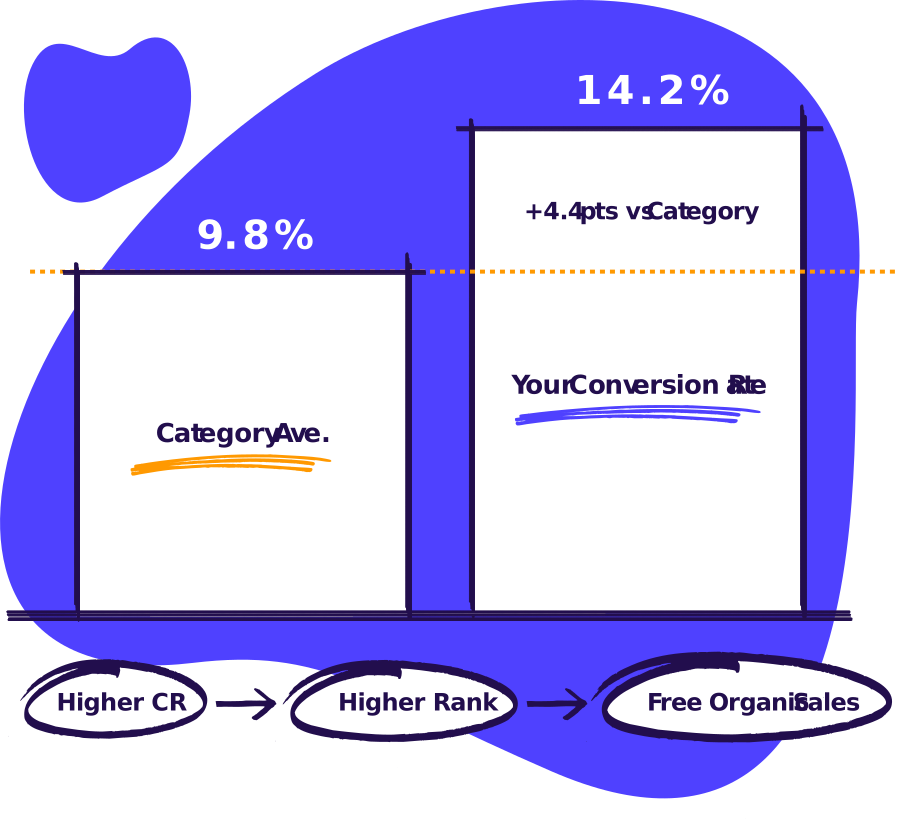
Check your impression-to-click rate first. Compare it to the category total. If shoppers click your listing less often than the category benchmark, your image, title, or price is not pulling them in. They see the ad and scroll past. On DSP, that is a budget drain with no floor.
Then check your click-to-purchase rate. If shoppers click the listing but buy less often than the category total, the listing is not closing the sale. The bullets, the A+ content, the reviews, the price: one of those is losing the customer after the click was already paid for.
Both sides need to pass before DSP makes sense. One broken side is enough to make the whole campaign unprofitable.
What Is the PPC Saturation Test?
DSP adds something Sponsored Products cannot: reach beyond search. It targets people who have not searched yet, category browsers, competitor viewers, and lapsed customers. That advantage only matters once Sponsored Products has been pushed to its limit.
If Sponsored Products is underfunded, the right answer is to fund it more aggressively, not to layer DSP on top. DSP running alongside an underfunded Sponsored Products campaign produces worse returns than simply allocating that DSP budget to search.
Three signals confirm Sponsored Products saturation. All three need to be present.
Search Query Performance shows 40% or more purchase share on your top five to ten search terms. Exact match keywords are winning strong impression share at reasonable CPCs, and raising bids further produces no meaningful increase in impressions. ACoS on primary terms is sitting at or above break-even, meaning more spend on Sponsored Products requires accepting unprofitable returns just to buy volume.
When all three signals are present, the ceiling is real. DSP is the next lever because it accesses audiences that search-based advertising structurally cannot reach.
When those signals are absent, Sponsored Products still has room to grow. Use that room before touching DSP.
What Is the Audience Pool Test?
DSP’s sharpest capability is audience targeting. Retargeting your own purchasers, conquesting competitor viewers, building lookalikes from your highest-value customers: these campaigns require actual audience data to function.
Amazon’s minimum to activate a custom audience is 2,000 records. Below that number, the audience cannot be pushed to DSP at all. The practical minimum for meaningful performance is 10,000 records or more.
Between 2,000 and 10,000 records, campaigns technically run. The pool is too narrow to deliver efficiently. CPMs rise because the audience cannot be scaled. Delivery is thin and inconsistent. The data returning from the campaign is not statistically reliable enough to optimize against.
Check the pool size directly. Open the DSP audience builder, create a test audience of your product purchasers or product viewers over the last 90 days, and look at the estimated size. Under 10,000 records means custom audience campaigns are not yet viable.
This does not eliminate DSP entirely. Amazon’s pre-built in-market audiences do not require minimum data and can still run prospecting campaigns. But the most valuable DSP use cases, retargeting, competitor conquest, lookalikes, all require that custom pool. If it is not there, building it through Sponsored Products volume over the next few months produces better long-term returns than starting DSP early.
What Is the Economics Test?
DSP operates on CPM pricing. You pay per thousand impressions, not per sale. The product’s economics need to support awareness-level spend, not just the performance-level returns that Sponsored Products generates.
Two numbers determine whether the economics work: average order value and gross margin.
A $48 supplement with a 50% gross margin has $24 of room per unit to absorb acquisition cost. A $12 kitchen accessory with a 30% margin has $3.60. DSP cannot operate inside $3.60 per unit. The CPM cost of generating an impression, earning a click, and closing a sale exceeds the available profit before the campaign has a chance to stabilize.
Products priced under $15 to $20 with thin margins rarely produce positive DSP returns. The math does not close. Higher AOV and higher margin create headroom for DSP to work, which is why mid-range and premium products generate better DSP performance than commodity items at low price points.
Does Repeat Purchase Behaviour Change the DSP Calculation?
Repeat purchase behaviour is not a hard requirement for DSP. It is the variable that makes DSP economics work at their best.
The brands that consistently build strong DSP returns share one structural characteristic. Every customer acquired on the first order keeps generating revenue on the second, third, and twelfth order. Supplements, beauty products, pet food, consumables, and CPG categories all have this property. A customer acquired in month one pays for themselves across two years of subscribe and save orders.
That lifetime value equation transforms the economics of DSP entirely. A $25 first-order acquisition cost that looked marginal becomes deeply profitable when the same customer spends $480 over the following 24 months.
One-time purchase products do not have this lever. The acquisition cost has to be recovered on a single sale. That is possible when AOV and margin are high enough, but it removes the compounding advantage that makes the strongest DSP programmes so durable.
If the product has repeat purchase behaviour, DSP is not just a traffic channel. It is a customer acquisition engine where early investment compounds over the customer’s lifetime.
How Do You Know When a Product Is Ready for DSP?
A product is ready for DSP when all four tests pass. The click-through rate and conversion rate match or exceed the category benchmarks in Search Query Performance. Sponsored Products is genuinely saturated across the top converting terms. The custom audience pool exceeds 10,000 records. The unit economics support awareness-level acquisition costs.
When a product fails any one of these tests, the correct investment is fixing that failure first. A listing with a weak click-through rate needs creative and copy work. An underfunded Sponsored Products campaign needs budget before it needs DSP. A product with a thin audience pool needs more Sponsored Products volume to build the data. A product with broken unit economics needs pricing or margin improvement before any advertising channel can help.
DSP accelerates what is already working. It does not repair what is broken. The ten minutes spent running these four tests before launching DSP is the difference between a campaign that builds real returns and one that produces impressive impression counts with nothing behind them.
Conclusion
The brands that get DSP right are not the ones with the biggest budgets or the most sophisticated targeting strategies. They are the brands that waited until the product was ready.
Pass the four tests. Then run DSP. In that order, every time.