Key Takeaways
- A brand paused a $48,000-per-month DSP campaign that ran for over a year, and their sales stayed flat while their profit went up.
- DSP campaigns without audience negations serve ads to people who were going to buy anyway, then claim credit for those sales.
- A healthy DSP budget splits across the funnel: 30% awareness at the top, 40% consideration in the middle, 30% retargeting at the bottom.
- Amazon changed its DSP attribution model in January 2026, removing the blind 14-day view window for on-Amazon placements and making reported ROAS numbers smaller but more honest.
- Your Amazon seller merchant token must be attached to your DSP advertiser account, or the same sale gets double-counted across DSP and Sponsored Products.
- An Amazon Marketing Cloud holdout test is the only way to prove whether DSP drives incremental sales, and these tests routinely show 30 to 50% of attributed conversions would have happened anyway.
General Summary
DSP can drive real growth for a brand, or it can spend tens of thousands of dollars a month taking credit for sales that were going to happen regardless. The difference comes down to five setup decisions: audience negations, funnel budget distribution, attribution accuracy, stage-matched metrics, and incrementality testing. Amazon’s January 2026 attribution change has exposed how many DSP accounts were running on phantom credit, and brands across the spend spectrum are now seeing their dashboard numbers shrink. That shrinkage is not the campaigns getting worse. It is the reporting getting honest. This piece walks through each of the five mistakes that cause a DSP account to claim credit without causing revenue, and the specific fix for each one, so you can audit any account in roughly ten minutes.
Extractive Summary
DSP without negations serves ads to people who were going to buy anyway. A lot of DSP campaigns concentrate spend on retargeting, which converts the audience the brand was already going to convert. Under Amazon’s old attribution model, a shopper saw a DSP banner, bought within 14 days, and DSP got full credit regardless of what actually drove the sale. Measuring every campaign with ROAS kills the awareness pipeline that makes retargeting work in the first place. Even with everything else fixed, the only way to know for certain whether DSP drives growth is a holdout test that compares an exposed group against a control group.
Abstractive Summary
The deeper pattern underneath all five mistakes is the gap between correlation and causation. For years, Amazon DSP was sold on dashboard ROAS, a number that conflated sales DSP caused with sales that happened nearby. The 2026 attribution shift marks a turning point for the channel: it forces brands to confront whether they have been buying growth or buying a flattering report. The agencies that thrive after this change will be the ones who were already measuring incremental lift rather than attributed credit. For a brand owner, the question stops being “what is my ROAS” and becomes “what would have happened if I had spent nothing.”
What happens when a brand pauses a DSP campaign to test it?
Sales stay exactly the same, and that flat result is the whole problem. One brand spent $48,000 a month on DSP, switched it off, and watched nothing change. They had been running that campaign for over a year through another agency. They paused it in December to see what would happen.
Sales did not drop. The business got more profitable, because $48,000 a month in wasted spend stopped hitting the account.
Every time we audit a DSP setup that is not ours, some version of this story is waiting underneath it. The campaigns look healthy on paper. The ROAS number in the dashboard looks strong. Then you pause the campaigns and nothing moves, because the sales were always going to happen.
We run DSP for brands spending between $30,000 and $550,000 a month in ads. The five mistakes below are the ones that cause this exact outcome, and each has a specific fix. By the end you will be able to look at any DSP account and know in about ten minutes whether it is driving new revenue or just claiming credit for sales the brand was already making.
One fix in particular almost no agency sets up properly at launch. Miss it and your reporting is wrong from day one. That one comes later, and it is worth the wait.
Why do DSP campaigns without negations waste money?
DSP without negations serves ads to people who were going to buy anyway. Existing customers. Active subscribers. People who bought last week. The campaign shows them an ad, they reorder a product they already intended to reorder, and DSP takes the credit.
The ROAS number looks strong because conversions are happening. They just are not conversions DSP caused.
When that brand paused their campaigns, those buyers kept buying. They were never influenced by the ads. They were reordering on their own schedule. The $48,000 a month was paying to follow them around with ads they did not need.
Every DSP account needs three negation layers from day one.
Recent purchasers: exclude anyone who bought in the last 30 to 90 days, depending on how long your product lasts.
Active subscribers: if the campaign is for acquisition, cut your existing subscribers out entirely. They do not need to be acquired. They are already yours.
Frequency caps: cap impressions at five or six per person in a given window. Past that, you are burning money on people who have already decided.
Check your DSP account right now. Look at the audience exclusions on any active order. If that section is empty or holds one or two basic rules, you have found the first leak.
How should DSP budget be distributed across the funnel?
A growth-driving DSP budget splits across three funnel stages rather than concentrating on the bottom. Too many campaigns pile spend onto retargeting: people who viewed the listing, added to cart, or visited the brand store. That is the easiest audience to convert, which is exactly why agencies love showing it. High ROAS, low risk, good dashboard numbers.
The retargeting pool has to come from somewhere. Every day you retarget the same pool without feeding it, the pool shrinks. CPMs rise because you are chasing fewer eligible impressions. The same 10,000 people see the same ad 40 times. Conversions plateau, then drop.
And pausing the campaign produces the same outcome as running it, because that audience was already converting on its own.
A DSP setup that actually grows the business looks different. Top of funnel gets 30% of the budget: awareness campaigns reaching new people who have never seen the brand. Middle of funnel gets 40%: category browsers, competitor viewers, people showing category intent. Bottom of funnel gets 30%: retargeting the warm audience you built from the first two stages.
The top feeds the middle. The middle feeds the bottom. Starve the top and the bottom starves with it.
What is phantom attribution in Amazon DSP?
Phantom attribution is DSP claiming credit for a sale it did not cause. This single issue made thousands of brands stop trusting DSP between 2022 and 2024.
Under Amazon’s old attribution model, a shopper saw a DSP banner ad, then bought within 14 days, and DSP got full credit. Even if they found the product through organic search. Even if they clicked a Sponsored Products ad five minutes before checkout. Even if they typed the brand name directly. DSP saw the view, the sale landed inside 14 days, DSP claimed it.
That is why ROAS numbers looked impossible. Returns of 10x, 12x, 15x that reflected the brand’s existing demand, not what DSP actually moved. And it is why the pause test became a thing. Pause the campaigns, watch the attributed sales keep happening, and realise you were paying for credit, not causation.
Amazon changed this in January 2026. The blind 14-day view window for on-Amazon placements is gone, replaced with a model that uses shopping behaviour signals to judge whether the ad view actually influenced the purchase. Click attribution still works the same way. Offsite DSP placements still use the old window.
DSP numbers in 2026 look smaller than they did in 2024. That is not the campaigns getting worse. That is the reporting getting honest. A lot of brands are cancelling DSP in early 2026 because their ROAS “dropped,” when what actually dropped was the phantom credit.
Why does the merchant token matter for DSP attribution?
The merchant token is what lets DSP deduplicate conversions between its own view credit and Sponsored Products click credit. Your Amazon seller merchant token needs to be attached to your DSP advertiser account. Without it, the same sale can be credited to both systems at once.
So you are not reading inflated numbers because the attribution model is generous. You are reading inflated numbers because the systems are double-counting.
Most agencies never attach it. Check yours. If it is missing, every ROAS figure you have looked at for the last year is wrong.
Why is measuring DSP with only ROAS a mistake?
Measuring every DSP campaign with ROAS kills the campaigns that have no business being measured that way. A top-of-funnel awareness campaign is not trying to drive immediate sales. It is trying to reach people who have never heard of the brand.
Judge that campaign on ROAS, see a low number, and kill it, and you have just eliminated the pipeline that makes your retargeting work. You cut the source that feeds the close.
Every DSP campaign needs a stage and a matching metric.
Awareness, top of funnel: measure reach and CTR, not ROAS. You want to know if the ad is reaching new people and resonating enough to pull a click.
Consideration, middle of funnel: measure detail page view rate. You want to know if the ad is driving people to look at the product.
Conversion, bottom of funnel: ROAS and purchase rate are the right metrics here. This is where immediate return matters.
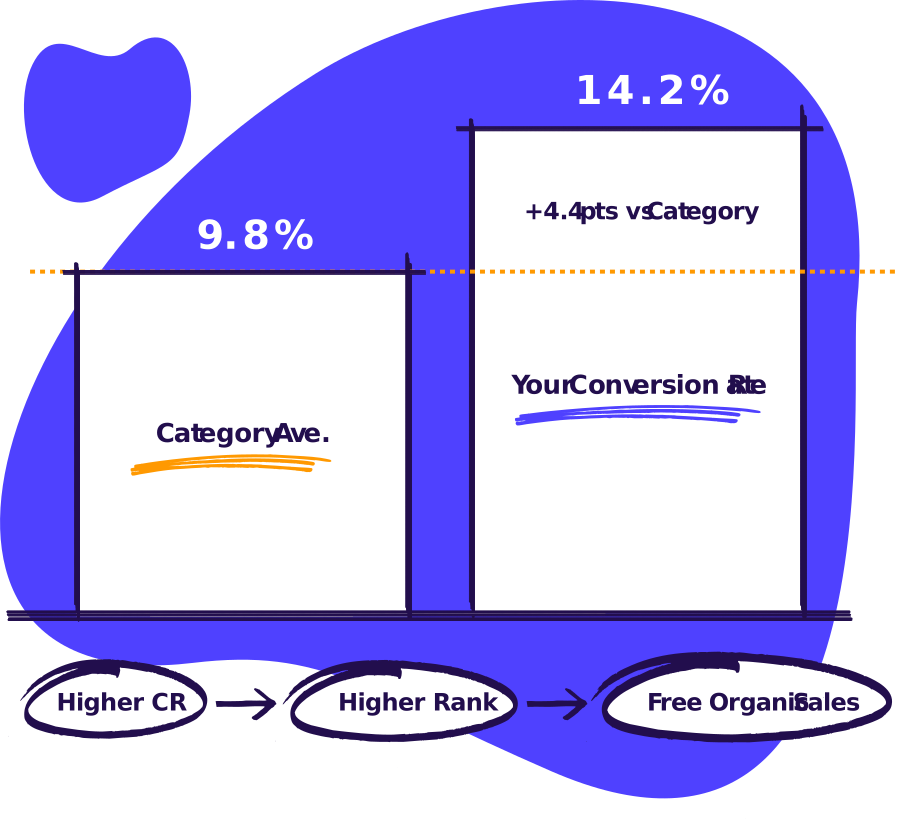
One metric matters across every stage: new-to-brand percentage. This is the share of conversions coming from people who have not bought from you in the last 12 months. At 70% or 80%, DSP is expanding your customer base. At 15%, DSP is cycling the same people you already had.
How do you prove DSP actually drives sales?
A holdout test is the only way to prove DSP drives sales. Even with negations, funnel structure, proper attribution, and the right metrics, a DSP campaign can still produce a clean ROAS number that is not driving real growth.
Split your target audience randomly. 80% see the DSP ads. 20% do not, and that 20% is your control group. Run both for four to six weeks. At the end, compare the conversion rate of the exposed group to the control group. The difference is the incremental lift: the sales DSP actually caused, separate from the sales that would have happened anyway.
This is Amazon Marketing Cloud incrementality testing, and it is the only real answer to the question that brand was asking when they paused their $48,000 a month. Is DSP driving sales, or would the sales have happened anyway? ROAS cannot answer that. A holdout test can.
The data from these tests is consistent. Across a lot of DSP campaigns, 30 to 50% of attributed conversions would have happened organically. Up to half the revenue your dashboard shows as “DSP-attributed” is revenue DSP did not cause.
One brand ran this test, found half their retargeting conversions were non-incremental, cut retargeting spend by 60% and moved it to prospecting. Their incremental sales went up 52%.
What does a DSP account that actually works look like?
A working DSP account drives sales the brand would not have made without it, and it can prove that with a holdout test. That is the whole bar. Negations stop you paying to reach people who were already yours. Funnel distribution keeps the retargeting pool fed. Correct attribution and an attached merchant token stop the double-counting. Stage-matched metrics keep you from killing the campaigns that build future revenue.
The brand that paused $48,000 a month did not have a DSP problem. They had a measurement problem dressed up as a strong ROAS number. The fix was never to spend more or spend less. It was to find out what the spend was actually doing.
Run the pause test on your own account, or better, run the holdout. The number you get back is the only one that has ever mattered.