Do Brands Get Their Own Amazon DSP Seat, and Who Owns It?

Key Takeaways

  • A DSP “seat” is the industry’s word for the Amazon advertising account that holds programmatic campaigns; in Amazon Ads Agent that is an advertiser account, and an agency’s manager account can hold many of them.
  • Brands can open their own account: Amazon offers self-service Display, Video and Audio campaigns with budgets you set, DVA+ bills on CPM with no minimum spend, and Amazon’s managed service typically needs $50,000 in the US.
  • Access to the full programmatic controls depends on history: existing programmatic advertisers and agencies get advanced settings automatically, while new and Sponsored Ads advertisers request them through an Amazon Ads account manager.
  • Amazon lets manager account admins unlink most accounts, but a Display, Video and Audio advertiser account created under an agency’s manager account with admin linking permission cannot be unlinked.
  • Amazon publishes no rule on who keeps audiences, Amazon Marketing Cloud data and campaign history when a brand leaves an agency, so the agency contract has to say it.

Yes, a brand can have its own Amazon DSP seat, but whether it owns the account, the audiences and the history depends on how the account was created and what the agency contract says. Amazon’s rules decide the first part and say nothing about the second. In this article, “seat” means the Amazon advertising account that holds programmatic campaigns, and “agency” means any third party that runs that account for you. The question matters more since September 2026, because Amazon moved DSP into its Amazon Ads Agent platform and opened programmatic buying to advertisers who never had a DSP account before.

Amazon DSP access at a glance

FactDetail
What a seat isThe advertising account that holds programmatic campaigns; a practitioner term, not Amazon’s
Where DSP lives nowAmazon Ads Agent, as DVA+ with advanced settings
Who can open an accountSellers, vendors and brands that do not sell on Amazon
Self-service minimumNone stated by Amazon; Display, Video and Audio campaigns run on budgets you set, and DVA+ bills on CPM with no minimum spend
Managed-service minimumTypically $50,000 in the US, and it varies by country (Amazon’s figures)
Pricing after the move to Amazon Ads AgentCarried forward: the DSP pricing model, self-service and managed, continues within DVA+
Advanced settingsAutomatic for existing programmatic advertisers and agencies with entity access; requested through an Amazon Ads account manager by everyone else
DVA+ availabilitySelect US advertisers; open beta expected from late October 2026; general availability across 35 markets targeted for the first quarter of 2027
Unlinking from an agencyMost accounts can be unlinked by a manager account admin; DVA advertiser accounts created under the manager account with admin linking permission cannot
Ownership on exitNot defined by Amazon; set by the agency contract

What is an Amazon DSP seat?
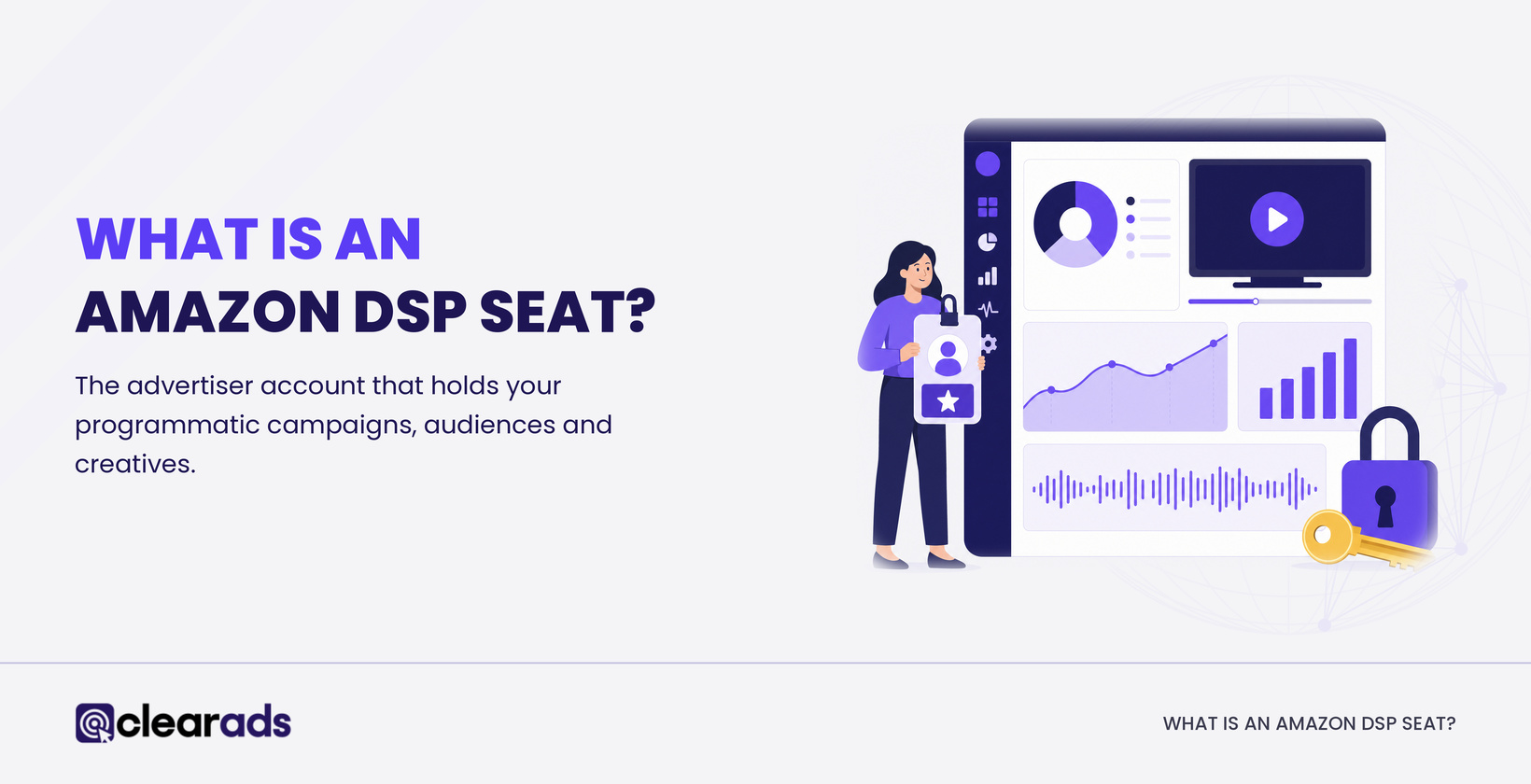
An Amazon DSP seat is the advertiser account that holds your programmatic campaigns, audiences and creatives

An Amazon DSP seat is the advertising account that holds your programmatic campaigns, and “seat” is the industry’s word rather than Amazon’s. Amazon’s own terms are advertiser account and manager account. An advertiser account holds one advertiser’s campaigns, audiences and creatives across programmatic, sponsored ads and Amazon Marketing Cloud (AMC). A manager account groups several advertiser accounts, and Amazon sets them up either for an advertiser’s own brands or for an agency’s clients.

An agency “seat” is therefore a manager account, or an older DSP entity, with client advertiser accounts inside it. When a brand asks “who owns the seat?”, the useful version of the question is “whose name is on the advertiser account, and who is its admin?”

Amazon changed the account layer twice in 2026. In July, existing Amazon DSP advertiser accounts became advertiser accounts that can buy across the Americas, Europe, the Middle East and Africa, and Asia Pacific from one login, with the existing DSP advertiser account ID carried over. In September, Amazon folded the DSP console into Amazon Ads Agent, where the programmatic controls now sit in DVA+ with advanced settings. What DVA+ changes for DSP advertisers covers that second change in detail; this article covers the account.

None of this changes what the platform does. Amazon DSP’s audiences, inventory and use cases are the same whichever account they run in.

What are the routes into Amazon DSP, and who holds the account in each?
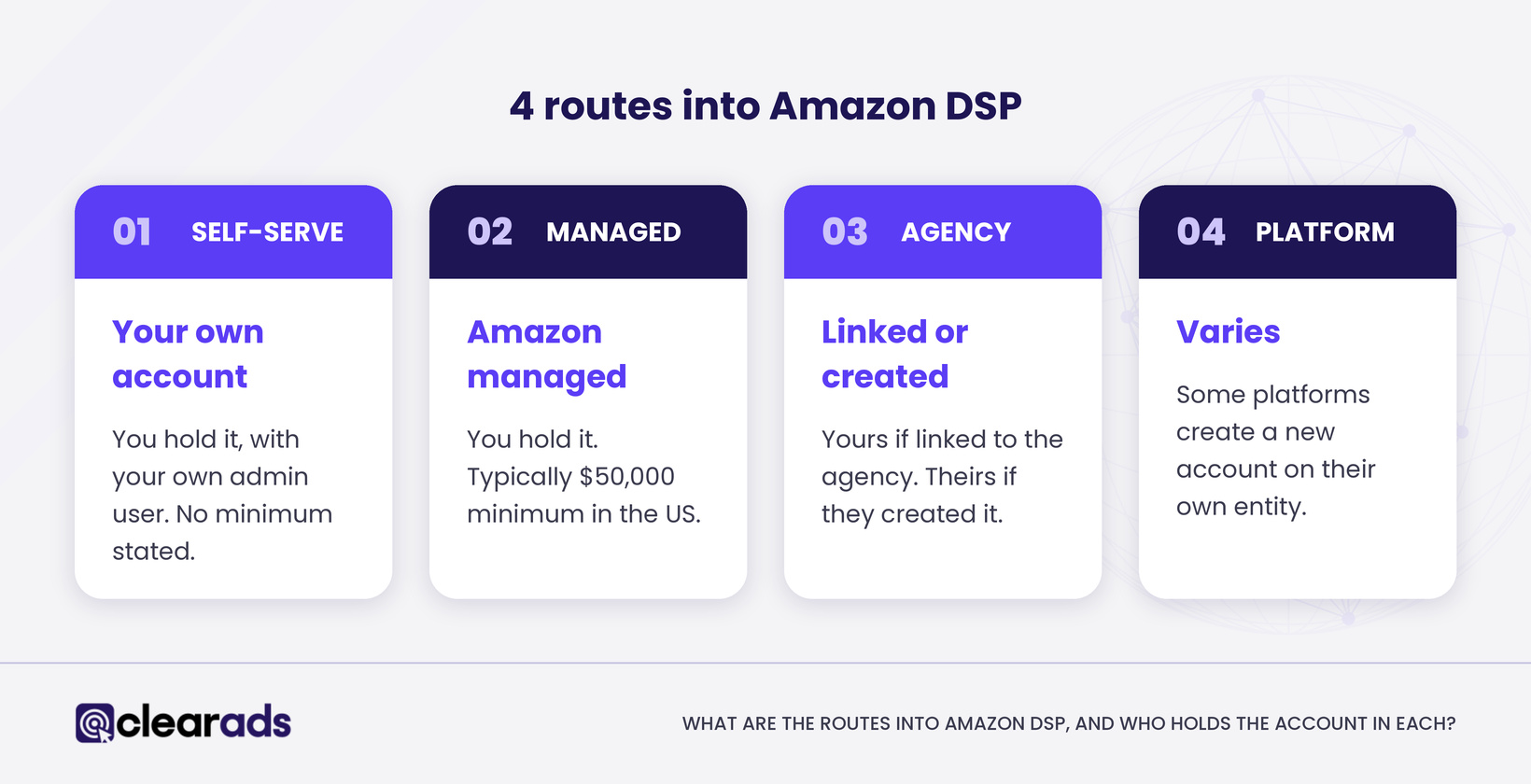
Four routes into Amazon DSP: self-serve, Amazon managed, agency and tech platform, and who holds the account

There are four routes into Amazon DSP, and the account is yours in only two of them by default. Amazon’s Ads Agent page says Display, Video and Audio campaigns are available self-service with budgets you set, or through a managed service that typically requires a minimum spend that varies by country.

Route Who holds the account Minimum spend Billing
Your own self-service account You, with your own admin user None stated by Amazon; DVA+ bills on CPM with no minimum Invoice, or “bill to advertiser”; card payment for DVA+ planned for early 2027
Amazon’s managed service You, with Amazon’s team running campaigns Typically $50,000 in the US; varies by country Invoice from Amazon
An agency Either your advertiser account linked to the agency’s manager account, or an account the agency created under its manager account Set by the agency, together with its fee “Bill to partner” (one agency invoice) or “bill to advertiser”
A technology platform Varies; some platforms create a new advertiser account on their own entity Set by the platform Through the platform

The managed-service figure comes from Amazon’s advertising FAQ, which says the managed-service option for display and video ads typically requires a minimum spend of $50,000 in the US. The same FAQ says that pricing did not change with the move to Amazon Ads Agent: the programmatic pricing model used in Amazon DSP, including self-service and managed-service options, continues within DVA+.

Older guides that quote a $50,000 monthly minimum for self-service describe a rule Amazon’s current pages do not state. An agency minimum is the agency’s own commercial decision, and it should be in the contract as such, not presented as Amazon’s requirement.

The agency route is where ownership gets decided, because the account can be created two ways. If you register the advertiser account and link it to the agency’s manager account, the account is yours. If the agency creates the account under its manager account, Amazon’s unlinking rules apply, and they are covered below.

How do you get DVA+ and the advanced settings?

Access to DVA+ depends on where you advertise, and access to its advanced settings depends on your history with Amazon. DVA+ is in an extended closed beta for select US advertisers, with an open beta that Amazon expects from late October 2026 and general availability across 35 markets targeted for the first quarter of 2027. Advertisers in the UK and 20 other countries who used Amazon DSP continue to see the Amazon DSP experience for now.

Within the US, Amazon sets out three cases:

  • existing advertisers with programmatic experience have access to both DVA+ and advanced settings

  • new advertisers and Sponsored Ads advertisers have access to DVA+, and can request advanced settings through their Amazon Ads account manager

  • agencies with existing entity access have full access to both

There is no self-serve request form. Advanced settings are requested through an Amazon Ads account manager, and AMC access alongside advanced settings is requested through an Ad Tech account executive. Amazon has not published how long approval takes. Payment during the closed beta is invoice-only, and campaigns can only be created in Amazon Ads Agent until the API arrives, which Amazon targets for the first quarter of 2027.

The second case is the one that matters for ownership. A brand that has only ever run Sponsored Products can now open its own programmatic account without going through an agency, and that brand holds the account from day one.

What happens to your account when an agency runs it?
If the agency created your Amazon DSP account, you have access to a seat, not ownership of one

An agency runs your account through a manager account, and Amazon’s linking rules decide how easily you can take the account back. The person who registers a manager account must be an admin on the advertising accounts it links, team members added as admins can link accounts too, and an advertiser must approve an agency’s request to link its account.

Unlinking is the agency’s side of the same rule. Manager account admins can unlink accounts at any time, from Administration, then Account access and settings, then the Manager accounts or Accounts list, then Remove. Sponsored ads advertiser accounts and other manager accounts can be unlinked this way.

One account type cannot. Amazon’s manager account help page says that Display, Video and Audio campaigns advertiser accounts created under the manager account, with admin linking permission, cannot be unlinked. Our reading is that if an agency created your DVA advertiser account under its own manager account, that account stays with the agency’s manager account, and the way out is a new account rather than a transfer.

Individual access is separate from the link. An agency employee invited as a user on your advertiser account keeps that access until someone removes the user from the Users tab, so an exit needs both steps: unlink the manager account and remove the users.

The test for any brand is simple: who created the advertiser account, and whose email is its admin? If the answer to both is the agency, you have access to a seat, not ownership of one.

Who owns the audiences, the AMC data and the history when you leave?

Amazon does not say. Its pages confirm that campaigns, audiences, creatives, deals and performance history carry forward when an account moves into Amazon Ads Agent, but they publish no rule on what transfers between a brand and an agency when the two part company. The assets fall into three groups:

  • Campaign history, audiences and creatives live in the advertiser account they were built in. If that account is yours, they stay with you; if the agency created it, they stay with the agency’s manager account.
  • AMC data lives in an instance. Amazon provisions AMC access through the advertiser account, and it says the data you upload stays within your dedicated AMC instance and cannot be exported or accessed by Amazon, with only aggregated outputs returned to you. If the instance was set up on the agency’s account rather than yours, it may hold other clients’ records, and the agency cannot hand it over without exposing them.
  • Deals and inventory arrangements negotiated under the agency’s entity, such as private marketplace deals, belong to that entity unless the contract says otherwise.

Technology platforms that take over DSP management make the same point from the other side: they generally ask a brand for a new advertiser account unless it already holds its own account with console access. An account that only exists inside someone else’s manager account does not travel.

What should your agency contract say about the DSP account?
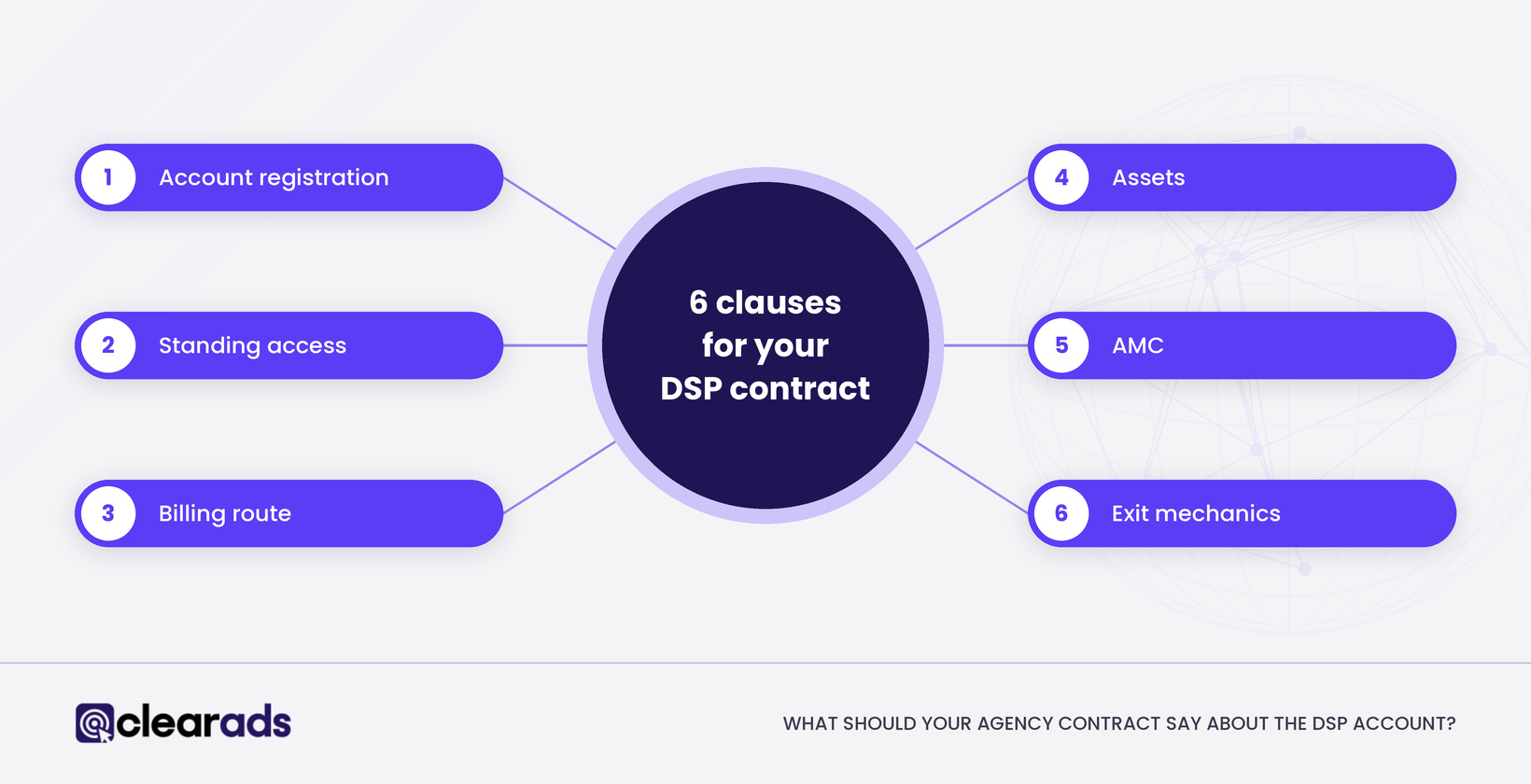
Six agency contract clauses for an Amazon DSP account, from account registration to exit mechanics

The contract should name the brand as the account owner and set out what happens to every asset on exit. These six clauses are Clear Ads recommendations, drawn from Amazon’s account rules rather than from any Amazon requirement:

  • Account registration. The advertiser account is registered to the brand, a brand email holds the admin role, and the agency’s manager account is linked to it rather than creating it.

  • Standing access. The brand keeps at least a viewer role for the whole engagement. Amazon’s standard roles are admin, editor and viewer, so there is no technical reason to be locked out of your own reporting.

  • Billing route. State whether Amazon bills the brand or the agency, because “bill to partner” puts the invoice relationship with the agency, and set out how prepaid or disputed amounts are settled on exit.

  • Assets. Audiences, creatives, deal IDs, campaign history and reporting stay in the brand’s account, and anything built elsewhere is exported before the end date.

  • AMC. Name whose advertiser account the AMC instance belongs to, and state that uploaded first-party data and saved queries are handed over or deleted when the engagement ends.

  • Exit mechanics. A notice period, who unlinks the manager account, and a deadline for the agency to remove its users.

One question tests all six before you sign: “If we left tomorrow, what would we keep?” An agency that can answer it in a sentence has set the account up properly.

What changed for existing DSP advertisers in 2026?

Existing DSP advertisers kept their accounts, their pricing and their campaigns through both of Amazon’s 2026 changes, and Amazon says no action was needed for either. The July upgrade turned each Amazon DSP advertiser account into an advertiser account that manages programmatic, sponsored ads and AMC together, with unified billing and the same admin, editor and viewer roles across every product. The September move into Amazon Ads Agent carried campaigns, audiences, creatives and reporting across, and Amazon’s FAQ answers the pricing question directly: your current pricing structure is carried forward.

Outside the US, the console still shows the Amazon DSP experience, so for a UK or European advertiser the practical change so far is the account layer, not the buying workflow.

What has changed for every advertiser is the bargaining position. Now that a brand can open a programmatic account with no minimum and no DSP expertise, there is less reason to hand an agency the account itself rather than access to it.

Frequently asked questions

Can a brand open an Amazon DSP account without an agency?

Yes. Sellers, vendors and brands that do not sell on Amazon can register an Amazon Ads account and create Display, Video and Audio campaigns themselves, with budgets they set. In the US, new advertisers get the simplified DVA+ workflow and can ask their Amazon Ads account manager for advanced settings; outside the US, self-service Amazon DSP is the equivalent route.

What is the difference between a manager account and an advertiser account?

An advertiser account is the account that holds one advertiser’s campaigns, audiences, creatives and billing. A manager account sits above it and groups several advertiser accounts so one team can work across them, which is how agencies run client accounts and how brands with several labels run their own.

Does moving to Amazon Ads Agent change your DSP account ID?

No. Amazon says your existing Amazon DSP advertiser account ID is now your advertiser account ID, and that legacy identifiers continue to work without modification. Amazon’s July 2026 announcement describes a new global account ID as well, sitting alongside the regional identifiers, so expect both to appear in your account.

Can you move an Amazon DSP account from one agency to another?

Yes, if the advertiser account is yours. The current agency’s manager account is unlinked, you approve the new agency’s request to link, and the campaigns, audiences and history stay where they are. If the account was created under the old agency’s manager account, Amazon’s rules say it cannot be unlinked, so the new agency will need a new account.

How long does it take to get advanced settings approved?

Amazon has not published a timeline. Requests go through your Amazon Ads account manager, or through an Ad Tech account executive when AMC access is needed as well, and Amazon describes access to its newer Ads Agent features as expanding in a rolling beta that depends on eligibility, marketplace and capacity.

What does this article not cover?

This article covers who holds and owns an Amazon DSP account.

What is the next step?

If an agency already runs your DSP, find out this week who created the advertiser account and whose email is its admin, then compare your contract with the six clauses above. If you are choosing an agency, ask the “what would we keep” question before anything else.

Clear Ads is an Amazon Ads Advanced Partner that manages Amazon PPC, Amazon DSP and full-service accounts for brands worldwide. If you want a second opinion on how your DSP account is set up, or help running Amazon DSP campaigns, get a free audit from Clear Ads.

YOUR PATH TO A HIGHER ROI STARTS HERE!

Talk to the Clear Ads team about Amazon DSP.

George Meressa

Founder & CEO, Clear Ads Limited

George Meressa is Founder and CEO of Clear Ads, the Amazon PPC, DSP and full-service agency he started in 2011. He has worked in digital advertising since 2009 and has helped over 1,000 advertisers grow sales and organic rank on Amazon. He writes and speaks internationally on Amazon advertising, organic rank and retail media.

The metric that decides your organic rank

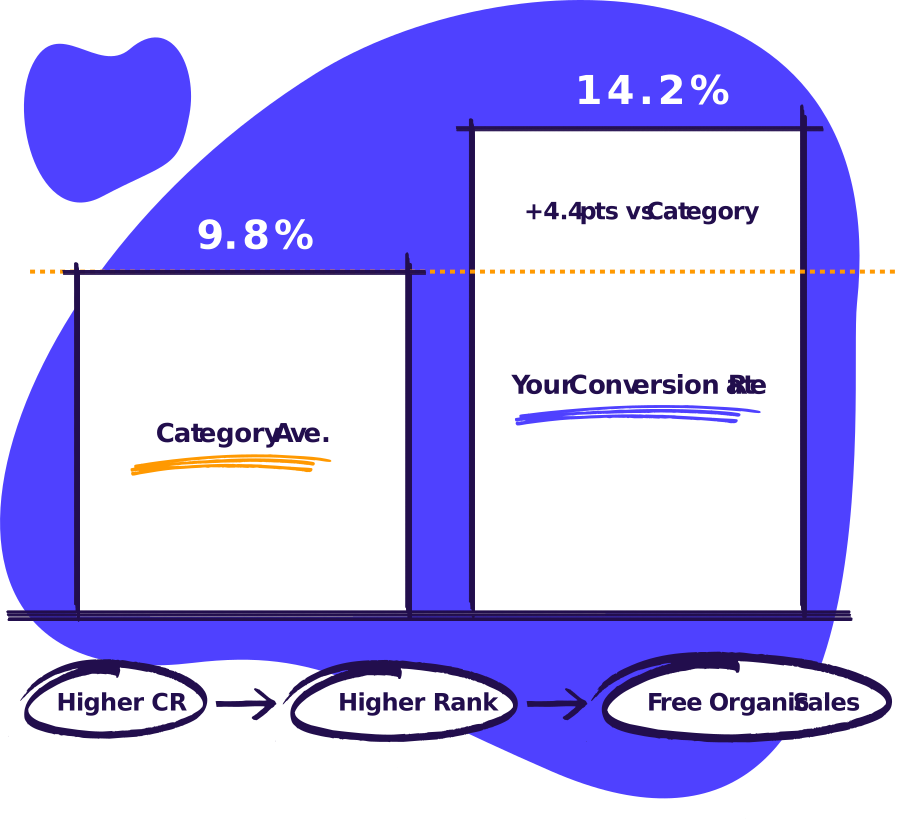
If you out convert the category, you’ll climb organic and sell more at a lower TACoS

Free PPC audit.

No call, no signup.

Cartoon laptop showing an audit score of 66/100

Nothing to sign in to. Your files stay in your browser.

Skip the sales call.

Get the audit.

Upload your ad reports. Get your audit in under 5 minutes.

The metric that decides your organic rank

If you out convert the category, you’ll climb organic and sell more at a lower TACoS

See how we can help you maximise revenue from your ad spend

Scroll to Top

Want to explore working with us?

Fill out the form below and our Head of Sales will reach out to you asap to coordinate an audit of your account. We’re looking forward to growing with you!

Name
What services are you interested in?