Key Takeaways
-
Since 6 November 2026, invited US customers can text Alexa for Shopping, Amazon’s AI shopping agent, to find, compare and buy products, and Amazon plans to add millions more customers in the coming weeks.
-
Trade press reports say Sponsored Products can appear among the options the agent texts back, free to advertisers for now, while purchases the agent completes on its own carry no ads.
-
Amazon’s announcement of the texting service does not mention ads, but Amazon Ads says existing sponsored ads campaigns are automatically eligible to serve in Alexa for Shopping, so US Sponsored Products advertisers may already be taking part.
-
No text-only bid, label, report or opt-out has been published, and Amazon said the metrics for an earlier Alexa ad placement would sit in existing reports.
-
Amazon ran Sponsored Products and Sponsored Brands prompts free in beta and then charged for them at existing cost-per-click bids, so plan for the possibility that the text placement follows the same path.
-
The best preparation is work that already pays: complete listings, healthy reviews and stock, a saved reporting baseline and written questions for Amazon, with no budget shift until the rules are published.
It means your existing US Sponsored Products ads may already be reaching shoppers in a new place: the text replies Amazon’s AI shopping agent sends to invited customers, reportedly at no cost to advertisers for now. In this article, Alexa shopping texts means the text-message channel that Amazon opened to invited US customers on 6 November 2026 for Alexa for Shopping, the assistant that replaced Rufus in May 2026. Amazon has confirmed the texting service and says existing sponsored ads campaigns are automatically eligible in Alexa for Shopping, but it has published no rules for ads in the text channel itself. Below is what is confirmed, what is only reported, how the placement compares with Amazon’s other conversational ads and what to do now.
Alexa shopping texts at a glance
| Question | Answer | Status |
|---|---|---|
| Launched | 6 November 2026, for invited customers; millions more due in the coming weeks | Confirmed by Amazon |
| Where | US only; no date for other countries | Confirmed by Amazon |
| How shoppers use it | A contact called Alexa Shopping in their messages app, with a personal Amazon account, a verified mobile number and RCS chats | Confirmed by Amazon |
| Ads in the replies | Sponsored Products can appear among the options the agent texts back | Reported |
| Cost to advertisers | Free for now, with no end date given | Reported |
| Purchases the agent makes on its own | No ads | Reported |
| Who is eligible | Existing sponsored ads campaigns are automatically eligible in Alexa for Shopping; the text channel is not named | Confirmed for Alexa for Shopping, not for texts |
| Label, bid, opt-out and reporting | None published for texts | Unknown |
What has Amazon launched for shopping by text?
Amazon now lets invited US customers text Alexa for Shopping, its AI shopping agent, from the messages app on their phone. Customers accept the terms, link a phone number and then message a contact called Alexa Shopping, which searches for products, compares them, builds carts, completes purchases, tracks prices and sends delivery updates.
Shoppers can describe what they need or send a photo, and the agent replies with options. Through Shop Direct, those options can include products from other online stores as well as Amazon’s own, and Amazon is rolling out the ability to carry a request between text, the Amazon Shopping app, the website and Alexa devices.
Access is narrow for now. Amazon’s FAQ for the service limits it to invited US customers with a personal Amazon account, a verified mobile number and RCS chats switched on, and Amazon says millions more customers will get the option in the coming weeks.
The audience behind it is large. Amazon says more than 400 million customers used Alexa for Shopping in the 12 months before the launch, although that figure covers the assistant across the app, website and devices, not the new text channel. Where do Sponsored Products appear in Alexa shopping texts?
According to trade press reports, a Sponsored Product can be one of the options the agent texts back while the customer is still choosing, and purchases the agent completes on its own carry no ads. The reports say Amazon is not charging advertisers for these placements yet, and none gives an end date for the free period.
Amazon’s own announcement of the texting service does not mention advertising. What Amazon has documented is the wider rule: its article on agentic shopping ads says existing sponsored ads campaigns are automatically eligible to serve in Alexa for Shopping, without additional campaign setup. The text channel is a new way into the same assistant, so if you run Sponsored Products in the US, assume your campaigns may already be eligible.
Several details are still unknown: how the sponsored option is labelled and laid out in a text, how bids and targeting decide which product is shown, and whether “free” covers clicks, impressions or both. Treat anything beyond the reported basics as unconfirmed until Amazon publishes it. Why does the ad-free purchase rule matter for brands?
Because it puts all of the advertising value at the moment a shopper chooses. If purchases the agent completes on its own stay ad-free, as reported, then a reorder or a price-target purchase goes to the product the customer already picked, and no competitor can pay to appear in it.
In our view that cuts both ways. Brands that customers already buy regularly are protected when the agent reorders for them, while challengers get one chance, the discovery reply, to reach the basket, which makes that first sponsored appearance worth more than a single click suggests.
The line between choosing and buying is not fully drawn yet. Amazon’s announcement describes the agent buying “with your approval” in one example and completing purchases “on your behalf” in others, and it does not explain how approval works in a text thread. Until Amazon defines which purchases count as the agent’s own, treat the ad-free rule as a reported principle that still needs Amazon’s definition.
How do Alexa shopping texts compare with Amazon’s other conversational ads?
They are the newest of Amazon’s conversational ad placements, and the only one below whose ad rules come from press reports rather than Amazon. Where Amazon has documented how campaigns get in, existing campaigns join automatically, which makes it likely the text placement works the same way.
| Format | Where it appears | How campaigns get in | Status in the US |
|---|---|---|---|
| Sponsored ads in Alexa for Shopping | Within conversations with the assistant | Existing sponsored ads campaigns are automatically eligible | Documented by Amazon |
| Sponsored Products and Sponsored Brands prompts | Questions in shopping results and on product pages that open a conversation with Alexa for Shopping | Campaigns enrolled automatically; any prompt can be paused | Charged at existing cost-per-click bids since 25 March 2026 |
| Branded Conversations | Sponsored Brands prompts extended into a longer conversation that draws on information the brand provides | Builds on Sponsored Brands prompts | Due in January 2027; marked Sponsored |
| Sponsored Products on Alexa+ | Shopping conversations with Alexa+ on Echo Show devices | Active Sponsored Products campaigns may be eligible, with no extra requirements | Documented by Amazon since August 2025 |
| Sponsored Products in Alexa shopping texts | Among the options the agent texts back | Not published for texts | Reported; free for now |
The prompts history is the best guide to what may come next. Amazon launched Sponsored Products and Sponsored Brands prompts as a free open beta in November 2025, enrolled campaigns automatically and began charging for them at existing cost-per-click bids when they reached general availability in the US on 25 March 2026. If the text placement follows the same path, the free period would end with charges under bids you have already set, so decide now how you will spot and judge that traffic.
What can advertisers control and measure today?
Very little that is specific to texts: Amazon has published no text-only bid, report row, label specification or opt-out, so control runs through the campaigns you already have. Your bids, budgets, targeting and negative keywords still shape which products can serve, but nobody outside Amazon knows exactly how they apply to a conversation.
Negative keywords are a good example. They match against search terms, and Amazon has not said whether a text request is matched as the shopper typed it, as a rewritten shopping query or in some other form, so keep your existing negatives in place and ask before relying on them for text traffic.
Measurement is the bigger gap. When Amazon added Sponsored Products to Alexa+ conversations on Echo Show, it said performance metrics would be consolidated within existing reporting dashboards, and nothing published so far suggests text replies will get their own line. If text delivery is counted at all during the free period, it would most likely sit inside your normal Sponsored Products figures.
Prompts show what good reporting looks like: Amazon gives them their own view with the prompt text, the ad and its impressions, clicks and orders, and you can pause any prompt in the console. Text replies have nothing equivalent yet.
So save a baseline now. Export the four weeks of Sponsored Products data before 6 November, including impressions, clicks, spend, orders, sales and conversion rate, keep a log of price, stock and campaign changes, and do not call any change incremental without a proper test. Our guide to reading an Amazon advertising report covers the metrics worth keeping.
What should advertisers do now?

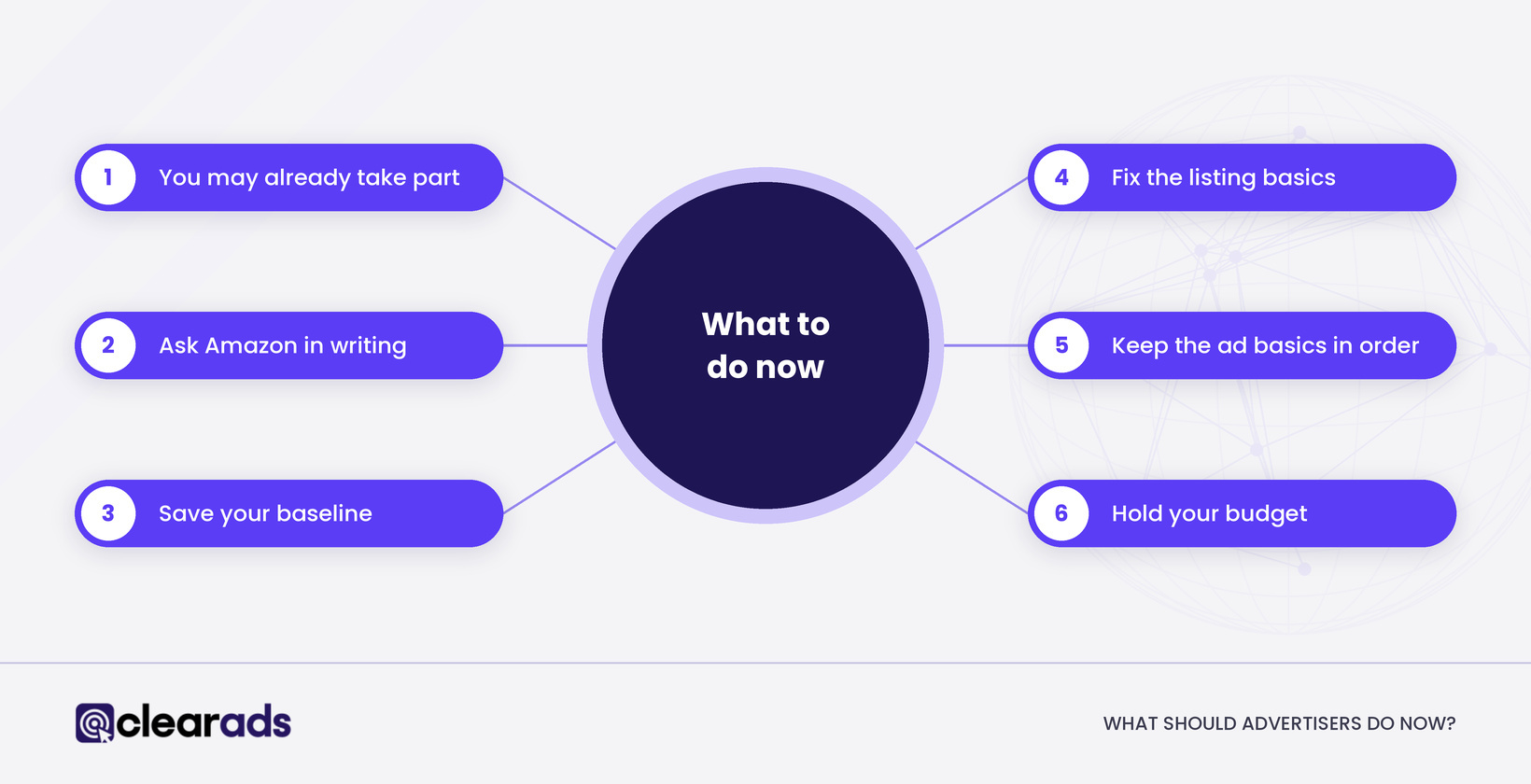
Treat the text placement as something to prepare for rather than buy: confirm what applies to your account, tidy the basics the agent relies on and keep budgets where your results say they should be. For US accounts, work through these steps:
-
Assume you may already be taking part. If you run Sponsored Products in the US, your campaigns may be eligible without any setup, so tell your team and clients before anyone sees changes they cannot explain.
-
Ask Amazon in writing. Find out which campaigns, products and marketplaces are eligible, how the sponsored option is labelled, how bids and negative keywords apply, whether you can exclude text replies, when charging starts and on what basis, and how delivery will show in reports.
-
Save your baseline. Export pre-launch data now, annotate 6 November in your reports and note the date Amazon starts charging, if it does.
-
Fix the listing basics. The agent compares products on details such as ratings and prices, so make titles, bullets, attributes and images accurate and complete, and deal with recurring review complaints.
-
Keep the ad basics in order. Sponsored Products only display for products that are in stock and eligible for the Featured Offer, so stock and offer problems are likely to keep you out of text replies as well as search results.
-
Hold your budget. Do not raise budgets, sell text placements to clients or promise insights from shopper conversations until Amazon publishes how the placement works, what it costs and how it is measured.

Frequently asked questions
Which ad types can appear in Alexa shopping texts?
Sponsored Products, according to the most detailed report so far. Amazon says existing sponsored ads campaigns in general are eligible in Alexa for Shopping, but nothing confirms Sponsored Brands in the text replies. Sponsored Brands has its own conversational format, Branded Conversations, due in the US in January 2027.
How are sponsored suggestions labelled in Alexa shopping texts?
Amazon has not published the format. Its other conversational ads are labelled: Branded Conversations, for example, will be marked Sponsored within Alexa for Shopping. Until you have seen a real example or an Amazon specification, avoid telling clients exactly how their ads look in a text.
Should you raise bids to appear in Alexa shopping texts?
No. Amazon has not published how bids affect which product appears in a text reply, and the placement is reportedly free for now, so a higher bid would mainly raise what you pay in placements you already buy. Judge bids on the results of your existing campaigns.
Can advertisers outside the US appear in Alexa shopping texts?
No, not yet. The texting service is limited to invited US customers and Amazon has given no date for other countries, so only campaigns on Amazon.com could be involved. Brands outside the US that sell on Amazon.com should ask about those campaigns; brands that sell only elsewhere have nothing to change yet.
Is Alexa for Shopping the same as Rufus?
No, it replaced Rufus. On 13 May 2026, Amazon combined Rufus’s product knowledge with the personal context of Alexa+ in one assistant across the Amazon Shopping app, the website and Echo Show devices in the US. Our guide to optimising listings for Rufus AI covers listing work for Amazon’s assistant, much of which carries over.
What does this article not cover?
This article covers ads in the text channel of Alexa for Shopping. Related topics live elsewhere:
-
Amazon ad types and best practices: how Sponsored Products and Sponsored Brands work;
-
Amazon’s Buy for Me AI: how Amazon’s agent buys from other brands’ websites;
-
How AI shopping agents will change Amazon: the wider shift to agentic commerce.
What should you do next?
This week, put the questions in the checklist above to your Amazon contact and export your pre-launch baseline, so you can read the placement clearly when Amazon publishes its rules or starts charging. If your account is outside the US, put the time into listing quality instead.
Clear Ads is an Amazon Ads Advanced Partner that manages Amazon PPC, Amazon DSP and full-service accounts for brands worldwide. If you want a second opinion on how Amazon’s conversational ads affect your Sponsored Products campaigns, request a call back from the Clear Ads team.