What is Amazon changing about display impressions in 2027?
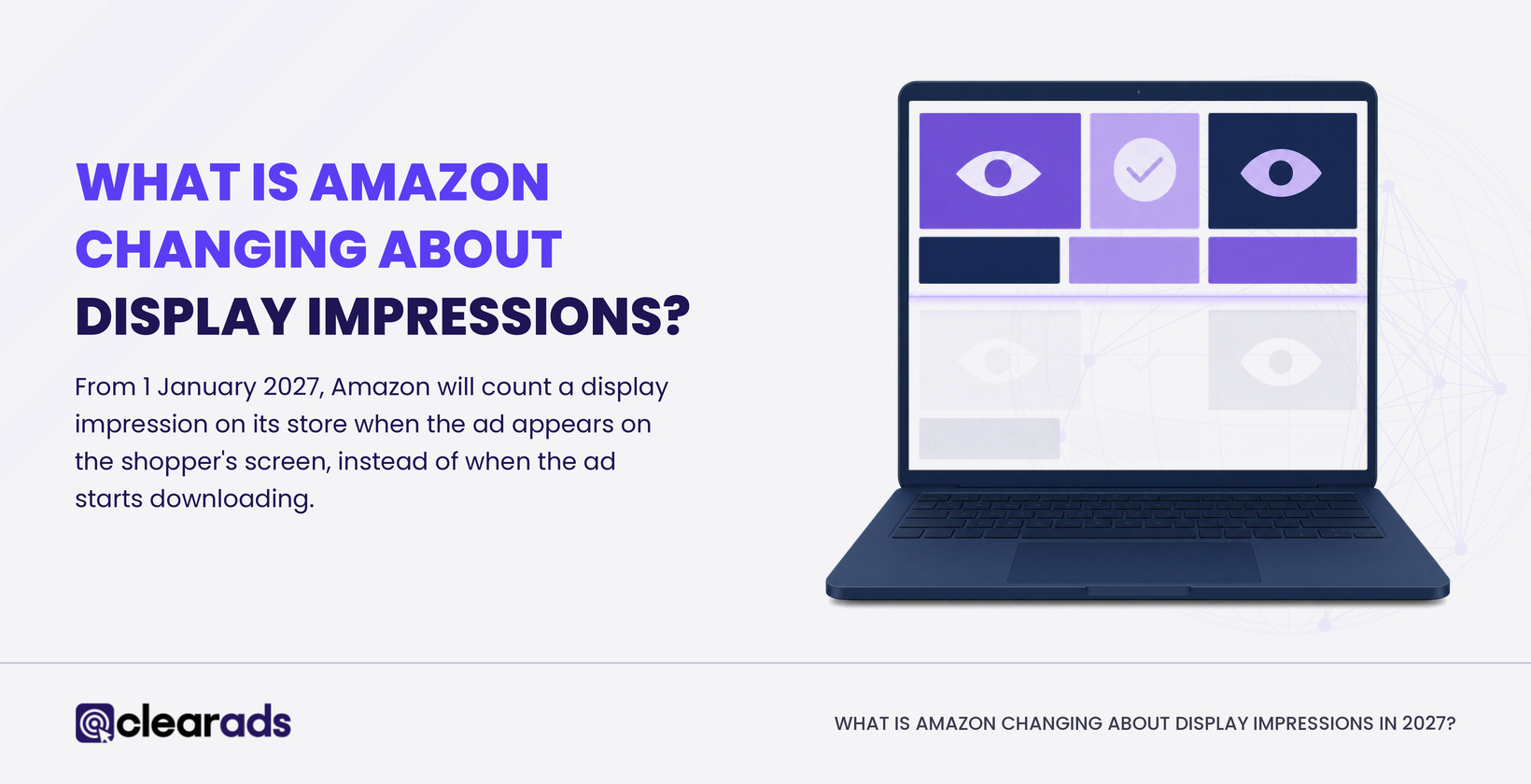
From 1 January 2027, Amazon will count a display impression on its store when the ad appears on the shopper’s screen, instead of when the ad starts downloading to the shopper’s device, according to its notice to advertisers. The notice calls the current method count-on-download: an impression registers as soon as the ad begins to load, even if the shopper never scrolls far enough to see it.
The notice names four placement types on the Amazon store: the home page, product detail pages, search results pages and order pages. It covers DVA display ads and does not mention video, audio, ads on third-party sites and apps, Sponsored Products or Sponsored Brands.
One overlap needs checking. Amazon now says Sponsored Display is known as display ads and lists existing Sponsored Display campaigns under Display, Video and Audio campaigns, but the notice does not say whether those campaigns are included. If you run them, ask your Amazon account manager before January.
The notice gives no list of countries and no time zone for the switch. Advertisers in the UK and 20 other countries still see the Amazon DSP console rather than DVA, so confirm which of your marketplaces and campaign types the change covers.
Why does Amazon expect 63% fewer impressions?
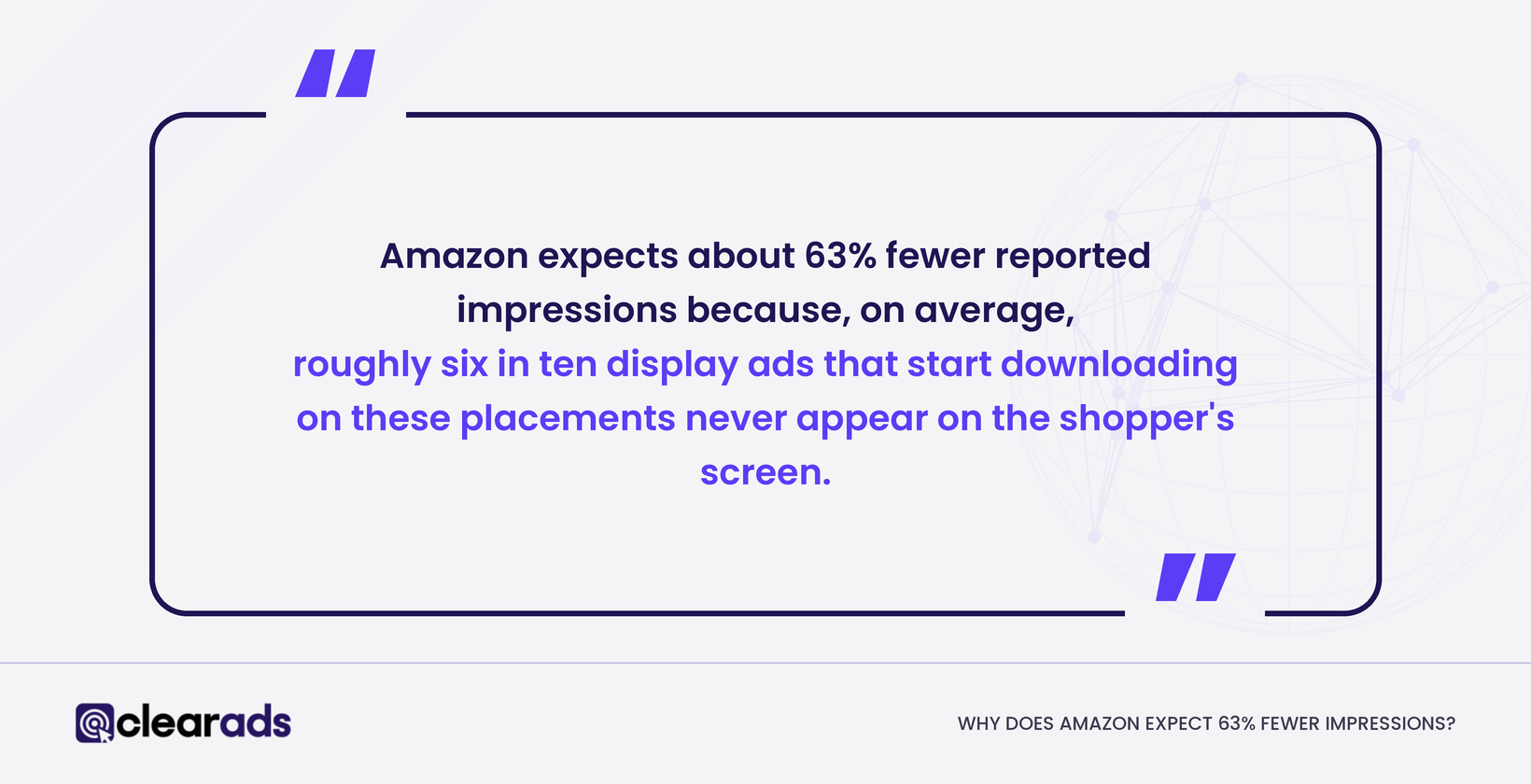
Amazon expects about 63% fewer reported impressions because, on average, roughly six in ten display ads that start downloading on these placements never appear on the shopper’s screen. The notice says placements lower on the page will see larger drops, which fits the mechanism: the further down an ad sits, the fewer shoppers scroll to it.
The 63% is an average across the affected placements, not a forecast for your account. According to the notice, the impact varies by campaign and placement, and it gives no sample, period, markets or weighting behind the figure.
A smaller count is not a smaller audience. An ad that loads below the fold and never reaches the screen had no opportunity to be seen, so dropping it from the count removes nothing a shopper saw. Reported reach can still fall if Amazon recalculates it on the new count, because shoppers whose only impressions never reached the screen would drop out of it.
The figure does not mean:
63% less spend: the notice describes reports, not invoices;
63% fewer shoppers reached: the people who saw your ads on screen still saw them;
63% fake or invalid impressions: the ads were delivered to the device but were not on screen when counted, and Amazon filters invalid traffic separately;
63% fewer conversions: attribution and impression counting are separate rules, and Amazon has based view-through conversions on viewable impressions, not every served one, since 2019.
What happens to CPM, click-through rate and other metrics?
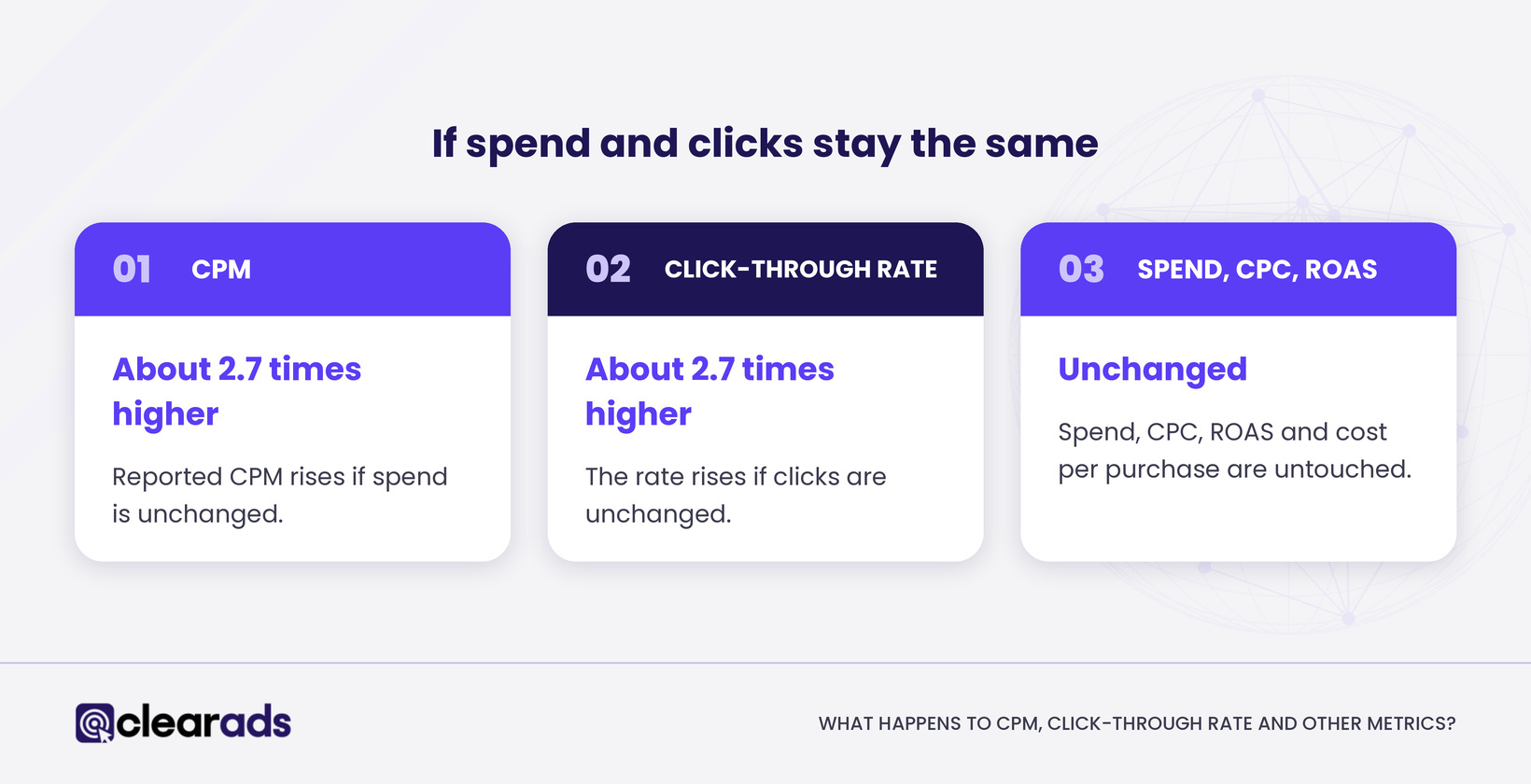
Metrics divided by impressions rise and metrics that do not use impressions stay where they were: if spend, clicks and purchases are unchanged, 63% fewer impressions makes reported CPM, click-through rate and Amazon DSP’s purchase rate about 2.7 times higher, while spend, CPC, ROAS and cost per purchase are untouched by the counting change itself.
| Metric | Effect if spend, clicks and purchases are unchanged | Watch out for |
|---|---|---|
| Impressions | About 63% lower, if the campaign matches the average | The drop varies by placement |
| CPM and eCPM | About 2.7 times higher | Spend has not risen |
| Click-through rate | About 2.7 times higher | Creative has not improved |
| Purchase rate (Amazon DSP) | About 2.7 times higher, because Amazon DSP divides purchases by impressions | Use purchases per click when you mean conversion rate |
| CPC | No change | Spend and clicks are its only inputs |
| ROAS and cost per purchase | No change from the count itself | Any movement has another cause |
| vCPM | No change, if viewable impressions stay the same | Viewable and total impressions are separate counts |
| Viewable rate | Depends on measurable impressions, its denominator | Any viewability share of total impressions rises by arithmetic |
| Average frequency | Lower, if reach stays the same | Frequency is impressions divided by reach |
| Reach | Cannot be worked out from the 63% | Depends on who loses their only impression |
In an illustrative US example, a campaign spends $10,000 on 2,000,000 impressions and gets 1,000 clicks: a $5.00 CPM and a 0.05% click-through rate. Count 37% of those impressions and the same delivery shows 740,000 impressions, a $13.51 CPM and a 0.135% click-through rate, with identical spend, clicks and sales.
Campaigns that mix store display with other inventory will see a smaller drop. If 40% of a campaign’s impressions come from the affected store placements and those fall by 63%, total impressions fall by about 25% (63% of 40%), and CPM rises by about a third.
Google made a similar move in 2018, when AdSense switched from counting served impressions to downloaded ones. It told publishers to expect fewer impressions and higher impression-based ratios such as RPM and click-through rate, and said earnings should not be affected. A counting change moves the ratios; money moves only if something else changes.
What should advertisers do before and after 1 January 2027?
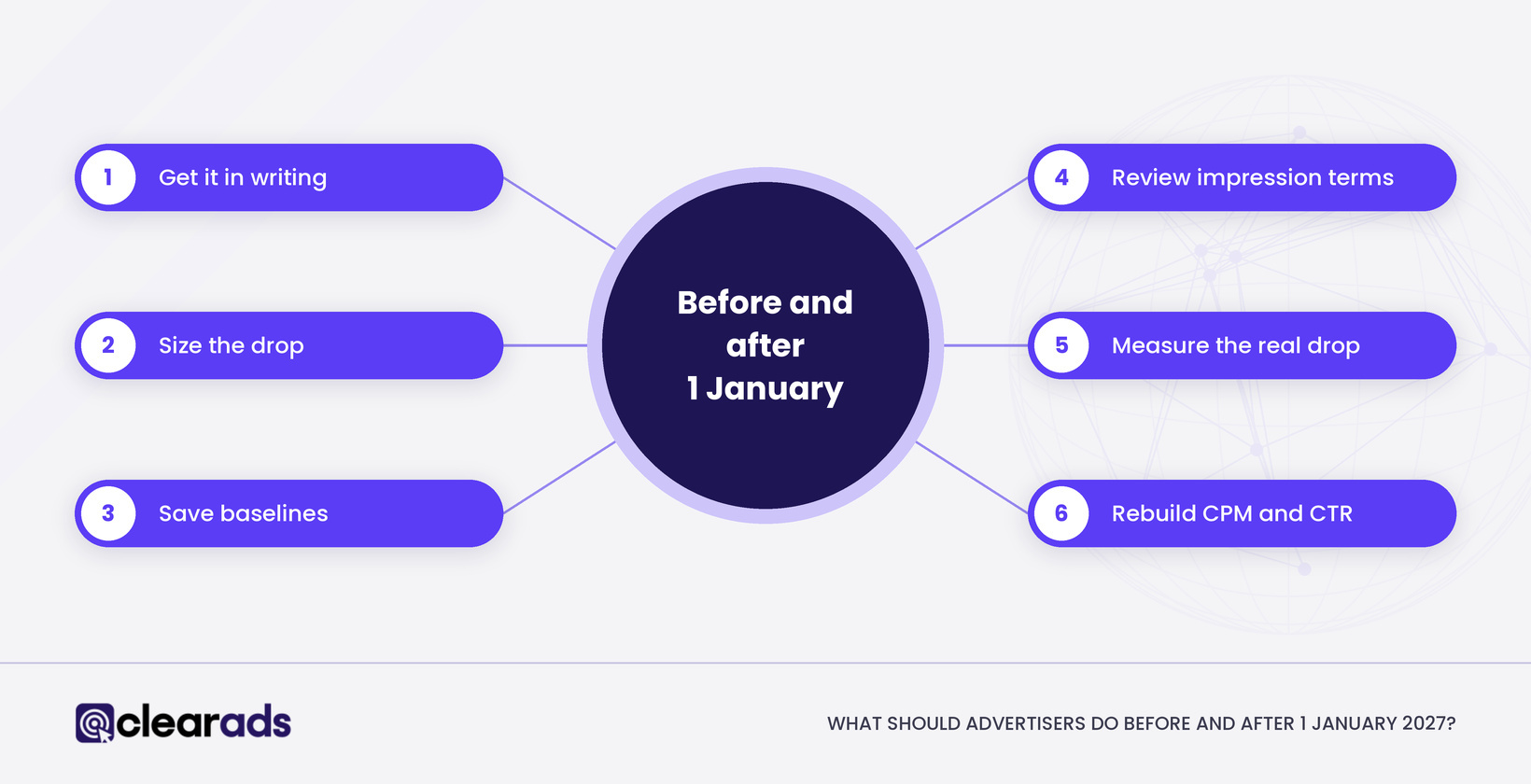
Before January, confirm the details in writing, save baselines and fix anything tied to impression counts; after January, measure the real drop by placement before you reset any benchmark, and explain the change before anyone panics about it.
What should you do before 1 January 2027?
Get it in writing. Ask Amazon to confirm which accounts, marketplaces, placements and campaign types are covered, and how billing, fees and frequency caps will work.
Size the drop. Compare default, begin-to-render and viewable impressions in the industry standard report to estimate your own range.
Save baselines. Export December 2026 data with impressions, viewable impressions, clicks, spend and conversions, with the metric definitions and attribution settings beside them. Amazon plans to retire the legacy Sponsored ads and Amazon DSP report pages by 31 December 2026, so rebuild scheduled reports in unified reporting before then.
Mark the date. Annotate dashboards and client reports at 1 January 2027, switch off year-on-year impression alerts and check automated rules that react to swings in impressions, CPM or click-through rate.
Review impression-based terms. Check impression targets, CPM ceilings, click-through goals, impression guarantees and every fee charged per thousand impressions.
Budget on spend. Plan 2027 on spend and outcomes, not on a 63% saving or a 2.7 times price rise.
What should you do after 1 January 2027?
Measure the real drop by placement, device and campaign against your December baseline.
Read impressions next to spend, clicks, viewable impressions and conversions, so a counting change is not mistaken for a delivery problem.
Check that frequency caps and automated rules behave as they did before, and that invoices match the count Amazon said it would bill on.
Recalculate CPM and click-through rate from totals rather than averaging campaign-level rates, and label any restated history as an estimate.
Rebuild CPM and click-through benchmarks from at least four weeks of post-change data, and allow for post-holiday seasonality when you compare.
Year-on-year charts need the most care. January 2027 against January 2026 crosses the new count, and against January 2025 it crosses the view-through attribution change of 1 January 2026 as well, which our post on the brand that paused $48K a month of DSP covers. For those charts, swap impression-based lines for viewable impressions and outcomes, or carry a note on the chart itself.
Why should you report viewable impressions after January?
Because viewable impressions should be the one impression count the change leaves alone. An ad that met the viewability standard was on screen, so it counted under the old method and still counts under the new one, which makes viewable impressions, and the cost per thousand viewable impressions (vCPM) you can work out from them, the steadiest line to carry across 1 January.
This is our reading of the two definitions, and it holds only if Amazon keeps measuring viewability the same way. One trade report says viewable impressions stay as they are, but the notice as reproduced does not mention them, so confirm it with Amazon before you rebuild a dashboard around viewable counts.
The viewability standard for display ads asks for at least half of the ad’s pixels in view for one continuous second, which the industry treats as an opportunity to see. Amazon’s notice does not say how much of an ad must appear on screen, or for how long, to count under the new method, so expect your new impression count to sit above your viewable count and below the old one. Our guide to performance measurement and analytics in Amazon DSP covers the wider set of DSP metrics and reports.
From January, we would report Amazon DSP delivery in four layers:
Viewable impressions and vCPM: for delivery and cost comparisons across the switch, with vCPM worked out as spend divided by viewable impressions, times 1,000;
Impressions: for pacing and frequency only, labelled with the counting method in force;
Viewable rate: with care, because Amazon’s viewability guide defines it as viewable impressions divided by measured impressions, and the measured count may change with the new method;
Outcomes: spend, sales, ROAS and cost per purchase for every judgement about performance.
How should you explain the change to clients or your board?
Separate what the dashboard counts from what shoppers saw and what you paid, and answer the six questions people ask first:
| Question | Short answer |
|---|---|
| Have we lost 63% of our audience? | No. Ads that loaded but never reached the screen stop counting; we will track reach and delivery separately. |
| Why has CPM jumped? | The same spend divided by fewer counted impressions. We will check whether invoices or cost per purchase changed too. |
| Why has click-through rate improved? | Fewer counted impressions with the same clicks. It is not evidence that the creative got better. |
| Will ROAS improve automatically? | No. ROAS uses sales and spend, not impressions, so it moves only if those move. |
| Were the old reports wrong? | No. Download, on-screen and viewable are different counting points, and the old figure measured downloads. |
| Should we cut the budget? | Not because of the count. We judge budget on spend, sales, cost per purchase and incremental results. |
Send the answers before the first January report goes out: a drop explained in advance reads as a reporting change, while the same drop explained afterwards can sound like an excuse.
Add one line to every January report so the change is explained where people see it. For example: “From 1 January 2027, Amazon counts store display impressions only when the ad appears on screen, so lower impressions and higher CPM and click-through rates reflect the new count rather than a change in the campaign.”