Key Takeaways
- Margin-per-click bidding sets the most you can pay for a click from two numbers: the conversion rate and the contribution each order leaves before advertising.
- An ACoS target built from a product’s own margin gives the same bid, so the real weakness is one blanket ACoS target applied across products with different margins.
- The widely shared case study linking margin-based bids to 29.9% more net profit changed listings, packaging, fees, stock planning and targeting at the same time, so it cannot show what the bidding method did on its own.
- Margin-based bids mislead when costs are stale, clicks are too few to trust, or the campaign’s job is a launch, a ranking push or winning repeat customers.
- The safest approach sets bid ceilings from contribution and judges results on total contribution and TACoS rather than on ACoS or profit per click alone.
Margin-per-click bidding is better than an ACoS target only when that target is one blanket figure that ignores each product’s margin; against an ACoS target set from the same margin, it produces the same bid. In this article, margin means contribution before advertising: the selling price minus product cost, Amazon fees, fulfilment, expected returns and seller-funded promotions, which is a different number from accounting net profit. The question matters now because a widely shared case study links margin-based bids to a 29.9% rise in net profit, which raises a fair question about dropping ACoS targets. Below are the maths, the case study, the failure points and a way to test a switch, using Sponsored Products examples in US dollars.
Margin-per-click bidding at a glance
| Fact | Detail |
|---|---|
| What it is | Setting bids from the contribution an average click earns: conversion rate (orders ÷ clicks) × contribution per order before advertising. |
| Break-even CPC | Conversion rate × contribution per order. Paying more than this on average loses money on the first order. |
| Target CPC | Conversion rate × average order value × target ACoS. |
| Target ACoS | Margin before advertising minus the margin you want to keep after advertising. |
| Link to ACoS | Break-even ACoS equals the margin before advertising, so a margin-based ACoS target and a margin-per-click bid agree. |
| Real contrast | Blanket ACoS targets against targets set from each product’s own margin. |
| Best fit | Mature products with reliable costs, enough conversion data and different margins across the catalogue. |
| Weak fit | Launches, ranking pushes, keywords with few clicks, stale costs, repeat-purchase products and ad formats that credit sales to ad views. |
| The viral case study | Reported net profit of $911,873 in 2023 and $1,184,541 in 2024 (USD), up 29.9%, alongside many other changes. Not independently verified. |
What is margin-per-click bidding?
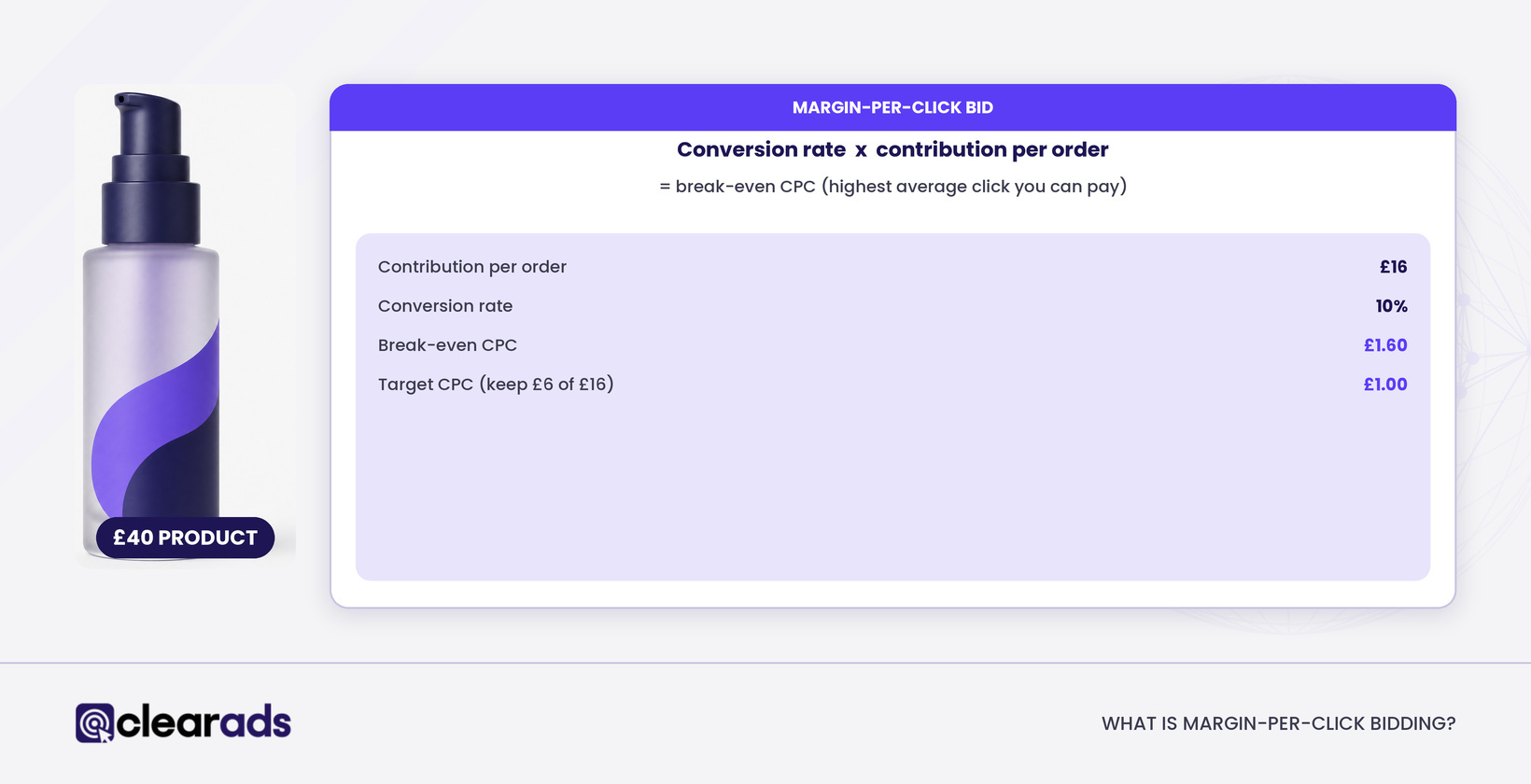
Margin-per-click bidding sets each keyword’s bid from the contribution an average click is expected to earn: the conversion rate multiplied by the contribution each order leaves before advertising. The result is the break-even CPC, the highest average cost per click you can pay before the ad loses money on the first order. Our guide to Amazon PPC budgeting and bidding strategies calls the same figure the maximum bid.
Three inputs drive it:
- Contribution per order: the selling price minus landed product cost, referral and fulfilment fees, expected return losses and any seller-funded promotion.
- Conversion rate: orders divided by clicks for the keyword or product.
- Actual CPC: the average price you pay per click, which can differ from the bid you entered.
Profit per click is contribution per click minus actual CPC. Keep the units consistent: if conversion rate counts orders, contribution must be per order, including multi-unit orders and any other products that sell from the ad.
In an illustrative US example, a $40 product leaves $16 of contribution per order before advertising, and 10% of clicks convert. An average click is worth $1.60 of contribution, so $1.60 is the break-even CPC. To keep $6 of every $16 after advertising, you can spend $10 per order, which at a 10% conversion rate is a target CPC of $1.00.
How is it different from an ACoS target?
Margin-per-click bidding differs only from an ACoS target that ignores margin, because an ACoS target set from a product’s own margin produces exactly the same bid. ACoS is ad spend divided by the sales Amazon credits to your ads (ad-attributed sales), and Amazon’s own ACoS guide ties it to margin directly: ACoS has to stay below your profit margin if you want to keep a profit.
That makes break-even ACoS equal to your margin before advertising, and target ACoS equal to that margin minus the margin you want to keep. The full definitions sit in our ACoS and TACoS guide.
Run the earlier example through ACoS and you reach the same bid. The margin before advertising is 40% ($16 of $40) and keeping $6 per order is a 15% margin after advertising, so the target ACoS is 25%. A 25% target ACoS on a $40 order at a 10% conversion rate gives a target CPC of $1.00, the same figure the margin-per-click route produced.
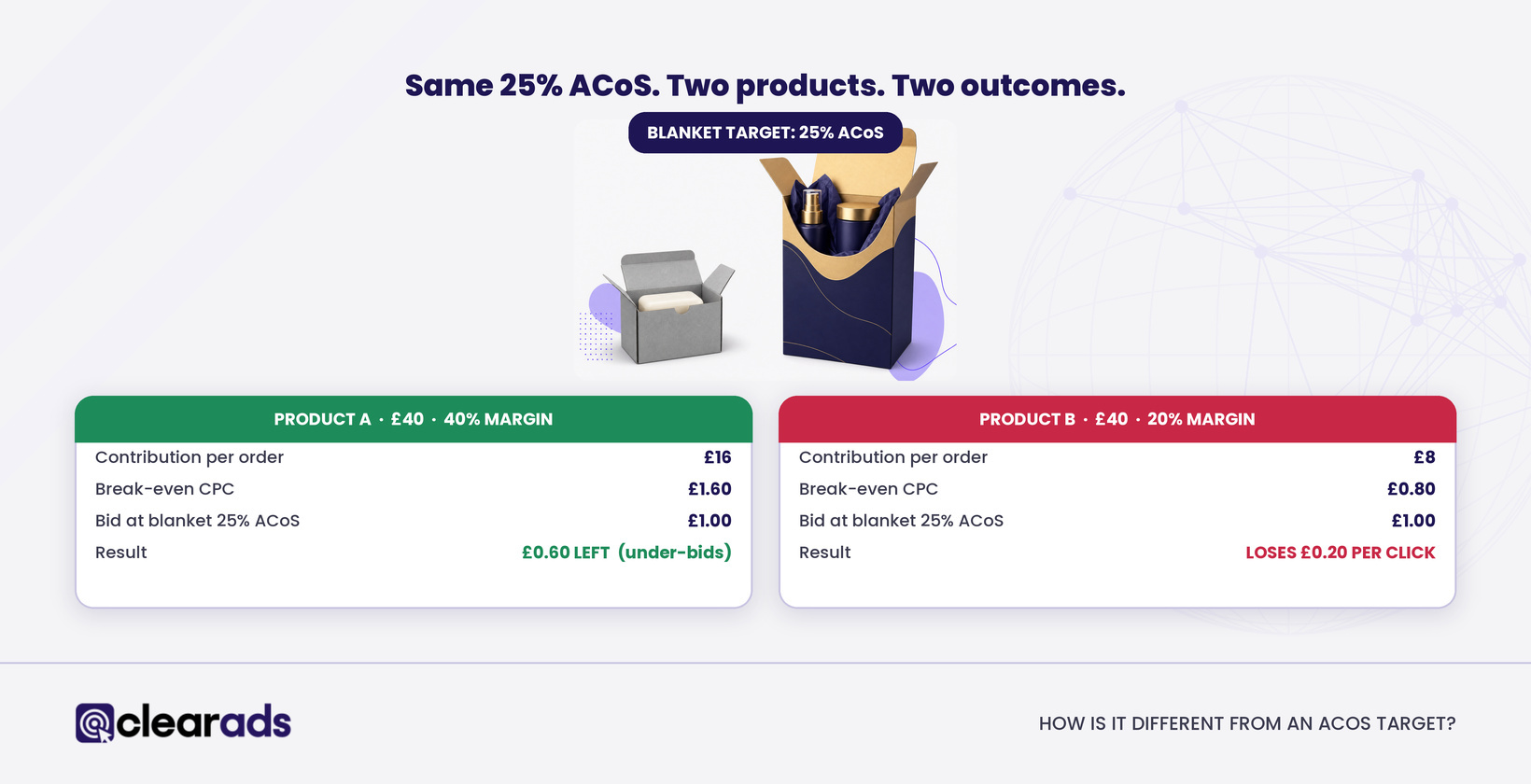
The two approaches part company when one ACoS target covers products with different margins. In this illustrative US example, both products sell for $40 and convert 10% of clicks:
| Measure | Product A | Product B |
|---|---|---|
| Contribution per order before advertising | $16 | $8 |
| Margin before advertising (break-even ACoS) | 40% | 20% |
| Break-even CPC | $1.60 | $0.80 |
| Target CPC at a blanket 25% ACoS | $1.00 | $1.00 |
| Result per click at a $1.00 CPC | $0.60 left | $0.20 lost |
A blanket 25% target gives both products a $1.00 target CPC. Product B loses 20 cents on every click at that price, while Product A could afford up to $1.60 and may be missing clicks that would still make money. Give each product an ACoS target from its own margin and the problem goes away, whatever the method is called.
The useful contrast is between blanket targets and margin-informed targets. What separates one implementation from another is the data behind it: how often costs are refreshed, how conversion rates are estimated for keywords with few clicks and how a target becomes the bid Amazon applies.
What does the 29.9% profit case study show?
The case study shows a business that grew its profit while changing many things at once, so it cannot show how much of the gain came from margin-based bids. It comes from the founder of an Amazon PPC software company and describes an eight-figure beauty manufacturer that moved its Amazon advertising away from an agency and set bids from contribution per click and product-level margin.
The reported figures, in US dollars, are:
- net profit of $911,873.13 in 2023 and $1,184,541.48 in 2024, a rise of 29.9%;
- ACoS that swung between about 16% and 37% in late 2023, ran mostly between 20% and 24% in 2024 and sat between about 17% and 20% in 2025;
- advertising ROAS of about 5 in 2025.
Read as evidence for the bidding method, it has five problems:
- Many other things changed. The same account lists new listing images, value-per-ounce messaging, pack-size tests, product page rewrites aimed at return reasons, packaging changes to cut fulfilment fees, purchase orders timed around campaigns, fee audits and a rebuilt campaign structure.
- The timing is not a clean before and after. Moving away from the agency began in late 2023, and full strategic control passed to the new team in August 2024, so 2024 mixes the old and new approaches and the strongest ACoS figures come from 2025.
- Net profit is not defined. The account groups returns, refunds and reserve losses in one adjustments line, so it is unclear what the headline figure deducts.
- Two of the numbers are one number. ACoS of about 19% and ROAS of about 5 are reciprocals (1 ÷ 0.19 is about 5.3), so they do not corroborate each other.
- Nobody independent has checked it. Verification is offered only under NDA, and the author’s company sells PPC bidding software.
The criticism behind the story is fair. An account that runs one ACoS target across every product does ignore margin, and setting bids from each product’s economics is sound practice. The 29.9% simply cannot be credited to the bidding change alone.
Where does margin-per-click bidding go wrong?
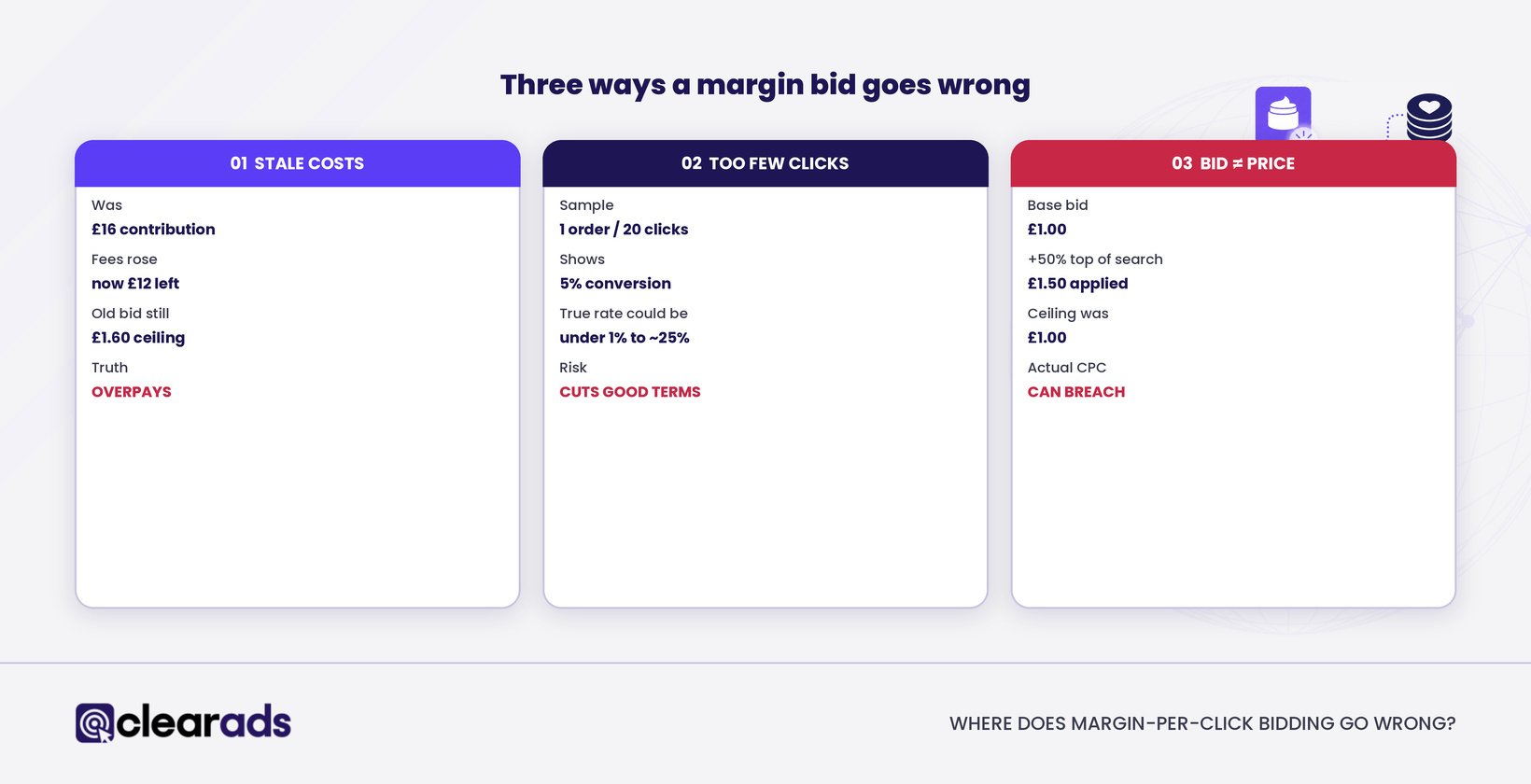
Margin-per-click bidding goes wrong when the inputs are wrong, when there is too little data to trust them, or when the bid it produces is treated as the price you will pay. Six failure points matter most:
- Stale costs. A bid ceiling is only as good as the contribution behind it. Supplier prices, Amazon fees, packaging, promotions and return rates change, so keep dated costs for each product and marketplace, recalculate when any of them moves and reconcile against your P&L at least monthly.
- Too few clicks. A keyword with one order from 20 clicks shows a 5% conversion rate, but the true rate could plausibly be anything from under 1% to almost 25%. Measurement is hard even at scale: across 25 large advertising experiments with major US retailers and brokerages, researchers found the median confidence interval on return on investment was more than 100 percentage points wide. Pool data across similar keywords or the whole product before acting, and do not cut a relevant keyword on a handful of clicks.
- Treating the bid as the price. The break-even CPC caps the average price you pay per click, and the bid Amazon applies can sit well above the one you typed. Placement adjustments can raise a bid by up to 900%, and dynamic bidding can move it again, so a $1.00 base bid with a 50% top-of-search adjustment is already a $1.50 bid on that placement. Check actual CPC by placement against the ceiling.
- Judging clicks too early. Purchases can be credited to an ad for days after the click: Sponsored Products reports credit purchases made within 7 days of an ad click for sellers and within 14 days for vendors. The latest days in any report are incomplete, so judge performance on completed date ranges.
- Ignoring sales outside the ad report. Ad-attributed figures miss organic lift, when ads improve a product’s ranking, and can credit ads with purchases that would have happened anyway, a particular risk on branded terms. Watch TACoS and total sales alongside them.
- Cash and stock. Contribution on paper turns into cash later: returns come back after the sale and stock can run out mid-campaign. Cap spend by cash and inventory as well as by margin.
When should you bid above break-even?
Bid above break-even only when the campaign has a job that first-order profit does not measure, such as a launch, a ranking push or winning customers who buy again, and give that spend a limit and a review date.
Profit per click and total profit are different targets. In the earlier example, a $1.00 CPC on 1,000 clicks leaves $0.60 per click, or $600 in total. If raising the bid to $1.20 brings 1,600 clicks at the same conversion rate, each click leaves $0.40 but the total rises to $640, even though ACoS climbs from 25% to 30%.
Whether that trade is worth making depends on stock, cash and what else the money could do. A system that only protects profit per click would never make it.
Launches and ranking pushes follow the same logic. Using ads to build organic ranking needs more investment up front and can show a higher ACoS at first, so it suits brands with the budget and cash flow to carry it, with bids reduced gradually as organic placement improves.
Repeat purchases raise the ceiling too. First-order contribution undervalues a customer who comes back, so for replenishable products add the contribution, not the revenue, you have measured from repeat orders, and avoid counting the same customer twice across campaigns.
Amazon’s new-to-brand metrics can help, within two limits. They cover Sponsored Brands and Sponsored Display rather than Sponsored Products, and they count an order as new to brand when the shopper has not bought from your brand in the previous 12 months, which is different from a first-ever customer.
Keep TACoS, total ad spend divided by total sales, as the guardrail across all of this. It shows whether the business is becoming more dependent on paid traffic, a risk our post on the Amazon ad metric killing your margin explains for established brands.
Which approach fits which situation?
Use margin-based bid ceilings where costs and conversion data are reliable, simple margin-informed ACoS targets where products are few and margins similar, and a separate budget where the campaign’s job is growth rather than first-order profit. Treat the table as a starting point to adapt, built from the trade-offs above:
| Situation | Start with | Guardrails |
|---|---|---|
| Mature products, reliable costs, plenty of conversions | Margin-based bid ceilings, or ACoS targets set from each product’s margin | Total contribution, TACoS, actual CPC by placement |
| Catalogue with very different margins | Targets by product or by margin band | Refreshed costs; which products actually sell from each ad |
| A few products with similar margins | One margin-informed ACoS or ROAS target | A margin check every quarter |
| Missing or unreliable costs | Provisional ACoS limits and cautious budgets while costs are fixed | Treat profit figures as estimates |
| Launch or ranking push | A separate budget with an ACoS ceiling and conversion and rank milestones | Spend cap and review date |
| Repeat-purchase product with cohort data | A bid allowance that adds measured repeat contribution | Payback limit; no double counting |
| Keywords with few clicks | Pooled conversion rates and cautious rules | No big moves on small samples |
| Branded terms or strong organic rank | Margin or ACoS limits plus TACoS checks | Brand and non-brand reported separately; incrementality tests where possible |
| Short of cash or stock | Margin-based bids capped by cash and stock | Cash forecast and days of stock cover |
What should you ask a tool or agency that promises profit-based bidding?
Ask what profit means in their system, where the cost data comes from and how they will show that the bidding change, rather than everything else, moved the result. The answers separate a reporting overlay from a bidding method:
- Is profit-based bidding a reporting layer, margin-adjusted ACoS targets, a target margin after advertising, or a model that predicts total contribution?
- Which costs are included, such as landed product cost, referral and fulfilment fees, returns and promotions, and how often are they refreshed?
- When an ad sells a different product from the one advertised, whose margin counts?
- How are keywords with few clicks handled?
- Do bids allow for placement adjustments and dynamic bidding, so actual CPC stays under the ceiling?
- Will results be judged on total contribution and TACoS over comparable periods, or on ACoS?
- Can you see and change the inputs?
How do you test a switch to margin-based bids?
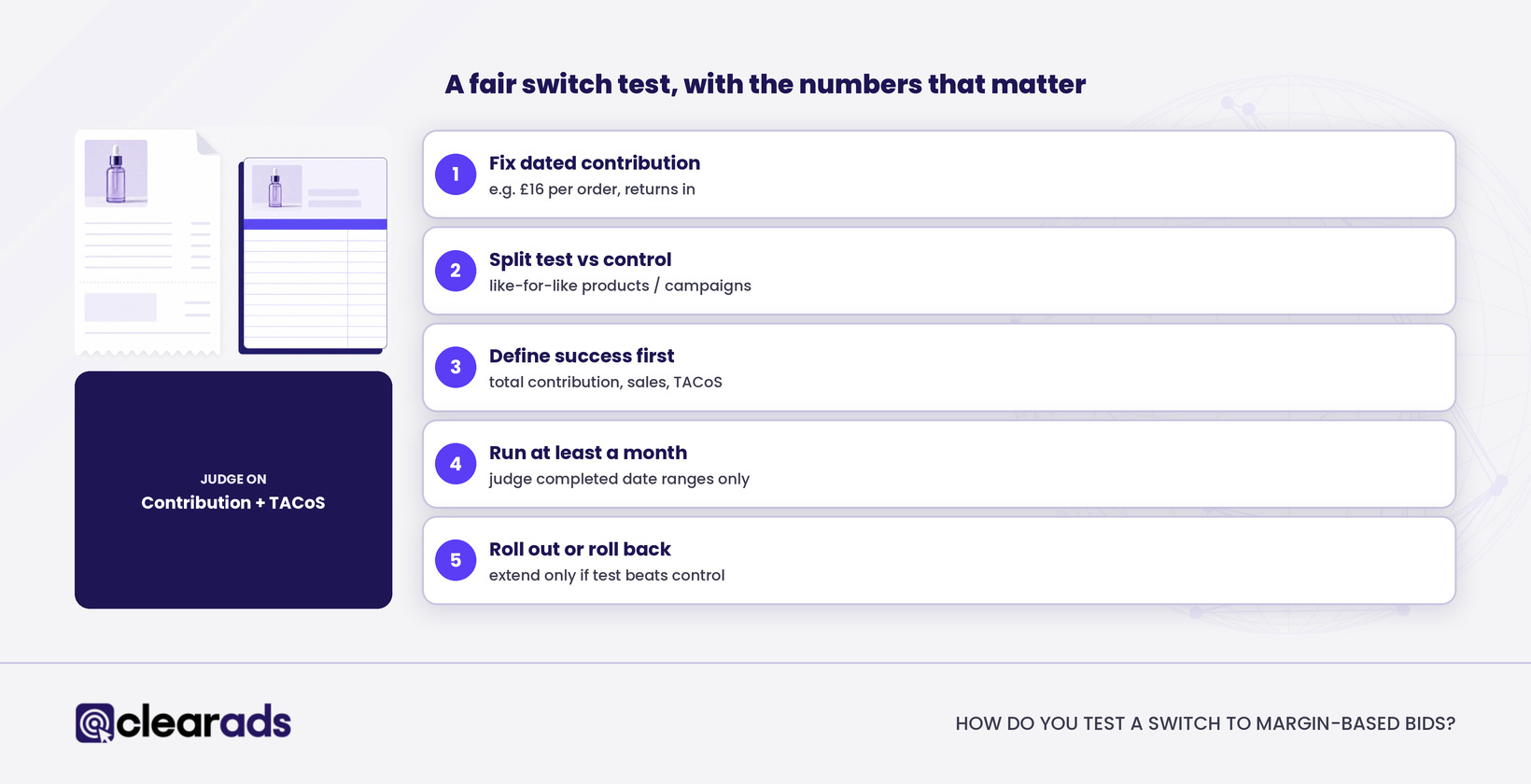
Test a switch by running margin-based bids on part of the account, keeping comparable products on your current targets, and comparing total contribution once sales and returns have had time to arrive.
- Fix the inputs. Calculate dated contribution per order for each product and marketplace, with returns and promotions included.
- Split comparable groups. Put similar products or campaigns into a test group on margin-based bids and a control group on current targets, and keep prices, listings and budgets as stable as you can.
- Define success first. Use total contribution after advertising, total sales and TACoS as the measures, with ACoS as a diagnostic only.
- Run it long enough. Allow at least a month, judge it on completed date ranges and check return costs before you call a winner.
- Roll out or roll back. Extend the method only if the test group beat the control on contribution without an unacceptable loss of sales or rank.
Frequently asked questions
Is ROAS better than ACoS for profit-based bidding?
No. Amazon defines ROAS as ad revenue divided by ad spend, the inverse of ACoS, so a 25% ACoS is a ROAS of 4 and switching between them adds no profit information. Either metric becomes profit-aware only when its target comes from the product’s margin.
Does Amazon offer profit-based bidding?
No. Rule-based bidding for Sponsored Products adjusts bids towards a ROAS goal you set, Amazon says it does not guarantee hitting that goal, and none of Amazon’s bidding options takes your product costs. You can convert a margin-based ACoS target into a ROAS goal, but the cost model stays in your own spreadsheet or tool.
Should branded keywords use the same margin-based bid?
No, not automatically. Branded clicks often convert well, so the formula allows a high bid, but some of those shoppers would have bought anyway. Set branded bids from what you need to defend against competitors, and judge them on TACoS and total branded sales rather than spending up to the break-even ceiling.
Should contribution per order include overheads?
No. Contribution per order should include only costs that rise with each sale, such as product cost, Amazon fees, fulfilment, returns and promotions. Fixed overheads such as salaries, software and rent are paid from total contribution, so cover them through the margin you choose to keep after advertising rather than loading them into every bid.
How does margin-per-click bidding apply to Sponsored Brands, Sponsored Display and Amazon DSP?
It applies most directly to Sponsored Products, where you pay per click and sales are credited to clicks. Since 1 January 2026, Amazon has credited views of vCPM-billed Sponsored Brands and Sponsored Display campaigns, and of DSP ads in its store, through a shopping-signal enhanced last-touch model with a shorter window. Judge those formats on their own measures.
What does this article not cover?
This article compares two ways of setting bid targets. For the metrics and formulas themselves, see:
- ACoS and TACoS in Amazon PPC for how ACoS, TACoS and ROAS are calculated;
- Amazon PPC budgeting and bidding strategies for the maximum and optimal bid formulas, budgets and placement modifiers;
- The Amazon ad metric killing your margin for why ACoS can mask problems for established brands.
What is the next step?
Start with contribution per order for your best-selling products. Once those numbers are right, either a margin-informed ACoS target or a margin-per-click bid will point you to sensible bids, and a split test will tell you which one runs your account better.
Clear Ads is an Amazon Ads Advanced Partner that manages Amazon PPC, Amazon DSP and full-service accounts for brands worldwide. To have your targets reviewed, get a free Amazon advertising audit.