Amazon Business Ads: When Should You Build Separate B2B Campaigns?

Key Takeaways

  • Amazon Business ads reach shoppers signed in with a verified business account, on a store Amazon says reached $60 billion in annualised gross sales in 2025 across 11 countries.
  • Sponsored Products campaigns can already serve on Amazon Business, and their reports blend business and consumer results unless you open the Amazon Business placement data.
  • The Amazon Business bid adjustment raises Sponsored Products bids by up to 900% on Amazon Business placements, inside a campaign that keeps one shared budget and keyword list.
  • Amazon Business-exclusive campaigns show only to business buyers and give them their own budget, keywords and bids, and Amazon reports 120% higher Amazon Business sales from them in a closed beta.
  • The common advice to split campaigns once B2B passes 3% of sales is an agency rule of thumb, so judge each product on its B2B share, placement results against a B2B break-even, and fit.

Amazon Business ads are Amazon Ads campaigns that reach people buying for a company through Amazon Business, Amazon's store for verified business buyers. In this article, "B2B" means sales to those business buyers, and "consumer" means sales on the regular Amazon store. Many sellers already reach business buyers without managing them, because Sponsored Products campaigns can serve on Amazon Business and report the results blended with consumer sales. Below are the key facts, how to measure your B2B share, the two ways to bid for business buyers, and how to decide when B2B deserves campaigns of its own.

Amazon Business ads at a glance

FactDetail
What Amazon Business isAmazon's store for shoppers buying with a verified business account
Scale$60 billion in annualised gross sales in 2025; 484 of the Fortune 500 buy from it (Amazon figures)
Countries11: US, Canada, Mexico, UK, Germany, France, Italy, Spain, Japan, India and Australia
Ways to advertiseSponsored Products bid adjustment; Sponsored Products and Sponsored Brands exclusive campaigns; display ads with B2B audiences; Amazon DSP
Bid adjustmentUp to 900% on Amazon Business placements only, inside an existing Sponsored Products campaign; available since late 2024
Exclusive campaignsShow only on Amazon Business, with their own budget, products, keywords and bids; eligible advertisers only
CostCost per click (CPC) or per 1,000 viewable impressions (vCPM), as on the regular Amazon store
Amazon threshold for splitting campaignsNone published; the 3% rule comes from agencies, not Amazon

What are Amazon Business ads?

Amazon Business ads are ads shown to shoppers signed in with a verified business account on Amazon Business. They appear in the same places as regular Amazon ads, such as shopping results and product detail pages, plus placements specific to Amazon Business.

Amazon Business is a sizeable channel in its own right. Amazon says it reached $60 billion in annualised gross sales in 2025, and that 484 of the Fortune 500 companies buy from it. It runs in 11 countries: the US, Canada, Mexico, the UK, Germany, France, Italy, Spain, Japan, India and Australia.

Four ad options reach these buyers:

  • Sponsored Products, through the Amazon Business bid adjustment or an Amazon Business-exclusive campaign
  • Sponsored Brands, through an Amazon Business-exclusive campaign
  • display ads targeted with Amazon's B2B audiences
  • Amazon DSP, which reports Amazon Business performance by placement

Eligible products already appear on Amazon Business, so a seller running Sponsored Products can already be paying for business clicks. The real decision is whether to manage that traffic on purpose.

How do you find your Amazon Business share of sales?
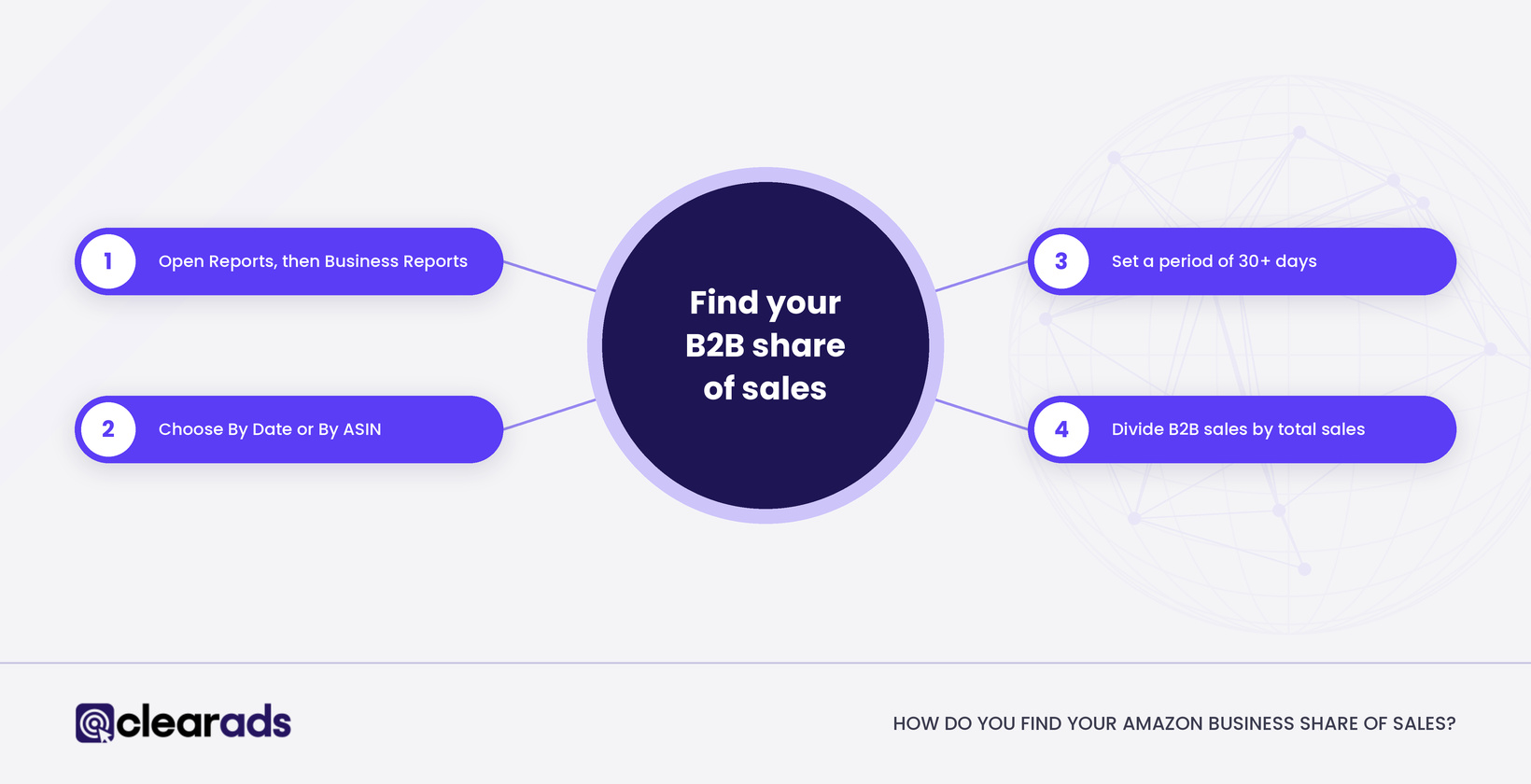
Four steps to find your Amazon Business share of sales in Seller Central Business Reports

Your Amazon Business share of sales is your B2B ordered product sales divided by your total ordered product sales, both taken from the Business Reports in Seller Central. Amazon points sellers to Reports, then Business Reports, then the By Date or By ASIN views.

  • In Seller Central, open Reports, then Business Reports.
  • Choose a By Date report for the whole account, or a By ASIN report to see which products sell to businesses.
  • Set a period of at least 30 days, so a single large business order does not distort the result.
  • Divide the "Ordered Product Sales – B2B" column by the "Ordered Product Sales" column.

The total column already includes B2B sales, so divide by the total rather than adding the two together. A seller with $200,000 of ordered product sales in a month, $9,000 of it from business buyers, has a B2B share of 4.5%. These are illustrative US figures.

Run the same sum by ASIN as well. One product, such as a case pack or a refill, can sell heavily to businesses while the account total stays low, and campaign decisions are made product by product.

What does the Amazon Business bid adjustment do?
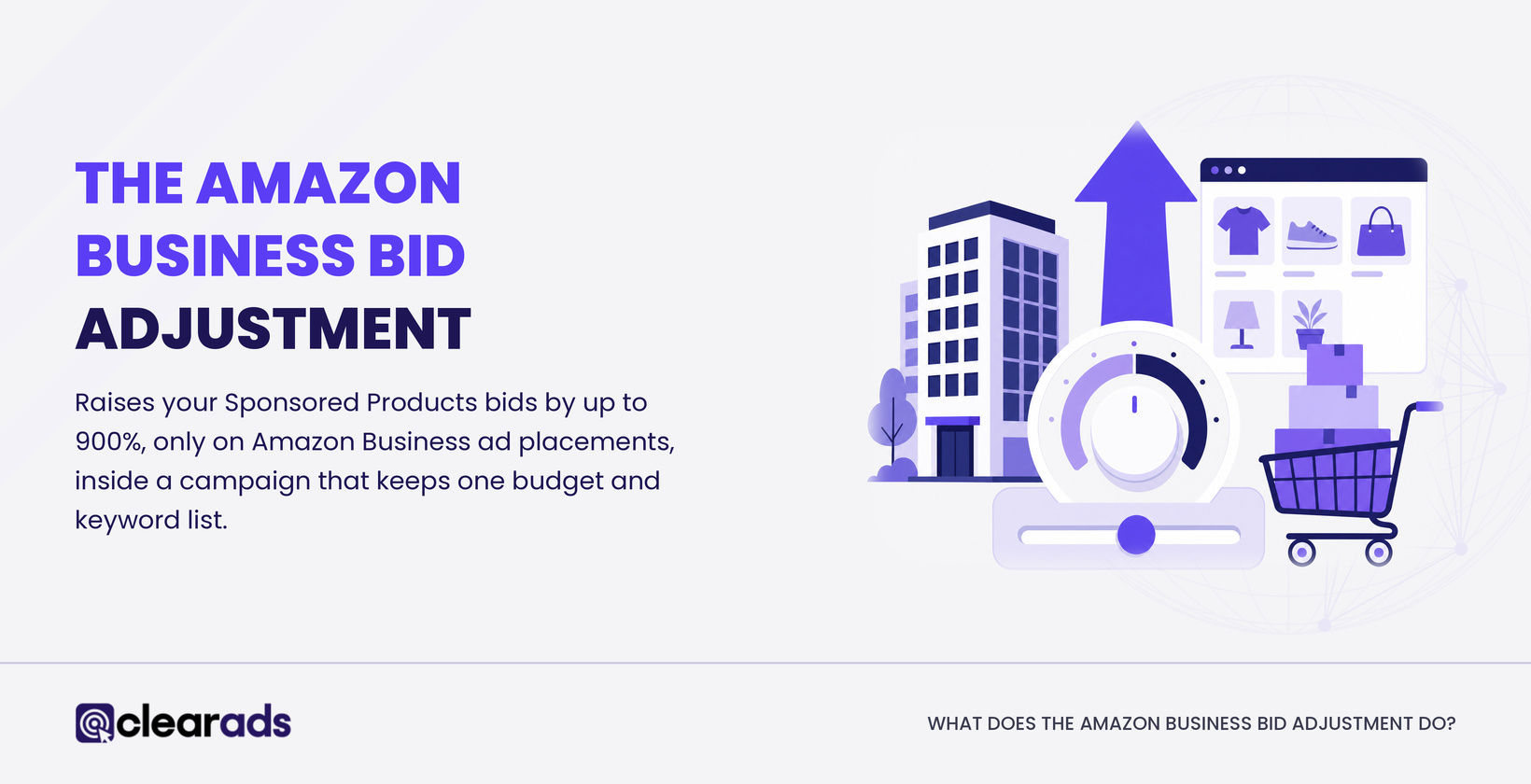
The Amazon Business bid adjustment raises Sponsored Products bids by up to 900% on Amazon Business placements

The Amazon Business bid adjustment raises your Sponsored Products bids by up to 900%, only on Amazon Business ad placements. It sits inside an existing campaign, so that campaign keeps one budget, one keyword list and one set of products for consumers and businesses alike.

Amazon introduced the adjustment in late 2024. It works in new and existing campaigns, on its own or alongside the other placement adjustments such as top of search. A 30% adjustment on a $1.00 keyword bid lets the campaign bid up to $1.30 when the ad competes for an Amazon Business placement.

Amazon says advertisers see 2x to 3x higher return on ad spend on Amazon Business than their overall campaign performance. That makes the adjustment a low-effort first step for products where business buyers already convert.

The limit is the shared campaign. Consumer and business searches draw on the same daily budget, and any keyword you add for business buyers runs for consumers too. Amazon recommends the adjustment for products that appeal to both consumer and business buyers.

What are Amazon Business-exclusive campaigns?

Amazon Business-exclusive campaigns are Sponsored Products or Sponsored Brands campaigns that show only to business buyers on the Amazon Business store, never on the regular Amazon store or off Amazon. Every setting in an exclusive campaign applies only to Amazon Business: budget, products, keywords, bids and bidding strategy.

For Sponsored Products, you create one by choosing Amazon Business in the Sites card while setting up the campaign. In the Amazon Ads API, the same choice is the siteRestrictions setting with the value AMAZON_BUSINESS. Amazon first announced exclusive Sponsored Products campaigns in May 2025, and its Amazon Business ads page now lists Sponsored Brands as well. Exclusive campaigns are open to eligible advertisers in all 11 Amazon Business countries.

Amazon reports that advertisers who created exclusive Sponsored Products campaigns saw Amazon Business sales rise 120% compared with their existing campaigns for the same products. The figure comes from a closed beta of managed accounts in the US, five European marketplaces and Japan, from September to December 2024.

A practical way to build your first exclusive campaign is to start from what already works. Take your best Sponsored Products campaigns for the products with the highest B2B share, keep the keywords that convert in the Amazon Business placement data, and add the terms business buyers use, such as bulk, wholesale, case pack and commercial. If your account has the option, the Copy campaign window in Amazon Ads includes a tick box labelled "Copy as an Amazon Business Sponsored Products campaign", which turns an existing campaign into an exclusive one with the same keywords, match types, bids and structure in one step. Once the campaign runs, its search term report shows only business searches, which makes it the cleanest source of new B2B keywords.

Amazon has published a US case study in which Boxed Water, a packaged water brand, separated its business and consumer campaigns, raised bids during weekday business hours and cut spend at weekends. Its ACoS fell from 14.22% to 5.8% year on year, and B2B sales grew 34% year to date. The brand changed its bidding method at the same time, so the result shows what a split can support rather than what it causes alone.

Should you use the bid adjustment or an exclusive campaign?
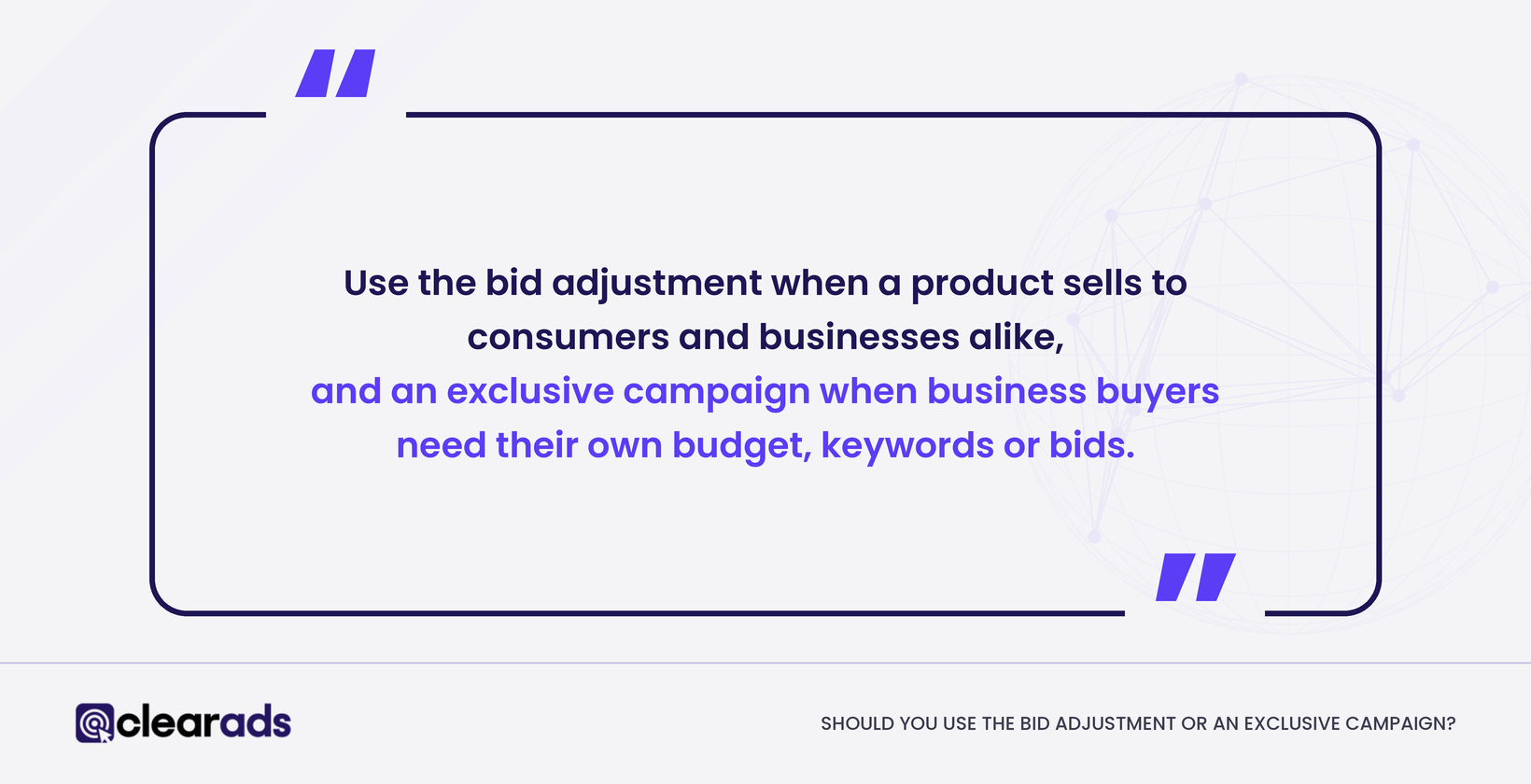
Use the bid adjustment for mixed buyers and an exclusive campaign when business buyers need their own budget

Use the bid adjustment when a product sells to consumers and businesses alike, and an exclusive campaign when business buyers need their own budget, keywords or bids. Amazon draws the line in the same place: the adjustment for products that appeal to both audiences, and exclusive campaigns for products built for B2B needs.

FeatureBid adjustmentExclusive campaign
Where ads showRegular Amazon and Amazon Business; the adjustment applies to Amazon Business placements onlyAmazon Business only
BudgetShared with consumer trafficIts own B2B budget
Keywords and productsThe same as the consumer campaignChosen for business buyers
BidsBase bid plus up to 900% on Amazon Business placementsSet for Amazon Business alone, with its own bidding strategy
Ad typesSponsored ProductsSponsored Products and Sponsored Brands
ReportingAmazon Business Placements tab under the campaign's bid adjustmentsStandard campaign reports, showing Amazon Business metrics only
Best forProducts bought by consumers and businessesProducts built for business buyers

The two tools work together. Keep the adjustment on campaigns where business sales are a small extra, and build exclusive campaigns for the few products where business buyers are a real share of sales. When a product gets an exclusive campaign, review the adjustment on its original campaign, so two of your own campaigns are not bidding for the same business buyer at different prices.

Is the 3% B2B rule a good trigger for separate campaigns?
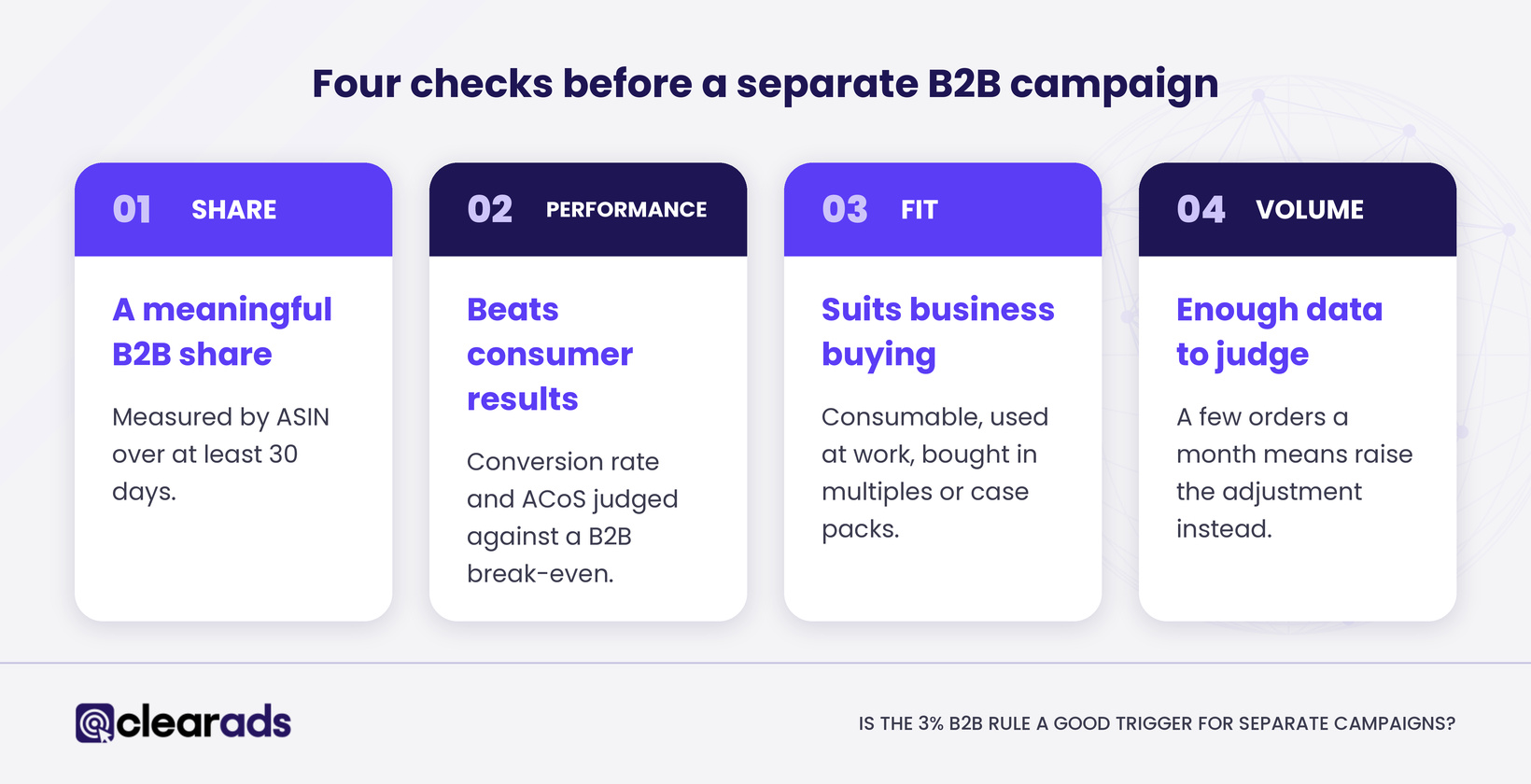
Four checks before a separate Amazon Business campaign: share, performance, fit and volume

The 3% rule is a useful prompt, but it is a rule of thumb shared by Amazon agencies, not an Amazon threshold. It says that once Amazon Business passes 3% of your sales, a raised placement bid is not enough and the account needs dedicated B2B campaigns. Amazon has published no threshold, and its own advice is to begin with your best-performing products, test, and scale what works.

A single account-level percentage misses too much, so we recommend four checks before giving any product its own B2B campaign:

  • Share. B2B is a meaningful part of that product's sales, measured by ASIN over at least 30 days. An account-level share above 3% is a sensible reason to look closer.
  • Performance. The Amazon Business placement data shows a conversion rate and ACoS for the product that beat its consumer results, judged against a B2B break-even.
  • Fit. The product suits business buying: it is consumable, used at work, bought in multiples or available in case packs.
  • Volume. The Amazon Business placements get enough clicks and orders to judge. A few orders a month is a reason to raise the adjustment, not to build a new campaign.

A product that passes all four is ready for an exclusive campaign. A product that passes only the performance check should get a higher bid adjustment, raised in steps of 10% to 30% and reviewed after two to four weeks. A product that passes none can keep the adjustment at zero, with a monthly look at its Amazon Business placement data.

How do you read Amazon Business results in your ad reports?

Sponsored Products reports blend Amazon.com and Amazon Business results by default, so you need the Amazon Business placement data to see B2B performance on its own. In a campaign that uses the bid adjustment, open the campaign, select Bid adjustments and choose the Amazon Business Placements report tab.

Amazon makes the Amazon Business data available to every Sponsored Products advertiser, whether or not they use the adjustment. It shows results by placement, such as Amazon Business Top of Search, and only goes back to 5 September 2024. Exclusive campaigns need no extra step, because their standard reports show only Amazon Business metrics.

Read B2B ACoS against a B2B break-even, not your usual target. Business orders carry more units, which can make ACoS look better, while a Business Price or quantity discount cuts the margin on every unit. Break-even ACoS is your profit before ad spend divided by the selling price, as the guide to calculating ACoS and TACoS explains.

Take a product that sells for $40 with $12 of profit before ad spend, a break-even ACoS of 30%. With a Business Price of $36 and the same costs, profit before ad spend falls to $8, so break-even ACoS falls to 22%. An Amazon Business placement at 25% ACoS looks better than a consumer placement at 28%, yet it loses $1 on every unit while the consumer sale still makes a small profit. These are illustrative US figures.

What should you set up before scaling Amazon Business ads?

Set up business pricing before you scale, because business buyers compare price per unit and expect lower prices on larger orders. Amazon lets sellers set a Business Price in the Business Price column of Manage Inventory, add discounts for business buyers and create offers that only business customers see.

We recommend five steps before a B2B budget grows:

  • Set a Business Price on every ASIN you plan to advertise, with the B2B break-even in mind.
  • Add two or three quantity discount tiers on products that sell in multiples.
  • List case packs or multi-packs where business buyers order in volume.
  • Check stock depth, because business orders carry more units and can empty a slow-moving ASIN.
  • Test weekday scheduling, raising bids in working hours when most business buying happens, as the Boxed Water campaigns did.

In September 2026, Amazon announced Business Deals at its Accelerate seller event: time-limited deals that only business buyers see, priced against your Business Price. Press reports say they need a product rating of at least 3.5 stars and a discount of at least 10%, so check the current terms in Seller Central before planning around them.

Frequently asked questions

Can you advertise on Amazon Business if you do not sell on Amazon?

Yes. Amazon says anyone can buy Amazon Business ads, whether they sell on Amazon or not. Brands without products on Amazon reach business buyers through display ads and Amazon DSP, because Sponsored Products and Sponsored Brands promote products sold on Amazon.

Why can't you see the Amazon Business option when creating a campaign?

Exclusive campaigns are open only to eligible advertisers, and Amazon has not published the criteria. If the Sites card shows no Amazon Business choice, Amazon asks you to contact your Amazon Ads or Amazon Business account manager about enrolment.

How are Amazon Business ads priced?

Amazon Business ads use the same pricing as other Amazon ads: cost per click (CPC) or cost per 1,000 viewable impressions (vCPM). Your final price depends on your adjusted bid and other auction factors, so a bid adjustment raises the most you can pay on Amazon Business placements.

Can vendors run Amazon Business ads?

Yes. Amazon lists sellers, vendors, partners, agencies and authors as advertisers who can use Amazon Business-exclusive campaigns. Amazon's instructions for checking B2B share of sales use Seller Central Business Reports, and it has not published a Vendor Central equivalent.

Can you target business buyers with display ads?

Yes. Amazon offers more than 60 B2B audiences for display campaigns, depending on the country, built on industry, company size or spending behaviour. Keeping one audience per campaign makes it clear which segment drives the results.

What does this article not cover?

This article covers advertising to Amazon Business buyers. Three related topics live on other pages:

What is the next step?

Start with the Business Report. If one product's B2B share is meaningful and its Amazon Business placements convert above a B2B break-even, that product is ready for a test.

Clear Ads is an Amazon Ads Advanced Partner that manages Amazon PPC, Amazon DSP and full-service accounts for brands worldwide. If you want help reading your B2B data or setting up Amazon Business campaigns, request a call back from the Clear Ads team.

YOUR PATH TO A HIGHER ROI STARTS HERE!

Talk to the Clear Ads team about your Amazon Business ads and B2B campaigns.

George Meressa

Founder & CEO, Clear Ads Limited

George Meressa is Founder and CEO of Clear Ads, the Amazon PPC, DSP and full-service agency he started in 2011. He has worked in digital advertising since 2009 and has helped over 1,000 advertisers grow sales and organic rank on Amazon. He writes and speaks internationally on Amazon advertising, organic rank and retail media.

The metric that decides your organic rank

If you out convert the category, you’ll climb organic and sell more at a lower TACoS

Free PPC audit.

No call, no signup.

Cartoon laptop showing an audit score of 66/100

Nothing to sign in to. Your files stay in your browser.

Skip the sales call.

Get the audit.

Upload your ad reports. Get your audit in under 5 minutes.

The metric that decides your organic rank

If you out convert the category, you’ll climb organic and sell more at a lower TACoS

See how we can help you maximise revenue from your ad spend

Scroll to Top

Want to explore working with us?

Fill out the form below and our Head of Sales will reach out to you asap to coordinate an audit of your account. We’re looking forward to growing with you!

Name
What services are you interested in?