What Do Amazon’s 2027 US Fee Changes Mean for Your Margins and Ad Targets?

Key Takeaways

  • Amazon says US FBA fulfilment fees rise by $0.19 per unit on average from 15 January 2027, about 0.8% of the average item’s selling price, with storage and low-inventory changes following on 1 February.

  • The average masks a wide spread: small standard-size products priced $10 to $50 rise $0.40 on average and those over $50 rise $0.70, while non-apparel large standard-size products under $10 do not change.

  • The 3.5% fuel and logistics surcharge stays, so every change in the base fee costs 3.5% more than the rate card shows.

  • From 1 February, storage becomes one age-based rate that costs the same for stock under 181 days but more for stock aged 181 to 330 days.

  • On an illustrative $29.99 product, the 2027 fee takes about $0.45 a unit off contribution and about 1.5 percentage points off break-even ACoS, so ACoS targets and bid ceilings need resetting product by product.

  • Before 15 January, rebuild contribution per product, reset ad targets, check prices near the $10 and $50 lines and plan any stock that will pass 181 days in the first quarter.

They mean thinner margins on most standard-size products from 15 January 2027, and a reset of the ACoS targets and bid ceilings you built on last year’s fees. Amazon announced its 2027 US referral and FBA fee changes on 5 November 2026: fulfilment fees rise by $0.19 per unit on average, storage and the low-inventory-level fee change on 1 February, and several smaller fees move in between. This article covers Amazon’s US store and the changes that move an advertiser’s unit economics, rather than every line of the rate card.

What has Amazon announced for 2027 US fees?

Amazon has announced a mix of increases, cuts and structural changes, led by a $0.19 average rise in FBA fulfilment fees from 15 January 2027, which it puts at about 0.8% of the average item’s selling price. That is more than twice the 2026 average rise of $0.08, which followed a year with no increase. Amazon’s announcement to sellers links to a full summary and rate card, and its summary announces no broad change to referral fees.

FBA fees are charged when a unit ships, so units that leave a fulfilment centre on or after 15 January pay the 2027 rate whatever the order date. The new rate tables run from 15 January to 14 October 2027, and Amazon has not yet published peak rates for the 2027 holiday season.

Key dates

Date What changes
5 November 2026 A lower referral fee for 3D printers: 12% on the first $200 and 5% above that
14 January 2027 Holiday peak fulfilment fees end
15 January 2027 New fulfilment fees; narrower low-price FBA eligibility; new bulky and oversize tiers and handling fees; Buy X, Get Y promotion fees; returns changes for apparel and shoes; the Central inbound region merges into East
1 February 2027 One age-based storage fee; the storage utilisation surcharge ends; a revised low-inventory-level fee; returns changes for other high-return categories; new Amazon Warehousing and Distribution (AWD) rates
February 2027 All promotion fees billed monthly
1 March 2027 AWD stock held over 12 months charged at 2.5 times the standard storage rate
18 October 2027 Last day of a 10% promotional referral fee for eligible Renewed products

How much will FBA fulfilment fees rise for your products?
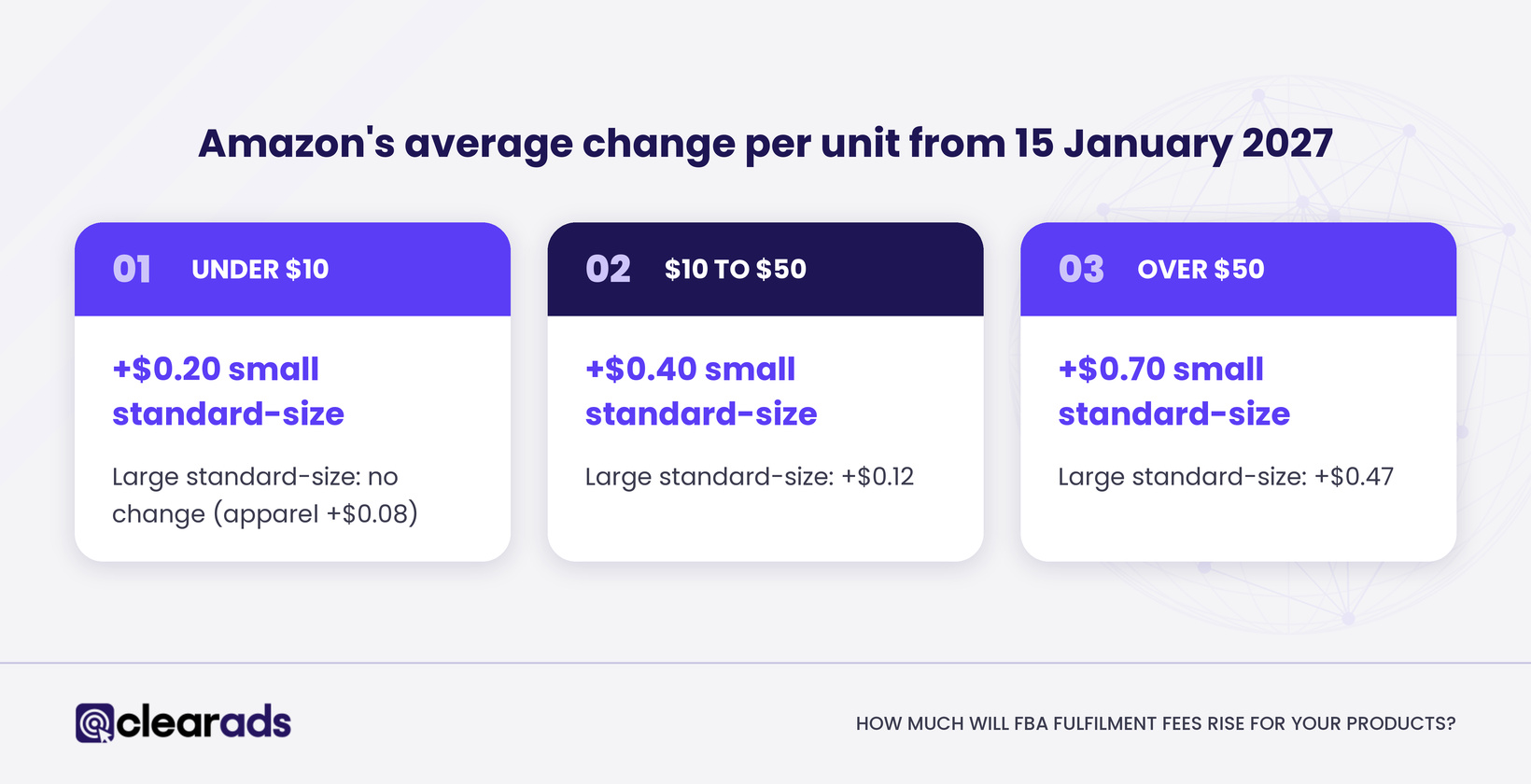
Amazon FBA fees 2027 average rise per unit by price band: +$0.20, +$0.40 and +$0.70 for small standard-size products

It depends on size tier and price band: Amazon’s averages run from no change for non-apparel large standard-size products under $10 to a $0.70 rise for small standard-size products over $50. Social posts quoting a $0.40 rise for everything priced $10 to $50 overstate it, because that figure applies to small standard-size products only.

Amazon’s average change per unit from 15 January 2027

Price band Small standard-size Large standard-size
Under $10 +$0.20 No change (apparel +$0.08)
$10 to $50 +$0.40 +$0.12
Over $50 +$0.70 +$0.47

Averages are a starting point; your own products follow the weight-based rate card. Two common rows show the pattern, before the surcharge and for non-apparel products:

Product (non-apparel) Under $10 $10 to $50 Over $50
Small standard-size, 6 to 8 oz $2.66 to $2.83 $3.54 to $3.97 $3.80 to $4.53
Large standard-size, 12 to 16 oz $3.78 to $3.78 $4.60 to $4.67 $4.86 to $5.23

Rate cards exclude the 3.5% fuel and logistics surcharge, which stays in 2027 and spreads to more services, including AWD transportation from 1 February. Add 3.5% to every base-fee change you model: the $0.43 rise on a 6 to 8 oz product priced $10 to $50 becomes about $0.45.

Five fee categories lose low-price FBA rates and pay the $10 to $50 rate even when priced under $10: Automotive and Powersports, Compact Appliances, Computers, Musical Instruments and AV Production, and Media (books, DVD, music, software and video). For a large standard-size product weighing 12 to 16 oz, that moves the base fee from $3.78 to $4.67, a rise of $0.89 before the surcharge.

Bulky and extra-large products move to four bulky and six oversize tiers, the overmax handling fee ends, and new handling fees apply to flat and overhanging products. Some items get cheaper and others dearer, so reclassify each one from its dimensions and weight rather than matching old tier names to new ones.

What changes for storage and low-inventory fees on 1 February?
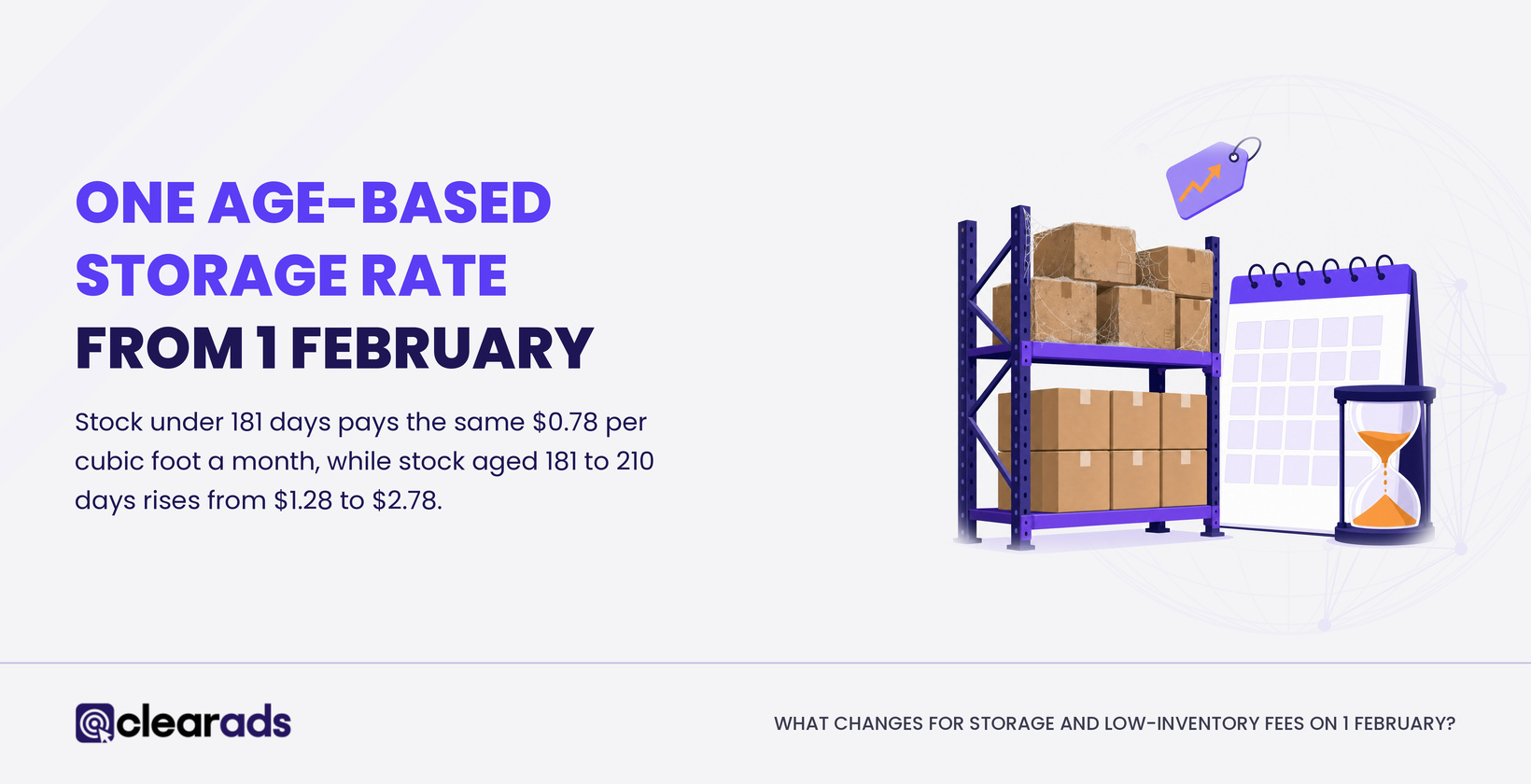
Amazon FBA fees 2027 storage: one age-based rate from 1 February, with stock aged 181 to 210 days rising to $2.78

Storage becomes one age-based monthly rate and the storage utilisation surcharge ends, while the low-inventory-level fee is recalculated weekly against sales before and after each check. The table shows standard-size rates per cubic foot per month, January to September, with 2026 figures excluding the utilisation surcharge:

Inventory age 2026: base plus aged surcharge 2027: unified rate
0 to 180 days $0.78 $0.78
181 to 210 days $1.28 $2.78
211 to 240 days $1.78 $2.78
241 to 270 days $2.28 $2.78
271 to 300 days $6.23 $6.68
301 to 330 days $6.48 $6.68
331 to 365 days $6.68 $6.68

The simpler structure costs more for older stock. Stock under 181 days pays the same base rate, and sellers who paid the utilisation surcharge save it, but stock aged 181 to 210 days now costs more than twice as much to store ($2.78 against $1.28), and the premium narrows as stock ages towards 270 days. October to December adds $1.62 per cubic foot, and clothing, shoes, bags, jewellery and watches, which were exempt from the aged surcharge at 181 to 270 days, now pay $1.78 in that window.

Two groups are exempt from the higher rates. Products where at least 70% of the inventory is auto-replenished from AWD pay the lowest rate whatever their age, and eligible FBA New Selection products get free storage for a limited period.

The low-inventory-level fee now applies only when both the four weeks before and the four weeks after a weekly check show fewer than 28 days of supply, and the higher figure sets the rate. Small standard-size products pay $0.32 to $0.89 a unit depending on days of supply, the fee extends to oversize tiers, and stock still on its way into the network does not count, so allow for receiving time when you plan cover.

Amazon exempts new Professional sellers for their first year, new products in FBA New Selection for their first 120 days and 200 units, products shipping fewer than 20 units in the previous seven days, products at least 70% auto-replenished from AWD over the previous 90 days, and grocery. The fee appears as its own line rather than inside the fulfilment fee, which makes it easier to track.

Which other 2027 fee changes affect sellers?

The rest of the update touches promotions, inbound shipping, returns and Amazon’s other fulfilment services. These are the ones most likely to reach an advertiser’s numbers:

Change What happens From
Buy X, Get Y promotions A $5 upfront fee plus a 2% variable fee, capped at $2,000; all promotion fees billed monthly from February 15 January 2027
Inbound regions Central standard-size inbound merges into East; the placement rate card does not change, but a shipment that went to Central may now pay a different rate 15 January 2027
Returns processing Moves to the 2027 size tiers for units shipped from the dates shown: apparel and shoes first, then other high-return categories 15 January and 1 February 2027
FBA New Selection Up to $600 in benefits per eligible new product, covering the first 200 units Now
Multi-Channel Fulfilment and Buy with Prime Standard-speed fees up 3.5% on average; expedited fees unchanged on average 2027 rate card
AWD Processing $1.55 per box, transportation $1.58 per cubic foot, 40% off inbound processing for single-SKU pallets; stock held over 12 months charged 2.5 times from March 1 February and 1 March 2027

Check promotions too. A Buy X, Get Y offer now carries a fee on top of the discount, so judge it on the contribution left after both, the same way you would judge an ad campaign.

What do the 2027 fees do to your ACoS targets and prices?
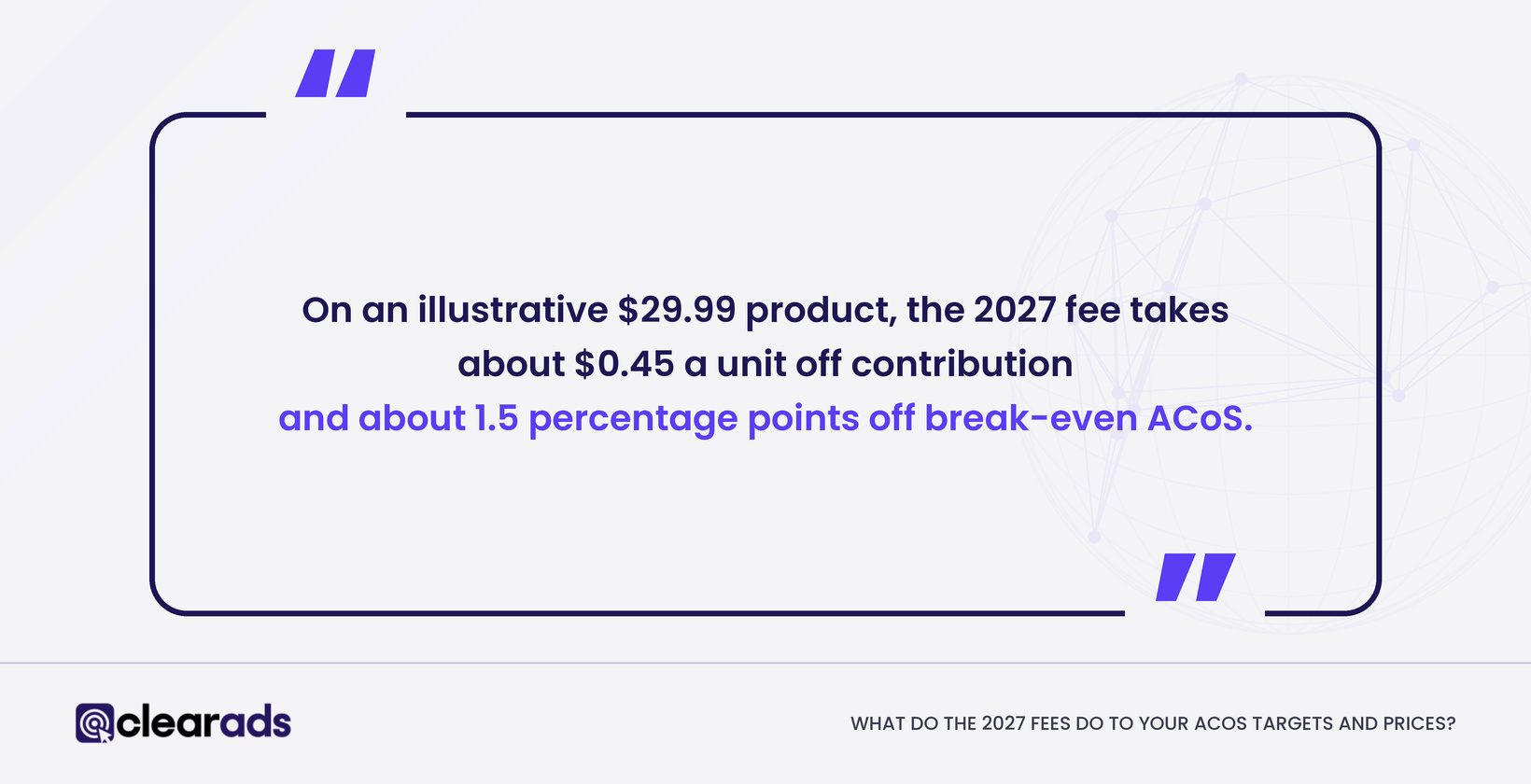
Amazon FBA fees 2027 example: a $29.99 product loses about $0.45 a unit and 1.5 points of break-even ACoS

They shrink the contribution each sale leaves before advertising, so break-even ACoS, target ACoS and the most you can pay per click all fall unless prices rise or other costs fall. The example below uses a small standard-size, non-apparel product weighing 6 to 8 oz, with illustrative inputs: a $29.99 price, a 15% referral fee, $9.00 landed cost, $2.00 of other variable costs, a 10% conversion rate and one unit per order.

Per unit (illustrative) 2026 fees 2027 fees
Fulfilment fee including the 3.5% surcharge $3.66 $4.11
Contribution before advertising $10.83 $10.38
Break-even ACoS 36.1% 34.6%
Target ACoS keeping 10% of the price as contribution after ads 26.1% 24.6%
Break-even cost per click at 10% conversion $1.08 $1.04
Highest cost per click keeping 10% contribution $0.78 $0.74

On this product the new fee costs about $0.45 a unit and takes about 1.5 percentage points off break-even ACoS, with everything else unchanged. A campaign still running on a 2026 target would bid above the new break-even, so update targets and bid ceilings before 15 January. Our guide to ACoS and TACoS explains how break-even and target ACoS are set.

Pricing can recover some of it. To keep the same dollar contribution, the price must rise by the fee increase divided by one minus the referral rate: about $0.53 on this product, provided it stays in the same price band and sales hold.

Small price changes can move a product into a different band. On the same 6 to 8 oz product, moving from $9.99 to $10.00 adds $1.14 to the base fee, and moving from $50.00 to $50.01 adds $0.56, because a product priced at exactly $10 or $50 pays the $10 to $50 rate. Test prices on both sides of each line before you change them, and remember that products in the five excluded categories lose the under-$10 rate anyway.

What should sellers do before 15 January and 1 February?
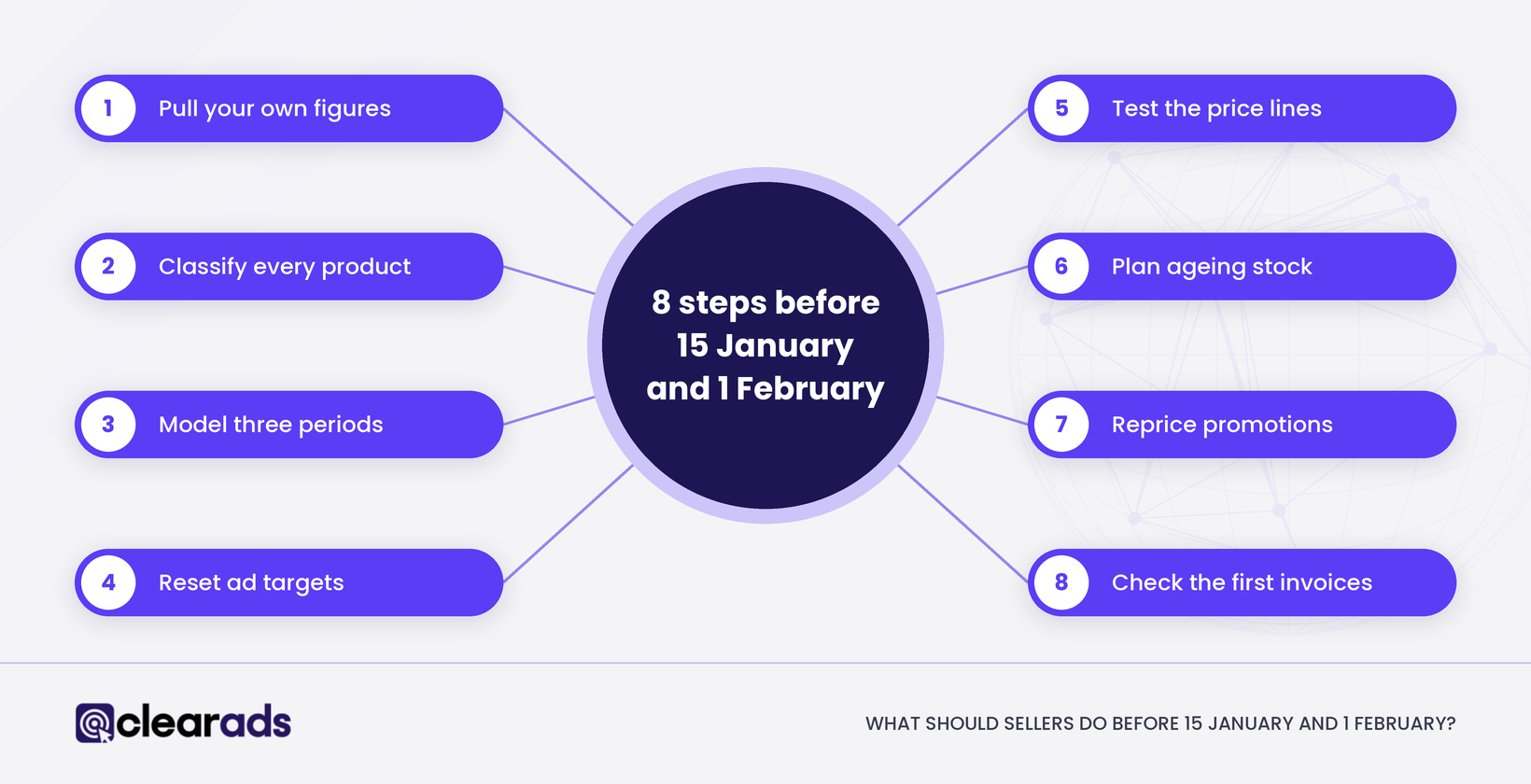
Eight steps to prepare for Amazon FBA fees 2027 before 15 January and 1 February, from pricing to ad targets

Rebuild unit economics for each product before the new rates land, then set prices, ad targets and stock plans from those numbers. Work through these steps:

  • Pull your own figures. Use Amazon’s Fee Change Comparison dashboard in Profit Analytics and the Revenue Calculator to see the change by product, and save dated copies of the rate cards.

  • Classify every product. Record size tier, shipping weight, price band, fee category and low-price eligibility, and check packaged dimensions against what Seller Central holds.

  • Model three periods. Keep separate models for 1 to 14 January (peak rates), 15 to 31 January (new fulfilment fees, old storage) and February onwards (new storage and low-inventory rules).

  • Reset ad targets. Recalculate break-even ACoS, target ACoS and cost-per-click ceilings for each product, and load them before 15 January.

  • Test the price lines. Review products priced just above $10 or $50, and products in the five categories losing low-price rates.

  • Plan ageing stock. Forecast which units will pass 181 days in the first quarter, and decide whether to sell them through, promote them or remove them.

  • Reprice promotions. Add the new Buy X, Get Y fee to every planned offer and check the contribution that remains.

  • Check the first invoices. After the billing lag, compare actual charges with your model and query any size, category or eligibility differences.


Frequently asked questions

Do the 2027 fee changes apply to Amazon UK or Europe?

No. These changes cover Amazon’s US store only. Amazon’s European rate card shows fulfilment fees returning on 15 January 2027 to the same non-peak rates as 2026. The change European sellers do need to price in came earlier: Amazon raised its European fuel and logistics surcharge from 1.5% to 2% on 2 November 2026, including in the UK.

Do UK-established sellers pay more on US sales?

Yes. Amazon adds a 2% digital services fee to Selling on Amazon and FBA fees on US sales by sellers established in the UK, so any rise in US fees carries that 2% as well. Model it alongside the 3.5% fuel surcharge when you rebuild US margins, and check how both appear on your statements.

When will the new fees show in your account?

Fulfilment fees change for units shipped from 15 January 2027. Storage and the low-inventory-level fee change from 1 February: storage is billed between the 7th and 15th of the following month, and the low-inventory fee is charged four weeks after each weekly check, so February’s numbers arrive in March.

Are 2027 holiday peak fees included?

No. The 2027 rate tables run from 15 January to 14 October 2027, and Amazon has not published peak rates for the 2027 holiday season. Keep a separate assumption for the fourth quarter in any full-year model, and replace it when Amazon announces peak fees later in the year.

Does the fee rise mean cutting ad budgets?

No. Higher fees lower the contribution each sale leaves, so reset each product’s ACoS target and cost-per-click ceiling, then judge budgets on what each campaign returns. Cutting every budget by the same share would starve products whose fees barely moved, such as non-apparel large standard-size items under $10.

What does this article not cover?

This article covers Amazon’s 2027 US fee changes and what they do to margins and advertising targets. Related topics live elsewhere:

What should you do next?

Before 15 January, rebuild contribution for your top products with the 2027 rates and load new ACoS targets and cost-per-click ceilings, so they are live when the new fees start. Then check inventory age before February, while there is still time to act on stock approaching 181 days.

Clear Ads is an Amazon Ads Advanced Partner that manages Amazon PPC, Amazon DSP and full-service accounts for brands worldwide. If you want help resetting your advertising targets for the 2027 fees, request a call back from the Clear Ads team.

YOUR PATH TO A HIGHER ROI STARTS HERE!

Founder & CEO, Clear Ads Limited

George Meressa is Founder and CEO of Clear Ads, the Amazon PPC, DSP and full-service agency he started in 2011. He has worked in digital advertising since 2009 and has helped over 1,000 advertisers grow sales and organic rank on Amazon. He writes and speaks internationally on Amazon advertising, organic rank and retail media.

The metric that decides your organic rank

Chart showing that out-converting your category lifts organic rank and lowers TACoS

If you out convert the category, you’ll climb organic and sell more at a lower TACoS

Free PPC audit.

No call, no signup.

Cartoon laptop showing an audit score of 66/100

Nothing to sign in to. Your files stay in your browser.

Skip the sales call.

Get the audit.

Magnifying glass over an ad spend report, for the free Amazon ads audit

Upload your ad reports. Get your audit in under 5 minutes.

The metric that decides your organic rank

Chart showing that out-converting your category lifts organic rank and lowers TACoS

If you out convert the category, you’ll climb organic and sell more at a lower TACoS

See how we can help you maximise revenue from your ad spend

Scroll to Top

Want to explore working with us?

Fill out the form below and our Head of Sales will reach out to you asap to coordinate an audit of your account. We’re looking forward to growing with you!

Name
What services are you interested in?