Key Takeaways
-
Since 26 October 2026, advertisers can buy selected Pinterest display and video inventory through Amazon Ads DVA+ as private marketplace deals, which Pinterest’s sales team arranges.
-
Amazon lists 12 countries for the Pinterest supply, from the US to Japan, but not the UK or any EU country, and neither company has given a date for Europe.
-
Buying through Amazon lets you apply Amazon audiences to Pinterest inventory, manage frequency with the rest of your Amazon buying and measure Amazon purchases.
-
Deals sit in DVA+ advanced settings, so advertisers who only run Sponsored Ads must ask their Amazon Ads account manager for access first.
-
The only published results come from one Moroccanoil campaign whose methodology is too thin to use as a benchmark.
-
Test it as a ring-fenced prospecting buy in one supported country, with placements, price and success measures agreed in writing before launch.
Yes, if you advertise in one of the launch countries: since 26 October 2026, Pinterest has sold selected display and video inventory through Amazon Ads DVA+, the campaign type that now holds Amazon DSP’s programmatic buying, as private marketplace deals. This article covers that programmatic route for brands that advertise on Amazon, not the Sponsored Products ads Amazon can place on Pinterest automatically. Access runs through Pinterest’s sales team, the UK and EU are not yet included, and the published evidence rests on one campaign.
What did Pinterest and Amazon launch?
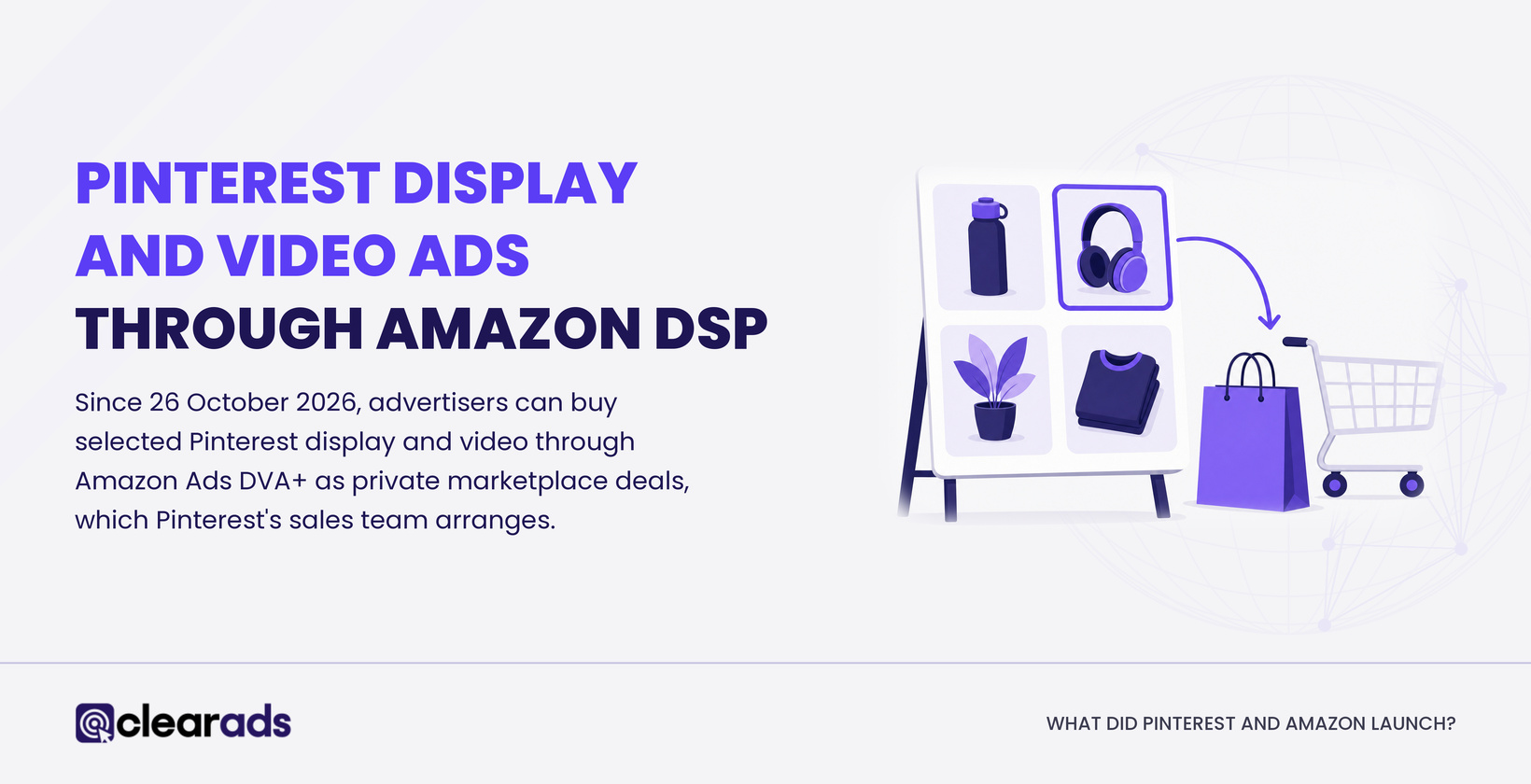
Pinterest made Programmatic Deals generally available on 26 October 2026, so enterprise advertisers can buy selected Pinterest display and video inventory through the buying platforms they already use. The four named at launch are Amazon Ads DVA+, Google Display & Video 360, Yahoo DSP and DeepIntent. Magnite is Pinterest’s primary supply-side partner, and Pinterest works with Google Ad Manager on the supply side in Latin America and Asia Pacific.
Amazon’s own announcement confirms private marketplace deals for display and online video in DVA+, with Amazon audiences, reach and frequency controls, and measurement that connects ad exposure with purchases. Trade press reports that preferred deals are live too, but reports differ on whether programmatic guaranteed deals are live or still in testing, and Amazon names only private marketplace deals. Pinterest’s announcement points interested advertisers to their Pinterest sales representative, building on a partnership that began in April 2023, when Pinterest named Amazon its first third-party ad demand partner.
What the launch confirms, and what to confirm for your deal
| Item | Published at launch | Confirm in writing |
|---|---|---|
| Formats | Selected display and online video | The exact placements, app or web, and creative specifications |
| Deal type | Private marketplace (Amazon); preferred deals live, guaranteed deals reported as live or in testing (trade press) | Your deal type, floor price and auction rules |
| Access | Through a Pinterest sales representative | Whether your advertiser account and any agency seat qualify |
| Targeting | Amazon audiences on Pinterest inventory | Which Amazon audiences and Pinterest contextual segments the deal allows |
| Pricing | No public rate card | CPM, floor, any commitment and which fees the price includes |
| Measurement | Ad exposure connected with purchases | Which metrics report at deal level |
Which countries and advertisers can use it?
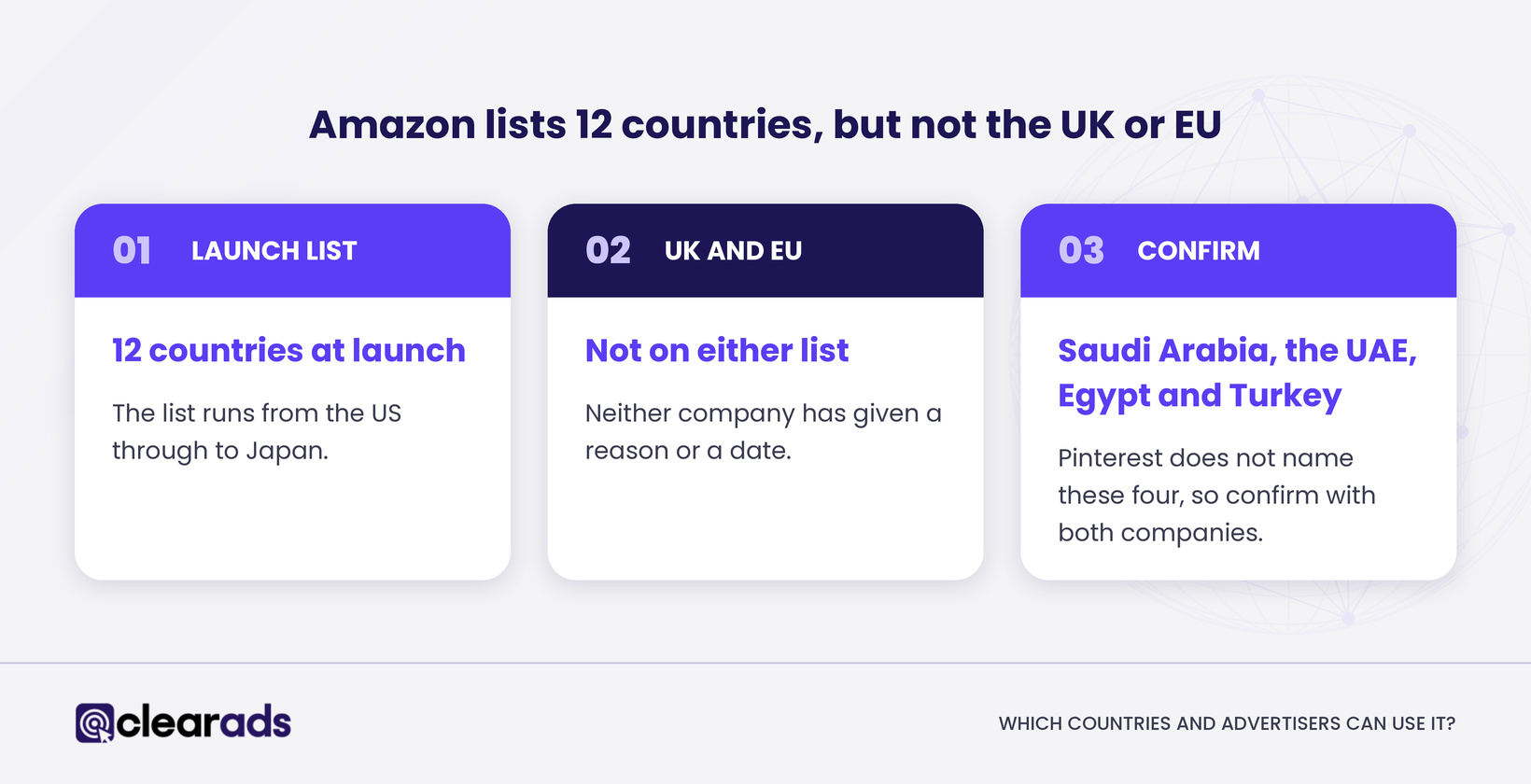
Amazon’s announcement lists 12 countries for Pinterest supply in DVA+: the US, Canada, Mexico, Brazil, Saudi Arabia, the United Arab Emirates, Egypt, Turkey, Australia, India, Japan and Singapore. Pinterest’s own announcement names three regions, North America, South America and Asia Pacific, with no mention of the Middle East, Egypt or Turkey, so confirm campaigns in Saudi Arabia, the UAE, Egypt and Turkey with both companies.
The UK and EU are on neither list, and neither company has given a reason or a date. Amazon’s buying platform reaches far more countries, including the UK and most of Western Europe, so an Amazon advertising account in those markets does not by itself unlock Pinterest deals there.
Where a brand is based and where its audience is are separate questions. A UK brand selling on Amazon.com and targeting US shoppers may qualify for US supply, but the launch materials do not cover cross-border advertisers, so ask Pinterest and Amazon to confirm for your account before planning around it.
Pinterest positions Programmatic Deals for enterprise advertisers, while Amazon’s announcement lists both managed-service and self-service advertisers as eligible. In practice, Pinterest arranges the deal, and you or your agency run it in your own Amazon account.
How do you set up a Pinterest deal in DVA+?
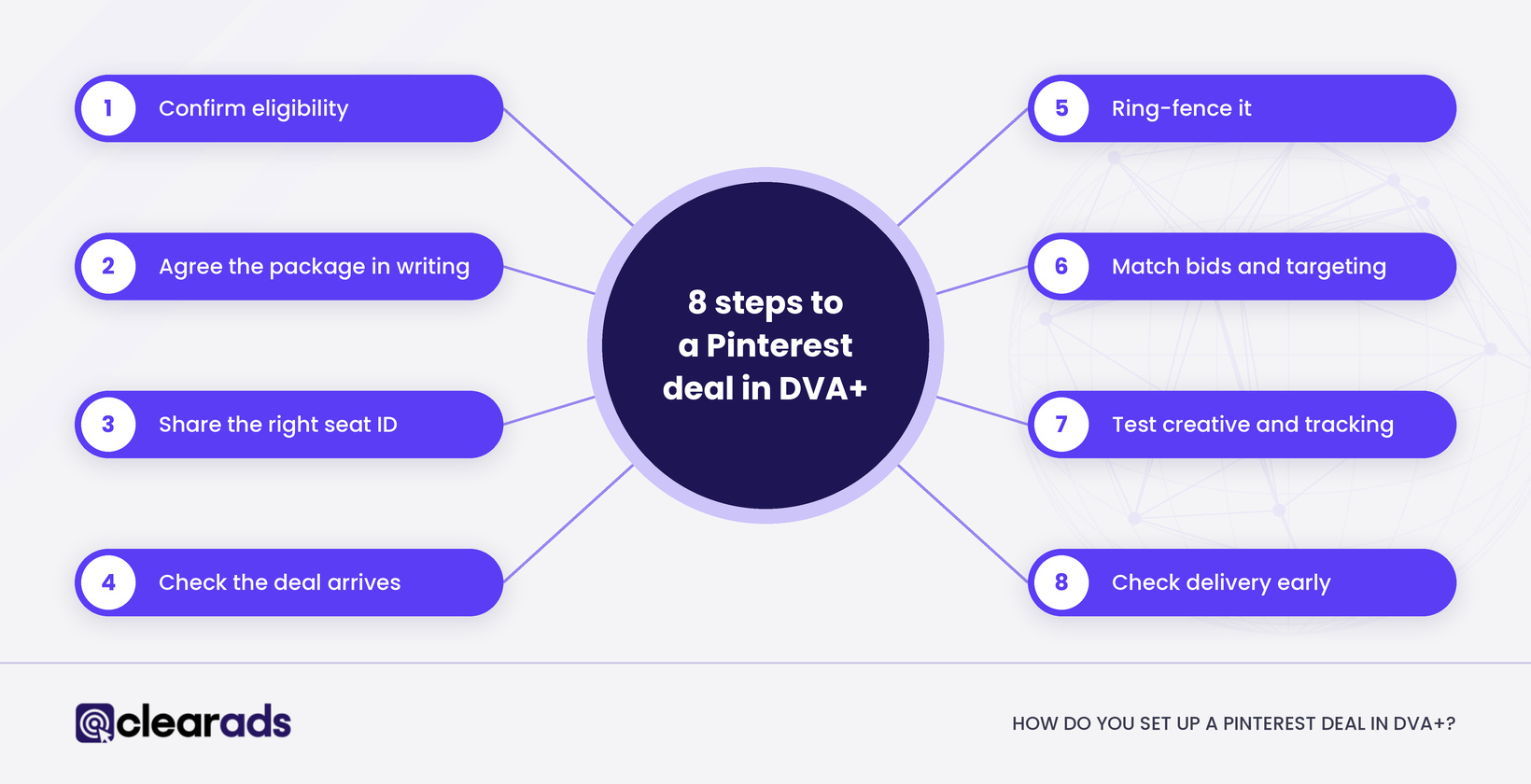
You agree the deal with Pinterest, give its supply partner your Amazon buyer seat ID so the deal reaches your account, then target it from an ad group with advanced settings switched on. Advanced settings hold the controls DSP buyers already use, including deals, audiences, frequency caps and custom bidding.
Access to those controls depends on your history with Amazon. Amazon says existing programmatic advertisers and agencies with entity access have advanced settings, while new and Sponsored Ads-only advertisers get DVA+ and must request advanced settings through their Amazon Ads account manager. DVA+ itself is still rolling out, with general availability across 35 markets targeted for the first quarter of 2027, so ask your Amazon contact which set-up your account will use for the deal. Our guide to DVA+ explains the two tiers.
-
Confirm eligibility. Give Pinterest and Amazon your advertiser entity, buying account, target country, landing destination, product category and proposed formats.
-
Agree the package in writing. Get the placements, devices, formats, targeting, price, floor, flight dates and any commitment confirmed before you build anything.
-
Share the right seat ID. Your account settings list a Deal Creation ID and a Spend Tracking ID for each supply partner; the partner uses the Deal Creation ID to map the deal to your account, and in Latin America and Asia Pacific that partner may be Google Ad Manager rather than Magnite.
-
Check the deal arrives. Get the deal ID, confirm which account it is mapped to, and ask whether it appears automatically or needs accepting.
-
Ring-fence it. Put the deal in its own ad group (formerly a line item) with its own budget, so automated budget allocation cannot move the money to other inventory.
-
Match bids and targeting to the deal. Set the base bid at or above the deal’s floor, and add targeting sparingly, because every extra layer shrinks the impressions a private deal can deliver.
-
Test creative and tracking. Confirm the assets are accepted, click destinations work and reporting can separate Pinterest from the rest of the campaign.
-
Check delivery early. In the first days, confirm that spend is reaching the deal, the right country and the agreed formats before you add budget.
What do Amazon audiences, frequency and measurement add?
They are the main reasons to buy Pinterest through Amazon rather than directly: Amazon says you can apply its audiences to Pinterest inventory, manage reach and frequency alongside your other Amazon buying, and connect ad exposure with purchases. Each needs checking at deal level, because the launch materials do not list which audiences, caps or metrics apply to Pinterest specifically.
Amazon describes the audiences as built from browsing, shopping and entertainment signals. Start with a few broad audience and contextual combinations, and avoid stacking narrow segments on a private deal until you know how much supply it has. Our guide to Amazon DSP targeting covers the audience types.
Frequency groups, Amazon’s tool for capping exposure across campaigns, channels and devices, let Pinterest impressions share a cap with the rest of your Amazon buying. The cap only counts what you buy through Amazon: Pinterest ads bought in Pinterest Ads Manager or through another DSP do not share the counter.
On measurement, Amazon reports shopping actions such as detail page views, purchases and new-to-brand purchases, where a new-to-brand shopper is one who has not bought from your brand on Amazon in the previous 12 months. Confirm which of these report at Pinterest-deal level before launch, and keep each measure to its proper job:
Which measure answers which question
| Measure | Use it to judge | Check first |
|---|---|---|
| Spend, impressions and delivery | Whether you bought the agreed supply | Pinterest can be isolated by deal, country and format |
| Reach and frequency | Audience expansion and exposure | What the deduplication covers |
| Detail page views | Product consideration on Amazon | The attribution definition and which ASINs count |
| Purchases and new-to-brand purchases | Attributed sales and first-time buyers | The window used, and promoted products versus wider brand sales |
| Incremental sales | Whether Pinterest caused extra sales | A holdout or experiment, because attribution alone cannot show it |
If Pinterest impressions reach your Amazon Marketing Cloud instance, you can compare people reached on Pinterest with the rest of your plan and study purchase paths that include it. Confirm the identifiers are there before launch, and remember that shoppers who saw Pinterest may differ from those who did not for reasons other than the ad.
What did the Moroccanoil campaign show?
Pinterest reports that it added new reach to one beauty brand’s Amazon campaign, but the published figures are too thin to use as a benchmark. In June 2026 Moroccanoil used a deal enabled by Magnite and bought through Amazon Ads to add Pinterest to an existing premium video and display campaign, combining Amazon lifestyle and in-market audiences with Pinterest’s contextual beauty targeting. Pinterest’s figures come from Amazon internal data for 1 to 30 June 2026, and Pinterest says they are specific to that campaign and not indicative of future performance.
Reading the Moroccanoil figures
| Reported result | What it tells you | What it does not tell you |
|---|---|---|
| 15% incremental reach | Pinterest reached people the rest of the campaign did not | Anything about extra sales, or what another brand would see |
| 1% audience overlap | Little duplication between Pinterest and the rest of the plan, as measured | Which groups were compared, or how people were matched |
| 63% more new-to-brand buyers among users whose purchase paths included Pinterest | Paths that touched Pinterest held more first-time buyers | That Pinterest caused 63% more buyers; no baseline is published |
| 20% higher click-through rate than the brand’s average video and display campaigns | The whole campaign beat the brand’s usual click rate | A Pinterest-only click rate, or a controlled result |
Spend, impressions, market and any sales-lift result are not published. Treat the case as one promising campaign, and push back if a pitch turns it into claims such as “Pinterest increased sales by 63%”. The gap between reach, attributed sales and incremental sales is the subject of our post on what happened when a brand paused $48K a month of DSP.
When is a Pinterest test through Amazon worth running?
It is worth running when you advertise in a supported country, sell something people plan visually, and can fund a test that measures new reach and first-time buyers rather than chasing immediate return. Beauty has the only published example; home and décor, fashion, and food and kitchen products are reasonable hypotheses to test, not proven results for this route.
Hold off when any of these apply:
-
Your campaign is UK- or EU-only.
-
The budget left after creative, set-up and measurement is too small to buy meaningful reach.
-
You need immediate lower-funnel returns and cannot carry a learning period.
-
Product pages, prices or stock are not ready to convert new demand.
-
You cannot isolate Pinterest spend or tell new reach apart from attributed sales.
If it passes, design the test before you buy:
-
Pick one supported country and one objective, such as reach among new audiences or new-to-brand purchases.
-
Keep prospecting separate from remarketing, so Pinterest is judged on the job it is bought for.
-
Use a small set of creative concepts made for the agreed Pinterest placements.
-
Set up a holdout or comparison group where the deal and measurement allow it.
-
Write down success, failure and extension criteria, including the attribution window, before launch.
-
Change one thing at a time, and judge the result only after conversions have had time to mature.
Budget should follow the deal’s quoted CPM and the reach you need to make a decision, plus any fees not already in that price, because no published minimum or standard budget applies. Our checklist on whether a product is ready for DSP is a useful filter before any test.

Frequently asked questions
Is this the same as Amazon’s Sponsored Products ads on Pinterest?
No. Since 2023 Amazon has been able to show Sponsored Products ads on Pinterest automatically, using each campaign’s existing bids and linking to Amazon product pages. A Pinterest Programmatic Deal is a separate buy of Pinterest display and video inventory that you negotiate, target and budget yourself in DVA+.
Is there a minimum spend for Pinterest deals through Amazon?
None has been published. Neither Pinterest nor Amazon has published a rate card, floor or minimum for Pinterest deals, so the deal itself sets the price and any commitment. Amazon’s typical US$50,000 minimum, which varies by country, applies to its managed DSP service, while DVA+ bills on CPM with no minimum spend. Who owns the seat matters too: see our guide to Amazon DSP seat ownership.
Where will you see results for a Pinterest deal bought through Amazon?
In your Amazon reporting for the ad group that targets the deal, which is one reason to give the deal its own ad group. Pinterest has not said whether its own tools will show impressions bought through outside platforms, so report the test from Amazon and keep it apart from any Pinterest Ads Manager figures to avoid double counting.
Can AI agents buy Pinterest inventory?
Yes, through Magnite. Pinterest’s inventory is part of Magnite Orchestration, a layer where buyer and seller AI agents can discover, package and activate inventory. Nothing in the launch materials makes it a requirement for a standard deal through Amazon, and Amazon has not said whether its own Ads Agent can negotiate Pinterest deals.
Does buying through Amazon replace Pinterest Ads Manager?
No. Programmatic Deals sit beside Pinterest Ads Manager rather than replacing it, and brands can still buy Pinterest’s own ad formats directly, which is the only route for UK and EU campaigns for now. Compare the two routes on the same objective, audience, country and full cost before assuming either is cheaper.
What does this article not cover?
This article covers buying Pinterest inventory through Amazon’s programmatic tools. Related topics live elsewhere:
-
Getting started with Amazon DSP: what Amazon DSP is and when it is worth adding.
-
ChatGPT ads through Amazon DSP: another outside publisher you can buy through Amazon.
What should you do next?
Check that your target country is on Amazon’s Pinterest list and that your Amazon account has advanced settings, or ask your account manager for them. Then ask Pinterest’s sales team for a written proposal covering placements, price, deal type and the measurement you will get, and agree success criteria before any budget moves.
Clear Ads is an Amazon Ads Advanced Partner that manages Amazon PPC, Amazon DSP and full-service accounts for brands worldwide. If you want help planning a Pinterest test alongside your Amazon DSP and Sponsored Ads activity, request a call back from the Clear Ads team.